대인관계의 척도는 신뢰이다. 신뢰는 인간관계 속에서 형성되기 때문이다. 신뢰란 다른 사람, 조직 또는 제품에 대한 확신이다. 즉, 상대방이나 상대방의 제품 또는 서비스가 정직하고 도덕적이고 공정하다고 믿을 수 있는 확신을 의미한다. 그러나 상대방이 나를 억지로 신뢰하게 할 수는 없다. 다만 나의 노력과 행동을 통하여, 상대방과의 관계성에 영향을 미칠 수 있을 뿐이다.
신뢰는 물과 같아서 위에서부터 아래로 흐르는 것이다. 그래서 팀원을 믿지 않는 팀장 밑에선 열정 있는 팀원들도 있을 수 없다. 리더십은 팀원들에게 열정을 불러 일으키는 것이기 때문이다. 따라서 신뢰조성(Trust Building)이야말로 성공적인 코칭의 시작으로써, 공동의 목표달성을 위하여 리더와 팀원들이 상부상조하기 위한 근간이다.
그러면 신뢰를 어떻게 조성할 수 있을까?
리더가 팀원들의 협조가 필요할 때, 어떻게 도움을 요청해야 할지를 생각해보자. 무엇보다도 먼저 리더는 항상 팀원을 도와주려는 의지가 전달되어야 한다. 즉, 팀원의 목표달성에 조력하겠다는 모습을 보여주어야 하며, 팀원을 단순한 부하직원이 아니라 함께 가는 동반자로 만들어야 한다. 그러기 위해서는 팀원들에게 대접받고자 하기보다 먼저 그들을 대접하되, 그들을 이해하고 그들의 욕구에 맞는 스타일로 눈 높이에 맞춰야 한다. 이것이 이 시대 리더들에게 요구되는 서번트 리더십(Servant Leadership)의 핵심이며 신뢰를 조성하는 기본 원칙이다.
따라서 리더가 ‘상대를 인정해 주고 상대를 도와주는 사람’이라면 신뢰는 자연스럽게 형성될 것이다. 아래 ‘나를 먼저 이해해 주세요’라는 글을 자신의 팀원이 요구하는 것이라 생각하고 읽어보자.
“당신이 원하는 것을 나는 원하지 않을 수도 있습니다. 내가 원하는 것이 잘못되었다고 말하지도 말아 주세요. 나는 당신보다도 다른 사람을 더 신뢰할 수도 있습니다. 나의 감정도 동일한 조건에서 당신보다 더 강하거나 약할 수도 있습니다. 나에게 더 강하고 약하게 느끼라고도 말하지 말아 주세요.
당신이 생각하는 대로 내가 행동하거나 행동하지 못할 수도 있습니다. 그냥 내가 하도록 맡겨 주세요. 나는 어떤 순간에도 나를 이해해 달라고 당신에게 요구하지 않겠습니다. 당신이 나를 당신과 똑같은 사람으로 만들려고 하지 않는다면 나에 대한 이해는 이루어질 것입니다.
나는 당신의 동반자, 동생, 친구, 동료가 될 수 있습니다. 당신이 나의 감정, 이성, 욕구를 있는 그대로 인정해 준다면, 언젠가는 나의 모든 행동과 태도가 잘못된 것만은 아니었으며, 나를 위해서는 옳을 수도 있었음을 당신도 알게 될 것입니다.
나를 있는 그대로 봐주기 위한 첫걸음이 나를 이해하는 것입니다. 만약 나를 이해하신다면 당신과 다를 수밖에 없는 나를 변화시키려 하기 보다는 나를 인정해 주시고 나와의 차이점을 더 살려주십시오.”
한자로 信(신)을 파해하면 사람(人)의 말(言)이다. 즉 사람이 내뱉은 말은 행동으로 이루어지고 언행이 일치되어야 하기 때문에, 믿음이 따라야 하기 때문에 믿을 신(信)이 되는 것이다. 그러나 비슷한 한자로 으르렁 은(狺)자가 있다. 은(狺)자는 개(犬)의 말(言)이다. 한마디로 아무 의미 없는 으르렁 거리는 소리일 뿐이므로, 사람이 말을 했는데 지켜지지 않는 다면 그건 개소리일 뿐인 것이다.
2,500년 전, 공자는 군군신신(君君臣臣)이란 말을 했다. 임금이 임금답지 않으면 신하도 신하답지 않을 수 있다는 말이다. 이 말은 서로 맡은 바 역할과 책임(R&R)을 다해야 한다는 말이지만, 신하 앞에 임금이 먼저 나오는 이유는, 리더가 먼저 그 책임을 다해야 아랫사람도 제대로 일을 할 수 있다는 말이기도 하다.
그래서 공자는 다음과 같은 말도 했다.
“군자의 덕은 바람과 같고, 백성의 덕은 풀과 같아서, 풀은 바람 따라 눕는 법이다”
결국 풀이 바람 따라 눕게 하기 위한 것이 바로 리더십의 요체인 신뢰라 할 수 있다. 따라서 공자가 말한 “군자는 백성들에게 신임을 얻은 뒤에 백성을 부리니, 신임을 얻지 못하고 부리면 자신을 괴롭힌다고 여기게 된다”는 글귀는 2,500년이 지난 지금도 리더들이 명심해야 할 리더십의 가장 핵심인 것이다.
이러한 신뢰의 형성은 사람에 대한 이해로 시작해서 이해로 끝나는 것이라 해도 과언이 아니다. 그러기 위해 반드시 필요한 것은 다름 아닌 관찰이다. 관찰에 기초하지 않은 코칭과 평가는 모래 위에 쌓은 성과 같이 위태로울 수 있으므로, 리더는 구성원들에 대해 편견과 선입관 없는 올바른 관찰을 해야만 한다.
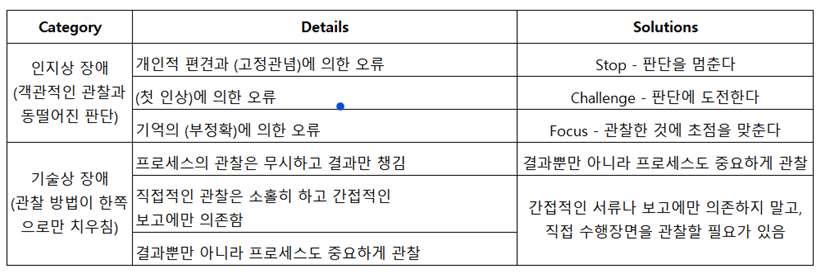
여기서 말하는 관찰이란 주관적으로 섣부른 판단을 하지 않고 상대방의 행동을 객관적으로 확인하는 것으로써, 조직 심리학에서 인간은 일반적으로 아래와 같은 관찰의 장애가 있으므로, 이를 극복해야 한다고 했다.
——————————–
The measure of interpersonal relationships is trust. Trust is built within human relationships. Trust is the confidence one has in another person, organization, or product. In other words, it is the assurance that the other person, their products, or services are honest, ethical, and fair. However, you cannot force someone to trust you. You can only influence the relationship through your efforts and actions.
Trust, like water, flows from top to bottom. Therefore, under a leader who does not trust their team, even the most passionate team members cannot thrive. Leadership is about inspiring passion in your team members. Thus, building trust is the cornerstone of successful coaching, laying the foundation for mutual support between leaders and team members in achieving shared goals.
So, how can trust be built?
Consider how a leader should ask for cooperation when they need their team’s help. First and foremost, a leader must always convey their willingness to support their team members. That is, the leader must show a commitment to helping the team members achieve their goals and treat them as partners rather than mere subordinates. To do this, the leader should focus on serving the team members, understanding their needs, and communicating with them at their level, rather than expecting to be served by them. This is the core of Servant Leadership, which is crucial for today’s leaders, and it is the fundamental principle of building trust.
Therefore, if a leader is someone who recognizes and helps others, trust will naturally be formed. Below, consider the following text, “Please Understand Me First,” as if it were a request from one of your team members.
“Please Understand Me First”
You may not want what I want. Please don’t tell me that what I want is wrong. I may trust someone else more than I trust you. My emotions may be stronger or weaker than yours under the same conditions. Please don’t tell me how I should feel.
I may not act or behave as you think I should. Just let me be. I won’t demand that you understand me at every moment. Understanding will come naturally if you don’t try to make me exactly like you.
I can be your partner, sibling, friend, or colleague. If you acknowledge my emotions, reason, and desires as they are, you will eventually realize that not all of my actions and attitudes were wrong; they may have been right for me.
Understanding me begins with seeing me as I am. If you understand me, instead of trying to change me to be like you, acknowledge our differences and help them flourish.
The Chinese character for trust, 信 (xìn), is composed of the characters for “person” (人) and “speech” (言). This means that words spoken by a person must be followed by action, and trust must accompany them, which is why it becomes the character for trust. However, there is a similar character, 狺 (yín), which means to growl. This character consists of the characters for “dog” (犬) and “speech” (言), indicating meaningless growling sounds. Therefore, if a person speaks without keeping their word, it’s nothing more than a meaningless growl.
2,500 years ago, Confucius said, 君君臣臣 (“Let the ruler be a ruler, and the minister be a minister”). This means that if the ruler does not act as a ruler should, the minister may not act as a minister should. While this phrase emphasizes that everyone must fulfill their roles and responsibilities (R&R), the reason the ruler is mentioned first is that the leader must fulfill their responsibilities first so that the subordinates can perform their duties properly.
Confucius also said:
“The virtue of a king is like the wind, and the virtue of the common people is like grass; the grass bends when the wind blows.”
In the end, leadership is about building trust, which makes the grass bend with the wind. Therefore, Confucius’ statement, “A gentleman commands his people only after earning their trust; without trust, commanding them leads to their resentment,” remains a key principle that leaders must keep in mind even after 2,500 years.
Building trust begins and ends with understanding people. For this, observation is essential. Coaching and evaluation not based on observation are as precarious as a castle built on sand, so leaders must observe their team members without bias or preconceived notions.
Observation, in this context, means objectively verifying the other person’s behavior without making hasty, subjective judgments. Organizational psychology teaches that humans generally have the following obstacles to observation, and these must be overcome.