

리더십(Leadership)이 무엇인가를 묻는다면, 그 본질은 항상 주변 사람(특히 아랫사람)에 대한 영향력이라고 할 수 있다. 영향력이란 리더가 의도하는 바를 상대방이 자발적으로 행동하게 만드는 것이다.
즉, 리더십이란 자기 자신이 일을 잘하는 것이 아니라, 남이 일을 잘하게 하는 것이다. 단, 절대 강요에 의하지 않아야 한다. 그래서 일류 리더는 타인의 지혜를 활용하지만, 이류 리더는 타인의 힘을 사용하고, 삼류 리더는 자기의 힘만을 사용한다는 말도 있다.
그러나 많은 리더들이 영향력을 권력으로 악용하여, 자신의 영향권 내에 주변 사람들을 가두려는 경향이 있다. 마치 관계적으로 자신이 우위를 차지하고 있음을 증명하려는 것인 양, 이래라저래라 잔소리도 참 많이 하게 된다. 결국 소위 말하는 꼰대가 되는 것이다.
나는 리더의 반대가 꼰대라 생각한다. 사실 꼰대를 결정짓는 일은 별것 아니다. 꼰대는 곧 잘못된 잣대이다. 누구나 각자 자기만의 잣대를 가지고 사람들을 평가하려고 하는데, 다분히 주관적인 이 잣대가 전부 옳은 것이라고 착각하여 나만이 옳고 나와 다른 사람들을 배척하려 한다면, 그것이 바로 꼰대이다. 구세대와 신세대, 상사와 부하, 스승과 제자, 선배와 후배, 부모와 자식, 남편과 아내…
살아온 경험과 지식, 위치와 환경에 따라 천차만별로 다른 잣대라도 한결같은 공통점 하나가 있다면, 그것은 바로 자신이 가지고 있는 잣대가 자신을 향하지 않고 남을 향하고 있다는 것이다. 사람은 각자 생각의 크기, 생각의 속도가 다르다. 그래서 다른 사람을 바라보는 시각 또한, 각자의 크기와 속도에 따라 달라져야 한다. 당신이 바라보는 그 사람의 크기는 딱 당신의 크기이지, 상대방의 것이 아니란 것이다.
꼰대를 경영학적인 단어로 표현한다면 관리자(Manager)가 적절할 것 같다. 우리는 흔히들 리더(Leader)와 관리자를 혼용해서 사용하는데, 이 둘은 엄연히 다른 개념이다. 물론 관리자가 리더십을 잘 발휘하면 좋은 매니저 또는 리더가 되겠지만, 직원을 사사건건 통제한다면 그가 바로 꼰대라고 불리어지는 것이다.
그렇다면 관리자와 리더는 어떻게 다를까? 그것은 관리하는 대상과 방식의 차이에 있다. 즉, 관리자는 ‘업무(task)’ 중심적 관점에서 통제를 하려 하고, 리더는 ‘사람’의 역할 중심적 관점에서 유연한 영향력을 발휘한다고 할 수 있겠다.
아래 표에서 Y축을 유연성과 통제성 측면으로 설정했을 때, 통제적 성향이 강한 사람은 내부적으로는 조정, 통제, 관리적인 경향이 강하고, 외부적으로는 경쟁력 강화 및 고객 서비스 강화 등 너무 일에만 몰두하는 경향이 있다. 반면 유연성이 높은 경우는 내부적으로는 팀을 관리하고 구성원과의 대인관계를 관리하며 구성원을 육성하는 한편, 외부적으로는 미래에 대처하기 위해 지속적인 혁신 및 개선 활동을 수행하는 경향이 강하다.

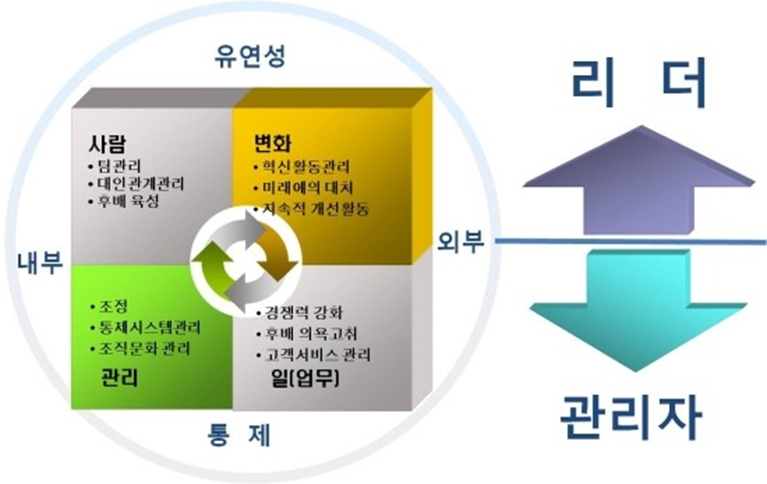
그런 점에서 내/외부적으로 유연성이 강한 경우를 리더, 통제성이 강한 경우를 관리자로 구분할 수가 있겠다. 물론 조직에서는 이 두가지 모두가 필요하지만, 보다 장기적이고 미래 지향적인 측면에서 리더는 인재의 육성과 변화관리에 더욱 유연한 사람이 되어야 할 것이다.
조직 내에서 기획, 예산, 조직, 통제, 문제 해결적인 업무를 수행하는 관리는 질서와 규칙, 원칙을 중시하고 단기적 성과를 중시한다. 따라서 리더십이 약하고 관리적 성향이 강하면 너무 관료주의적으로 치우칠 우려가 있는 반면, 리더십도 약한 상황에서 관리적 성향마저 약하면 업무를 방만하게 처리하고 직무 유기적 경향으로 치우칠 우려가 있다.
또한 리더십은 중장기적 미래 방향을 설정하고 이에 맞게 인력을 제대로 배치하며, 구성원들에게 영향력을 발휘하여 그들을 동기부여 한다. 그러나 관리적 성향이 약하면서 너무 리더십적 성향만 강조한다면 정치적이고 선동적인 경향의 리더로 빠질 수가 있으므로, 관리적 성향과 함께 리더십적 성향이 균형 있게 배합된 통합적 리더가 훌륭한 리더라 할 수 있다. 요약하면 “업무를 관리하고 사람을 리드하라(Managing Job, Leading People)”는 이 한마디 문장이 정답이다.
그런데 리더 자리에 앉은 대부분의 사람들이 반대로 행동하는 것이 문제이다. 즉, 반대로 “사람을 관리하고 업무를 리드하는(Managing People, Leading Job)” 행동을 하기 때문이다. 이건 바로 상사로서 권력을 휘두르고 싶은 욕망과 편의성 때문이다. 그리고 책임을 모면하기도 쉽다. 예를 들어 일의 결과가 좋지 않을 때, 나 때문이 아니라 구성원이 잘못해서 그렇게 되었다고 핑계 대기도 쉽다.
——————————-
If asked what leadership is, its essence can always be said to be the influence over those around you, especially subordinates. Influence means getting others to voluntarily act according to the leader’s intentions. In other words, leadership is not about doing the work well oneself, but about enabling others to do the work well. It must not be forced. Hence, there’s a saying that a top-notch leader utilizes the wisdom of others, a second-rate leader utilizes the power of others, and a third-rate leader only uses their own power.
However, many leaders tend to abuse their influence as power, trying to confine those around them within their sphere of influence. They end up giving orders and nagging a lot, trying to prove their superiority in relationships. This is how they become what we call a “kondae” (a derogatory term for an old-fashioned, authoritarian figure).
I believe the opposite of a leader is a kondae. Actually, becoming a kondae is not a big deal. A kondae is someone who imposes a flawed standard. Everyone has their own standards by which they judge others, but when one mistakenly believes their subjective standard is entirely correct, thinking only they are right and excluding those who are different, they become a kondae.
Different generations, superiors and subordinates, teachers and students, seniors and juniors, parents and children, husbands and wives… Everyone has different standards shaped by their experiences, knowledge, position, and environment.
But the common trait among these diverse standards is that they are often aimed at others rather than oneself. People have different sizes and speeds of thinking. Therefore, the perspective from which one views others should vary according to each person’s size and speed of thinking. The size at which you view someone is merely your perspective, not theirs.
If I were to express a kondae in business terms, “manager” would be appropriate. We often use “leader” and “manager” interchangeably, but they are distinctly different concepts. Of course, a manager can become a good manager or a leader if they exhibit strong leadership, but if they control employees excessively, they are labeled as a kondae.
So, how do managers and leaders differ? It lies in the focus and methods of their management. Managers tend to control from a “task-centered” perspective, while leaders exert flexible influence from a “role-centered” perspective.
When setting the Y-axis as flexibility versus control, individuals with a strong controlling tendency focus heavily on coordination, control, and management internally, and on enhancing competitiveness and customer service externally, often being too job-focused. Conversely, those with high flexibility manage teams and interpersonal relationships internally, nurturing members, while externally engaging in continuous innovation and improvement to prepare for the future.
In this respect, individuals with high internal and external flexibility can be considered leaders, while those with strong control tendencies can be seen as managers. Both are necessary in an organization, but for long-term, future-oriented perspectives, a leader should be someone more flexible in nurturing talent and managing change.
Managers, who perform tasks such as planning, budgeting, organizing, controlling, and problem-solving within an organization, prioritize order, rules, principles, and short-term performance. Therefore, if a manager’s leadership is weak and they lean too much towards management, there is a risk of excessive bureaucracy. On the other hand, if both leadership and management tendencies are weak, work may be handled inefficiently, leading to dereliction of duty.
Leadership involves setting medium- to long-term future directions, properly allocating personnel accordingly, and motivating members through influence. However, if one’s management tendency is weak while emphasizing only leadership, they may become a politically manipulative and agitational leader. Thus, an excellent leader is an integrated leader with a balanced mix of managerial and leadership traits. To summarize, “Manage the job, lead the people” is the answer.
The problem is that most people in leadership positions act the opposite way. They “manage people and lead the job” instead. This stems from a desire to wield power as a superior and for convenience. It also makes it easier to avoid responsibility. For instance, when outcomes are poor, they can easily blame the members rather than taking responsibility themselves.