

[고조선의 문자]
고대문명을 이루는 중요한 조건 중 하나는 문자의 사용입니다. 고조선 이전에 배달을 건국했을 때 우리 민족은 이미 문자 생활을 영위하였습니다. [태백일사] <소도경전본훈>에 “환웅천황께서 신지 혁덕에게 명하여 녹도(사슴 발자국 모양)의 글로써 천부경을 기록하게 하였다‘라고 한 것을 보면, 배달 시대에 녹도라는 문자를 사용하였음을 알 수 있습니다.
고조선에는 3세 가륵단군이 새 글자를 만들기 전에 진서라는 상형문자가 있었습니다. 이 진서라는 문자는 사용하기 불편한 녹서를 대폭 개량한 것으로 단군왕검 때 새로 만들었을 가능성이 큰 것으로 보입니다. BCE2181년에 3세 가륵단군은, 그 진서가 ‘해독하지 못할 정도로 어려웠으므로’ 삼랑을 보륵에게 명하여 정음 38자를 만들게 하였습니다.(단군세기, 태백일사-소도경전본훈)
이로써 고조선의 새로운 문자, 가림토가 탄생하였습니다. 그런데 가림토 또는 가림다라 불리는 이 글자의 모습은 조선 세종 때 만든 훈민정음과 그 형태가 같거나 흡사합니다. 특히 모음 11자는 똑같습니다.
최근 중국 곳곳에서 상(은)나라 갑골문 이전의 문자로 추정되는 상고금문이 발견되고 있습니다. 이것을 연구한 중국 학자 뤄빈지는 자신의 저서 [금문신고]에서 “상고금문은 한민족의 언어를 바탕으로 만들어진 문자”라고 밝히고, 그 문자를 만들어 사용한 주체를 동방 조선족이라 단언하였습니다. 동이족이 창안한 상고금문이 은나라의 갑골문, 주나라의 대전, 진나라의 소전을 거쳐 지금의 한자로 완성된 것입니다. 그러므로 한민족의 문자가 바로 중국 문자의 원형임을 알 수 있습니다.
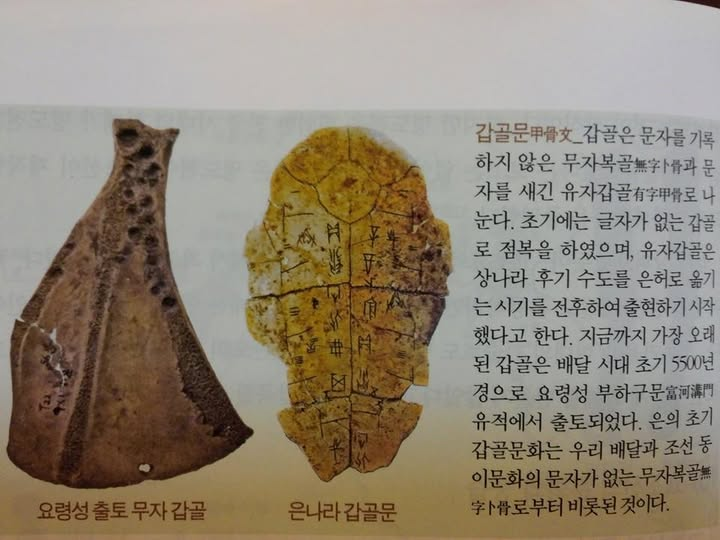
우리는 흔히 갑골문자가 상나라 유적에서 주로 발견되었기 때문에, 갑골문 하면 으레 상나라의 것으로 연상합니다. 그러나 이형구 교수에 따르면, 갑골문자는 우리 민족과 문화적으로 매우 밀접한 관계를 갖고 있는 발해 연안의 동이족 문화권에서 처음 발생하였습니다. 그곳에서 서남쪽으로 내려간 갑골문화가 전성기를 맞았던 곳이 상나라의 도읍지인 은허지역입니다. 이 때문에 오늘날 갑골문이 상나라 문자로 인식되고 있지만, 사실은 상고금문과 마찬가지로 동이족 문자입니다.
[고조선의 예악]
고조선은 제정이치 국가로서 일찍이 예악이 발달했습니다. BCE2000년경의 것으로 추정되는, 제사 의례에 사용한 전통적인 악기인 석경과 편종이 고조선의 강역이었던 중국 요령성 건평현 이도만자 남산 유적에서 출토되었습니다. 가장 오랜 것으로 추정되는 이 석경 외에 인근의 하가점하층 문화에서도 석경이 출토 되었습니다.
또한 한반도의 두만강 유역에서는 역시 BCE2000년경에 제작된 것으로 추정되는 또 다른 악기, 뼈피리가 발견되었습니다. 한족의 이리두 문화에서 발굴된 중국의 석경은 BCE1900~BCE1600년의 것으로 고조선 강역에서 출토된 것보다 한참 후대의 것입니다.
그런데 고조선의 예악은 배달로부터 전수된 것입니다. BCE3000년경 배달시대의 유적인 홍산문화에서 고조선 것보다 더 오래된 석경이 출토된 사실이 이를 말해 줍니다. 홍산 문화의 제단 유적에서는 특히 타악기가 주로 나옵니다. 홍산 문화에서는 오공금이라는 옥으로 만든 악기도 발견되었습니다. 홍산 문화와 고조선 유적에서 출토된 뻐피리, 석경, 오공금 등의 악기로 볼 때, 동방 한민족이 동북아에서 가장 먼저 예악 문화를 누렸음이 분명합니다.
현대인이 유행가를 즐겨 부르듯이 고조선 사람은 제천가를 즐겨 불렀습니다. 매년 삼신상제님께 천제를 올릴 때 나라에 큰 제전을 열어 모두 한마음으로 상제님의 덕을 찬양하며 <어아가御阿歌>라는 제천가를 불렀습니다. 감탄사 어아로 시작되는, 2세 부루단군이 지은 이 어아가는 한마디로 삼신과 인류의 조상이신 천상의 대조신大祖神(삼신상제님)을 맞이하는 노래입니다. 어아가는 후일 고구려 시대에 이르러 [참전계경]속에 수렴되었습니다. 참전계경은 고구려 9세 고국천열제 때 재상 을파소가 하늘의 계시를 받아 백성들의 인성 교육을 위해 지은 경전으로, 신교 문화의 3대 경전 가운데 하나입니다.
고조선 시대에는 일반 백성도 악기를 즐겨 다루었습니다. 공후(서양 하프 모양의 현악기)라는 악기를 연주하며 부른 <공무도하가>가 널리 퍼져 나간 데에서 이를 알 수 있습니다. 고조선의 공후는 BCE 106년쯤 중국 한나라에 전해졌습니다. 고조선은 한마디로 동방 예악 문화의 고향입니다.

—————-
[The Writing System of Gojoseon]
One of the critical elements of ancient civilizations is the use of writing systems. Even before Gojoseon, during the establishment of Baedal, the Korean people were already utilizing written language. In Taebaek Ilsa (Sodo Gyeongjeon Bonhun), it is stated: “Hwanung Cheonhwang commanded Shinji Hyeokdeok to record the Cheonbu-gyeong using the Nokdo script (a character resembling deer hoofprints).” This indicates that the Nokdo script was in use during the Baedal era.
In Gojoseon, before the creation of a new script by the 3rd ruler, Dangun Gareuk, a pictographic writing system called Jinseo existed. This script, believed to have been developed during the reign of Dangun Wanggeom, was a significant improvement over the Nokdo script, which was cumbersome to use. However, by 2181 BCE, this Jinseo script became “so complex that it was indecipherable.” As a result, Dangun Gareuk ordered Samrang Eulboruk to create a new script comprising 38 letters. (Dangun Se-gi, Taebaek Ilsa – Sodo Gyeongjeon Bonhun).
Thus, the Garimto script was born in Gojoseon. Interestingly, the form of Garimto, also referred to as Garimdara, bears remarkable similarities to Hunminjeongeum (the Korean alphabet created by King Sejong) in both appearance and structure, particularly in its 11 vowels, which are identical.
Recently, inscriptions predating the Shang Dynasty’s oracle bone script have been discovered in various parts of China. Chinese scholar Luo Binji, in his book Jinmun Shingo, asserts that these Shanggogeum (ancient golden inscriptions) were created based on the Korean language and identifies their creators as the Dongbang Joseonjok (Eastern Joseon people). According to Luo, the Shanggogeum script invented by the Dongyi people (ancestors of Koreans) evolved into the Shang Dynasty’s oracle bone script, the Zhou Dynasty’s large seal script, and the Qin Dynasty’s small seal script, eventually becoming the Chinese characters we know today. This suggests that the Korean script served as the prototype for Chinese writing.
We commonly associate oracle bone scripts with the Shang Dynasty, as they are primarily found in Shang archaeological sites. However, according to Professor Lee Hyeonggu, the oracle bone script first originated in the cultural sphere of the Dongyi people along the coastal areas of Balhae (modern-day Bohai Sea). From there, it spread southward, reaching its pinnacle in Yin Xu, the Shang Dynasty’s capital. Although modern recognition of the oracle bone script ties it to the Shang Dynasty, it is fundamentally a Dongyi script, much like the Shanggogeum.
[Rituals and Music of Gojoseon]
As a theocratic state, Gojoseon developed a rich tradition of rituals and music early on. Archaeological finds, such as stone chimes (Seokgyeong) and bronze bells (Pyeonjong) used in ceremonial rites around 2000 BCE, have been unearthed in Nanshan, Yidumanzi, Jianping County, Liaoning Province—an area once part of Gojoseon. These instruments are among the oldest known, predating similar finds in Han Chinese sites. For instance, stone chimes found in the Erlitou culture, associated with the Xia Dynasty, date to between 1900 and 1600 BCE, significantly later than those from Gojoseon.
However, Gojoseon’s ritual and music traditions originated in the earlier Baedal era. Stone chimes from the Hongshan culture (circa 3000 BCE), predating those of Gojoseon, substantiate this connection. Notably, percussion instruments were prominent in Hongshan ceremonial sites, including jade instruments like the Ogonggeum (five-stringed zither). Artifacts such as bone flutes, stone chimes, and jade instruments from the Hongshan and Gojoseon cultures demonstrate that the Korean people were the pioneers of ritual and musical traditions in Northeast Asia.
Similar to how modern people enjoy popular songs, the people of Gojoseon sang Jaecheonga (ritual songs) during grand national ceremonies honoring the Three Heavenly Spirits (Samsin Sangje). One of these songs, “Eo-Aga (어아가)”, was composed by the 2nd ruler, Dangun Buru, to praise the virtues of the Heavenly Lord. The song begins with the exclamation “Eo-A!” and is a hymn welcoming Samsin Sangje, the ancestor of all humanity and the divine creator. This song later became part of the Chamjeon Gye-gyeong in the Goguryeo period. Compiled during the reign of the 9th King Gogukcheon, this scripture was written by the prime minister Eulpaso as part of a spiritual guide for moral education. It is one of the three foundational scriptures of Korea’s traditional Shin-Gyo (Divine Religion) culture.
Musical instruments were also widely enjoyed by ordinary people during the Gojoseon era. The popularity of the “Song of Gongmudoha”—sung while playing a gonghu (a harp-like string instrument)—indicates the cultural importance of music. The gonghu was introduced to China around 106 BCE, demonstrating Gojoseon’s influence on East Asian music. Ultimately, Gojoseon was the birthplace of the ritual and music traditions of the East.