근대적 역사 서술과 조선사 편찬이라는 허울 좋은 구실로 우리 고대사를 삭제한 일제는 도처에 식민사관의 독버섯을 심어 놓고 물러갔습니다. 그 치명적 독버섯 중의 하나가 일제의 하수인 노릇을 했던 이병도입니다.
이병도는 서인과 노론의 대표적 가문의 하나인 우봉 이씨의 후예로 태어났습니다. 보광학교와 일본인이 운영하던 불교 고등학교를 다녔고 보성전문학교 법과에 입학한 후 와세다대학 ‘사학 및 사회학과’를 졸업한 국내 최초의 대학 출신 역사학자입니다.
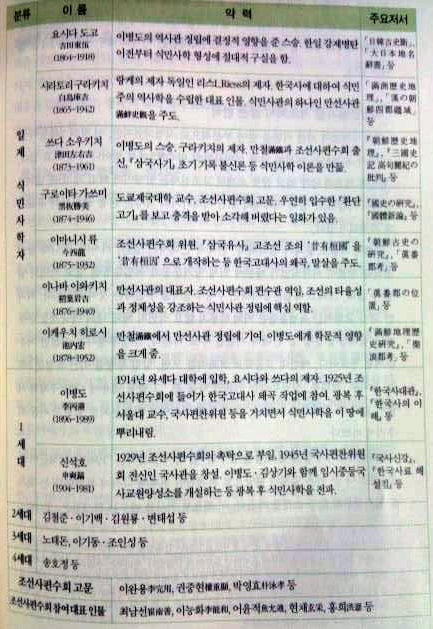
일본 유학은 이병도의 역사관 정립에 결정적 영향을 미쳤습니다. 이병도에게 영향을 준 일본 학자는 요시다 도고, 쓰다 소우키치, 이케우치 히로시입니다. 이병도는 자신의 생애에 가장 영향력을 많이 준 사람으로 요시다를 꼽았습니다. 이병도가 서양사를 전공하려다가 한국사로 방향을 바꾼 계기는 바로 요시다가 쓴 [일한고사단]이었습니다. 요시다는 일본이 조선 국권 강탈 이전부터 식민사학을 준비하는 데 절대적인 구실을 한 인물입니다.
이병도와 그의 선후배 한국 유학생들은 요시다에게 ‘일본이 한국을 동화시키려고 하는데 과연 그렇게 될지’ 질문을 했다고 합니다. 이에 대해 요시다는 “단시일엔 안 된다. 그러나 앞으로 50년만 이 상태가 계속되면 반드시 동화가 될 것이다.” 라고 자신 있게 답했다고 합니다 (식민사관을 계승한 이병도 사관[청산하지 못한 역사] 3집-김정희)
이병도는 요시다 후임으로 온 쓰다 소우키치 밑에서 강의를 들으면서 국사를 연구해 보겠다는 뜻을 굳히고, 쓰다의 지도 아래 역사 연구 훈련을 받았습니다. 그리고 쓰다의 소개로 동경제국대학 교수 이케우치 히로시를 만나 사적인 지도를 받았습니다. 동경제국대학 사학과는 실증사학을 창시한 랑케의 제자 리스를 초빙하여 창설한 학과입니다. 그래서 자연스럽게 실증사학이 일본 사학계의 주류를 이루게 되었습니다.
이케우치는 만주를 일본 손에 넣기 위한 수단으로 만들어진 만철조사부라는 기관에 학문적으로 참여한 제국주의 사학자 이고, 이병도를 조선사편수회에 참여하도록 추천하였습니다. 이병도가 제국주의 식민사관을 가진 일본 학자들에게 영향을 받은 데에서 우리나라 근대 역사학의 비극이 시작된 것입니다.
이병도는 1925년 조선사편수회에서 수사관보로 학문적 연구를 시작했습니다. 이병도는 이마니시 류와 함께 고려 이전 시기를 담당했고 자연히 주로 고대사를 연구했습니다. 그런데 이병도는 “우리 사회는 청동기 시대를 거치지 않고 철기 시대로 들어온 일종의 변칙적 발전”을 하였다고 확신하였습니다.
한사군 이전은 미개사회이고 한사군이 우리나라에 철기 문화를 전래한 이후 국가가 성립되었다고 하였고, 고려 시대까지도 낙후한 도참사상에 의해 지배되었다고 보았습니다. 이처럼 우리나라 문명이 중국의 식민지 지배를 받으면서 비로소 시작되었다고 보았으니, 한사군이 한반도에 있었다는 어처구니 없는 연구 결과를 낸 것도 이상한 일이 아닙니다.
이런 결과는 모두 일본 사학자들이 실증사학이라는 미명하에 한국 고대사를 부정한 것을 그대로 답습한 데에서 나온 것입니다. 이병도는 와세다 대학 동창, 경성제대 출신 학자들과 함께 1934년에 진단학회를 만들었습니다. 그 주요 구성원은 조선사편수회 활동도 함께 하고 있었습니다. 따라서 진단학회도 일본의 논리를 크게 벗어날 수 없었습니다.
안타깝게도 해방 후 이들이 국사학계를 주도하였습니다. 1950년에 발발한 한국전쟁을 전후하여 백남운(1894~1979)같은 사회경제사학 계열의 사학자들이 월북하고, 안재홍과 정인보 같은 민족사학의 거목이 납북되자, 이병도와 그 제자들은 식민사학을 실증사학으로 위장시켜 한국 역사학계를 좌지 우지 하였습니다.
그런데 광복 후 국내 사학계를 이처럼 식민사학자들이 장악할 수 있었던 데에는 정치적 배경도 작용하였습니다. 일본이 물러가고 이 땅에 들어서 미군정이 친일파 관리와 학자를 기용한 것입니다. 미군정 3년이 끝난 뒤 이승만 정부는 친일파 숙청 건의를 묵살하고, 심지어 반민족 행위자를 처벌하기 위해 제헌 국회에 설치한 반민특위의 활동도 무산시켰습니다.
프랑스는 2차대전이 종결된 후 나치에 협력한 사람 70만 명을 체포하고, 1만 8천명에게 사형선고를 내렸습니다. 중국도 중일전쟁 당시 일본에 협력한 민족반역자 십 수만 명을 총살하거나 처벌하였습니다. 필리핀, 베트남, 미얀마 역시 태평양 전쟁이 끝난 후 자국의 친일파를 청산하였습니다.
무려 35년 동안 일제의 악랄한 지배를 받은 대한민국은 오히려 친일파 청산을 전혀 하지 않은 유일한 나라입니다. 해방 후 독립운동의 공로로 훈장을 받은 사람은 대통령 이승만과 부통령 이시영뿐이었습니다.
——————–
Under the pretext of compiling a modern historical narrative and authoring the History of Joseon, Imperial Japan erased Korea’s ancient history and planted the poisonous seeds of colonial historical perspectives throughout the peninsula. One of the most lethal agents of this ideological contamination was Yi Byeong-do, who functioned as a collaborator for the Japanese Empire.
Yi hailed from the Ubong Yi clan, a prominent family of the Seoin (Westerners) and Noron factions. He attended Boguang School and a Buddhist high school run by Japanese administrators, later enrolling in the Law Department of Boseong College before graduating from Waseda University’s Department of History and Sociology. He was the first Korean historian with a formal university education.
Yi’s historical outlook was decisively shaped during his studies in Japan. Influential figures in his intellectual development included Japanese scholars Yoshida Togo, Tsuda Sokichi, and Ikeuchi Hiroshi. Yi considered Yoshida to be the most influential figure in his academic life. Originally intending to major in Western history, Yi changed course to focus on Korean history after reading Yoshida’s Ilhan Gosadan (Old Historical Facts of Japan and Korea). Yoshida had played a pivotal role in constructing a historical framework justifying Japan’s annexation of Korea, even before the formal occupation.
Yi and his contemporaries studying in Japan asked Yoshida whether Japan would succeed in assimilating Korea. Yoshida confidently replied, “It cannot be done in a short time. But if the current conditions persist for 50 years, assimilation will certainly be achieved.” (From The Yi Byeong-do Historiographical Perspective, an Unsettled History Vol. 3 by Kim Jeong-hee)
Yi resolved to study Korean history while taking courses under Tsuda Sokichi, who succeeded Yoshida. Under Tsuda’s guidance, he received formal historical training. Tsuda later introduced Yi to Professor Ikeuchi Hiroshi at Tokyo Imperial University, from whom Yi received private instruction. The history department at Tokyo Imperial was founded by inviting Ranke’s disciple, Rieß, and thus promoted the German method of empirical historiography, which became mainstream in Japanese academia.
Ikeuchi was an imperialist historian who contributed academically to the South Manchuria Railway Research Department, an institution created to facilitate Japan’s domination of Manchuria. It was he who recommended Yi for participation in the Chosenshi Compilation Committee. Yi’s exposure to Japanese scholars with imperialist and colonial historical views marked the beginning of the tragedy of modern Korean historiography.
In 1925, Yi began his academic career as an assistant investigator at the committee. Alongside Imanishi Ryū, he focused on the period before the Goryeo Dynasty, thus naturally specializing in ancient history.
Yi firmly believed that Korean society had bypassed the Bronze Age and developed abnormally by entering directly into the Iron Age. He argued that the period before the establishment of the Han commanderies was a primitive society, and that Korean civilization began only after the introduction of iron culture by the Han commanderies.
He further claimed that even in the Goryeo era, society was dominated by irrational prophetic beliefs. Based on these assumptions, he asserted that Korean civilization only began under the colonial influence of China, making his claim that the Han commanderies were located on the Korean peninsula unsurprising.
Such conclusions stemmed directly from his uncritical adoption of Japanese historians’ empirical methods, which were used to deny Korea’s ancient history. In 1934, Yi and fellow Waseda alumni and Keijō Imperial University scholars founded the Jin Dan Historical Society. Many of its key members were also involved in the Chosenshi Compilation Committee. Consequently, Jin Dan could not escape Japanese academic influence.
Tragically, after liberation, these individuals came to dominate the Korean historical field. When the Korean War broke out in 1950, scholars like Baek Nam-un of the socioeconomic historiography school moved north, and prominent nationalist historians like Ahn Jae-hong and Jeong In-bo were abducted. Yi and his disciples then disguised colonial historiography as empirical historiography and monopolized historical academia in South Korea.
The post-liberation dominance of colonial historians in Korean academia also had political roots. After Japan’s departure, the U.S. Military Government in Korea utilized pro-Japanese officials and scholars. Even after the U.S. Military Government ended, President Syngman Rhee’s administration ignored calls to purge collaborators and dissolved the Special Committee for Prosecution of Anti-National Acts, which had been established by the constitutional assembly.
In stark contrast, France arrested 700,000 Nazi collaborators and sentenced 18,000 to death after World War II. China executed or punished tens of thousands of traitors who had cooperated with Japan during the Second Sino-Japanese War. The Philippines, Vietnam, and Myanmar also purged collaborators after the Pacific War.
Korea, which endured 35 years of Japanese occupation, remains the only nation that failed to address its collaborators. After liberation, only President Rhee and Vice President Yi Si-yeong were awarded for independence activism.