

일본인은 자신들이 조선인보다 인종적으로 우수하다는 근거 없는 우월감을 가지고 있었습니다. 이 편견을 바탕으로 조선 지배를 합리화하기 위해 일본은 체질인류학적 연구를 시행했습니다. 당시의 연구 자료를 보면, ‘조선인들의 두골이 작고 골격이 두꺼워서 뇌용량이 작기 때문에 야만에 가깝다’, ‘일본인에 비해 동작이 활발하지 못하고 안면 표정이 섬세하지 못하며 조잡한 음식을 먹는 까닭에 소화기관이 발달했다’는 등 편견으로 가득합니다.
그런데 그 연구 결과, 일본 국내 지역간 인종적 차이가 일본인과 한국인과의 차이점보다 훨씬 큰 것으로 나타났습니다. 그리하여 한국인이 열등하다는 근거를 만들기 위해 시작한 체질인류학 연구가 나중에는 한국인과 일본인의 뿌리가 같다는 일선동조론의 근거로 이용되었습니다.
이렇게 열등한 민족으로 낙인찍은 한국인을 일제가 어떻게 대접했는지 보여주는 실화가 있습니다. 일본은 1907년 3월에 메이지 왕 재위 40주년을 기념하는 도쿄 박람회를 결행하였습니다. 러일전쟁을 승리로 이끌고 아시아 최강 제국으로 올라선 일본의 국력을 자랑하는 무대였습니다.
이 박람회에 우리의 눈과 귀를 의심케 하는 전시물이 있었습니다. 조선 사람 두 명이 살아 있는 동물처럼 전시된 것입니다. 사람이 사람을 전시한 이 반인륜적인 박람회에서 당시 일본인들은 “조선 동물 두 마리가 아주 우습다”라는 반응까지 보였다고 합니다. 일본인에게 비친 한국 사람은 인간의 탈을 쓰고 있는 동물에 지나지 않았던 것입니다.
일본인의 한국인 참살 만행은 또 어떠할까요?
약자를 억압하여 자신의 힘을 극대화하는 제국주의 사조로 말미암아 6백만 명의 유대인이 학살 되었다고 하는데, 일제는 19세기 후반 부터 20세기 중반까지 무려 8백만명의 한국인을 참혹하게 죽였습니다.
우선 1984년 갑오동학혁명을 진압하면서 동학군과 양민을 합쳐 최고 30만 명으로 추산되는 조선인을 학살했습니다. 동아시아 최초의 국제 양민 대학살이었습니다. 일본은 청일전쟁을 수행하고 동학군을 진압하기 위해 1884년 9월부터 1889년 7월까지 10개월 동안 수도를 동경에서 히로시마로 옮기기까지 하였습니다. 그들의 비밀 문건을 보면, 동학군이 함경도 방향으로 도망하지 못하도록 전라도 방향으로 몰아서 섬멸한다는 치밀한 작전까지 적혀 있습니다.
그때 일본은 저항하지 않는 동학군과 양민까지 무참하게 학살했습니다. ‘우지개’라 불리는 볏짚으로 만든 농기구를 머리에 씌우고 불을 질러 죽이기도 했습니다. 동학혁명에서 가장 치열한 싸움이었던 우금치 전투에서는 계곡과 산마루가 동학군의 시체로 하얗게 덮였고 개천에는 핏물이 여러 날 흘렀다고 전합니다.
이후 일제에 항거하는 의병이 수없이 죽어갔고, 만주에서는 양민 대 학살이 자행되었습니다. 1920년에 일본군은 3~4개월 만에 조선인 5천 명 이상을 무자비하게 죽였습니다. 간도 일대에서 자행된 한국인 학살을 지켜본 미국인 선교사는 “피 에 젖은 만주 땅이 바로 저주받은 인간사의 한페이지”라고 탄식하였습니다.
또한 일제는 만주와 한반도에서 이른바 ‘마루타(통나무)라는 암호로 통하던 생체실험을 행하였습니다. 만주에 주둔한 일본군 731부대가 중심이 되어 세균성 무기를 개발하기 위해 중국인, 러시아인, 한국인을 상대로 무려 31종류의 실험을 행하였습니다. 고속원심분리기를 사용해 생사람의 피를 짜고, 사람 몸에 말의 피를 넣었을 때 어떻게 죽는지 관찰하였습니다. 각종 독가스를 살포하여 얼마 만에 죽는지 측정하고, 페스트와 콜레라 균을 주입시켜 체내 장기에 어떤 변화가 생기는지 생체 해부로 알아냈습니다.
또한 인체의 70%이상이 수분이라는 것을 증명하고자 생사람을 한 증막에 넣고 쪄서 수분을 빼는 실험을 감행하고, 사람에게 전혀 물 안 주고 빵만 먹이면 6~7일째 가서 퉁퉁 부은 채 피를 토하고 죽는다는 것도 알아냈습니다. 아직 그 전모가 밝혀지지 않은 일본의 생체실험은 인류 역사상 가장 잔혹한 범죄 중의 하나입니다.
일본의 생체실험 증거가 서울에서 발견된 사례가 있습니다.
2008년에 대학로의 한 공사 현장에서 50~100년 전으로 추정되는 유골 28구가 출토되었는데, 두개골 유골에 톱으로 가운데를 정밀하게 절단한 흔적이 있습니다. 당시 근처에 경성의학전문학교가 있었던 것으로 보아 일본인이 조선인을 생체 실험한 후 암매장한 것으로 보입니다. [KBS역사스페셜, “조선 사람은 왜 일본 박람회에 전시됐나” 2011.12.8.]
한국인을 역사에서 지우려는 음모의 절정은 바로 1933년 흥아 연구소라는 특수 조직에서 도요카와 젠요라는 자가 작성한 경성천도 공작입니다. 이 문건은 한반도의 지정학적 특성을 들어, 일본이 세계를 경영하려면 동경은 수도로서 부적당하고 조선의 경성이 가장 적합한 곳이라 주장합니다. 만약 일본인 1천만 명을 한반도로 이주시킬 것을 계획한 이 공작이 실행되었더라면 한국은 완전히 일본인의 나라가 되었을 것입니다. 혈통이 섞이고 언어와 역사도 완전히 빼앗겨 한민족이란 인종 자체가 역사 속에서 완전히 사라져 버렸을지도 모를 일입니다.
백암 박은식은 일본에 의해 자행된 참변을 다음과 같이 묘사했습니 다.
“마을의 민가, 교회당, 학교 및 곡식 수 만석을 불 질러 잿더미로 만들었으며, 남녀노소를 총으로 죽이고 칼로 죽이고, 몽둥이로 때려 죽이고, 목을 졸라 죽이고, 주먹으로 때려 죽이고 발로 차 죽이고, 도끼로 찍어 죽이고, 생매장하기도 하고, 불에 태우기도 하고, 솥에 삶기도 하고, 몸을 갈가리 찢기도 하고, 코를 꿰기도 하고, 갈비뼈를 발라 내기도 하고, 배를 따기도 하고, 머리를 자르기도 하고, 눈알을 뽑기도 하고, 가죽을 벗기기도 하고, 허리를 자르기도 하고, 사지에 못을 박기도 하고, 손과 발을 자르는 등 인간이라면 차마 할 수 없는 짓들 을 저네들은 오락으로 삼았다.
우리 동포들 중에는 할아버지와 손자가 함께 죽었고, 아비와 아들이 함께 도륙 당했으며, 그 지아비를 죽여서 그 지어미에게 보였고, 그 아우를 죽여서 그 형에게 보였으며, 죽은 부모의 혼백상자를 끌어 않고 도망가던 형제가 함께 떼죽음을 당하기도 했고, 더러 산모가 포대기에 아이를 싸않고 달아나다가 모자가 함께 목숨을 잃기도 했다“
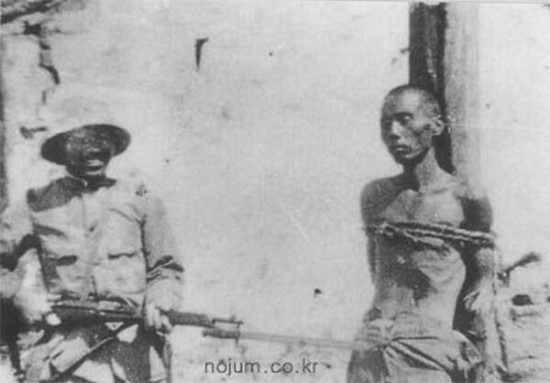
1923년 일본 관동 지역이 대지진으로 초토화되자 일본정부는 혼란해진 민심을 수습하기 위해 조선인 폭동설을 날조 유포시켜 자국 국민을 선동했습니다. 이 때문에 일본인 자경단이 약 2만 명이 넘는 우리 동포들을 처참하게 학살하는 비극이 발생했습니다. 그리고 일본군은 포로와 일제에 저항하는 사람들을 신병들의 총검술 훈련 대상으로 삼아 잔인하게 죽이기도 했습니다.
오늘의 한국인은 민족의 역사가 난도질되고, 당시 한국 인구의 1/3 에 달하는 8백만 명이 살해되고, 자칫 민족의 씨종자까지 말라 버릴 뻔했던 참담한 과거를 너무도 쉽게 잊고 삽니다. 한국인이 일제에게 겪은 수난은 기억 저편으로 사라진 과거의 사건이 결코 아닙니다. 우리들의 부모형제가 당한 그 고통은 오늘날에도 우리 한민족 정서 속에 깊은 한으로 새겨져 있습니다.

————–
The Japanese harbored an unfounded sense of racial superiority over Koreans. Based on this prejudice, Japan conducted physical anthropological studies to justify its colonial rule over Korea. These studies were filled with bias, claiming, for example, that “Korean skulls are smaller and thicker, resulting in smaller brain capacity, which makes them closer to savagery,” or that “Koreans move less energetically, have coarser facial expressions, and because they eat crude food, their digestive systems are more developed.”
However, the research revealed that the racial differences within various regions of Japan were significantly greater than those between Japanese and Koreans. Consequently, the very anthropological studies that aimed to prove Korean inferiority ended up supporting the naisen dōsoron (theory of common ancestry between Japan and Korea), asserting a shared origin of the two peoples.
There exists a historical account showing how the Japanese Empire treated Koreans whom they had branded as racially inferior. In March 1907, Japan held an exposition in Tokyo to commemorate the 40th anniversary of Emperor Meiji’s reign. It was a grand display of national power following Japan’s victory in the Russo-Japanese War and its rise as Asia’s dominant imperial power.
One exhibit at this exposition defied all human dignity—two Korean individuals were displayed alive like animals. At this inhumane exhibition, the Japanese reportedly mocked the display, saying, “These two Korean animals are hilarious.” To the Japanese, Koreans were nothing more than animals in human form.
What of Japan’s atrocities against Koreans?
Just as imperialism sought to amplify its strength by oppressing the weak—resulting in the murder of six million Jews—Japanese imperialism massacred an estimated eight million Koreans between the late 19th and mid-20th centuries.
Beginning with the suppression of the Donghak Peasant Revolution in 1894, the Japanese military killed up to 300,000 Koreans, including both revolutionaries and civilians. This was the first large-scale massacre of civilians in East Asian history. To carry out the war and suppress the Donghak forces, Japan even temporarily relocated its capital from Tokyo to Hiroshima from September 1884 to July 1889. Japanese secret documents reveal strategic plans to corner Donghak forces toward Jeolla Province to annihilate them, preventing escape toward Hamgyeong Province.
The Japanese massacred even the unarmed Donghak fighters and civilians. They would force straw-made farm tools known as ujigae over people’s heads and burn them alive. In the fiercest battle of the revolution, the Battle of Ugeumchi, valleys and mountain ridges were said to be blanketed with the corpses of Donghak fighters, and bloody water flowed in the streams for days.
Later, countless Korean militias resisting the occupation were killed, and large-scale massacres of civilians took place in Manchuria. In 1920 alone, the Japanese military slaughtered over 5,000 Koreans within just three to four months. A U.S. missionary who witnessed these atrocities in the Gando region lamented, “The blood-soaked soil of Manchuria marks a cursed page in human history.”
The Japanese also conducted live human experimentation in Manchuria and Korea, referred to with the codename “Maruta” (log). Led by Unit 731 of the Japanese army stationed in Manchuria, they conducted 31 types of experiments on Chinese, Russian, and Korean victims to develop biological weapons. They used high-speed centrifuges to extract blood from living humans, injected horse blood into human veins, tested how quickly different gases killed victims, and studied how the plague and cholera bacteria affected internal organs via live dissections.
They also conducted grotesque dehydration experiments, steaming people alive in sealed chambers to extract bodily fluids, and tested starvation effects by feeding humans only bread without water, leading to bloated bodies and death after six to seven days. These undisclosed human experiments by Japan remain among the most heinous crimes in human history.
There is evidence of these experiments discovered in Seoul. In 2008, 28 human remains estimated to be 50–100 years old were excavated at a construction site in Daehangno. Several skulls showed precise saw marks, suggesting dissection. Given that the Kyungsung Medical College was nearby, these remains are believed to be those of Korean victims of Japanese human experiments, later secretly buried. [KBS History Special, “Why Were Koreans Displayed at the Japanese Exposition?” Dec. 8, 2011]
The height of Japan’s conspiracy to erase Koreans from history came in 1933 with the drafting of the “Kyungsung Capital Relocation Plan” by Toyokawa Zenyo of the East Asia Research Institute. The document argued that, due to the Korean Peninsula’s geopolitical significance, Tokyo was unfit as the capital of a world empire and Kyungsung (present-day Seoul) was more appropriate. If the plan to relocate 10 million Japanese to the Korean Peninsula had been executed, Korea might have been entirely overtaken. Bloodlines would have mixed, and language and history would have been lost, possibly leading to the complete erasure of the Korean ethnic identity.
Baekam Park Eun-sik described Japan’s atrocities in the following way:
“They burned down villages, churches, schools, and thousands of seok (Korean grain measure) worth of crops. They shot people, stabbed them with swords, bludgeoned them to death, strangled them, beat them with fists, kicked them, axed them, buried them alive, burned them, boiled them in cauldrons, tore them limb from limb, pierced their noses, pulled out their ribs, disemboweled them, decapitated them, gouged out eyes, skinned them, cut them at the waist, nailed their limbs, and amputated hands and feet—all as sport, beyond what any human could possibly conceive.
Among our people, grandfathers and grandsons died together, fathers and sons were slaughtered side by side, husbands were killed in front of their wives, brothers murdered before their siblings’ eyes, siblings clutching ancestral tablets were massacred while fleeing, and mothers with infants strapped to their backs perished together.”
After the 1923 Great Kanto Earthquake devastated the region, the Japanese government, in a bid to calm public unrest, fabricated and spread rumors of a Korean uprising. This incited mass hysteria among the populace. As a result, Japanese vigilante groups brutally murdered over 20,000 Korean residents. Furthermore, the Japanese army used prisoners and Korean resistance fighters as live bayonet practice targets for military training.
Modern Koreans too easily forget this tragic past, in which our national history was butchered, eight million—nearly a third of the population—were killed, and the very seed of the Korean people nearly extinguished. The suffering endured by our ancestors is not a relic of the past, but a sorrow deeply etched into the collective psyche of the Korean people even today.