

[서양(그리스.로마)문명의 기원을 찾아서]
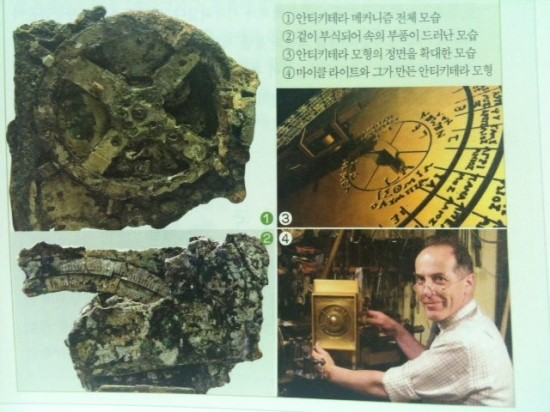
1902년 그리스 남부에게 해의 안티키테라 섬 근처 바다에서 발견된 고대 난파선에서 녹슨 고철덩어리 하나가 발견되었습니다. 배는 2천 년 전 로도스 섬에서 로마로 향하다가 난파된 배였습니다.
발견된 곳의 이름을 따 ‘안티키테라 메커니즘’이라 불리는 이 고철이 무슨 물건인지 모르는 채로 지내다가 1951년 영국의 물리학자 데릭 프리이스가 처음으로 연구하였습니다. 그 무렵 개발된 엑스레이 기술을 이용해 부식층 안을 살펴본 결과, 그것은 매우 복잡한 기계였습니다.
이 기계의 톱니, 기어, 새김글을 면밀히 조사하여 모형을 만든 끝에 그는 그것이 해와 달의 이동을 계산하는 매우 정교한 장치라고 결론짓고, 1974년 자신의 연구결과를 그리스인의 톱니바퀴라는 논문으로 발표하였습니다.
그의 논문에 대해 국제적으로 관심이 뜨거워지는 가운데 런던 과학박물관의 큐레이터 마이클 라이트도 이 정교한 장치의 정체를 밝히는 데에 도전하였습니다.
과거 그리스인들이 그랬던 것처럼, 컴퍼스와 쇠줄만 가지고 톱니바퀴를 재고 자른 끝에 그 모형을 완성하였는데, 마침내 완성된 기계는 오늘날의 컴퓨터와 유사한 자동 계산 장치였습니다. 그것은 세계 최초의 컴퓨터로 자주 거론되는 1830년대 찰스 배비지의 기계와 비교해보면 놀랍도록 비슷하였습니다.
2천여 년 전의 이 유물에서 보여주는 그리스인들의 고도의 과학, 수학, 공학 기술은 순전히 그리스 자체에서 태동한 것일까요?
대영박물관의 어빙 핕켈박사는 그리스의 수학, 천문학, 의학, 그리고 여러 학문에 바빌로니아 문명이 녹아 있다고 말합니다. 그는 바빌론 유적지에서 발굴된 설형문자 점토판 중에 한쪽에는 바빌로니아 말이 있고, 반대쪽에는 그것을 옮긴 그리스 말이 적힌 것들이 이를 증명 한다고 합니다. 그리스 학자들이 바빌로니아 말을 배우고 학문을 익혔다는 것입니다.
서양철학의 아버지로 불리는 탈레스(BCE624~546?)는 BCE585년에 일어난 일식을 정확히 예즉한 인물입니다. 그런데 그것은 바빌로니아 천문학자들의 기록을 근거로 계산한 것입니다. 바빌로니아인들은 탈레스가 일식을 예측한 때보다 두 세기나 앞선 때 (BCE747)부터 일식, 월식 등을 정확히 기록하기 시작했습니다.
후에 바빌로니아를 정복한 알렉산더 대왕도 바빌로니아 천문학에 매료되어 많은 그리스 학자들로 하여금 바빌로니아의 천문관찰 기록을 수집, 번역 하도록 하였습니다.
메소포타미아 땅에서 번성한 바빌로니아인들은 뛰어난 천문학자일뿐 아니라 기울기, 각도, 분수, 방정식을 최초로 이용한 훌륭한 수학자들이었습니다. 그들은 60진법을 사용하여 모든 계산을 하였고 황도 12궁도 탄생시켰습니다.
그렇다면 바빌로니아 문명은 어디에서 자양분을 공급받았을까요? 그들의 역사적 배경, 문화적 유산이 말해주듯 바빌로니아인들은 수메르의 문명을 그대로 계승하였습니다.
그들의 설형문자와 60진법은 곧 수메르의 문자와 수학입니다. 2천 년 전의 고대 과학의 정교한 유물인 자동 계산 장치는 그리스 시대에 어느 날 갑자기 나타난 것이 아닙니다. 이것은 5천5백 년 전의 수메르 문명에서부터 축적된 힘이 3천 년간의 공력 끝에 만들어낸 작품입니다.
그런데 수메르 문명을 연 주인공은 중앙아시아에서 천산을 타고 넘어온 환국 사람들입니다. 그러므로 그리스. 로마 문명을 포함한 모든 문명이 9천 년 전에 태동한 환국에서 비롯된 것입니다.

—————-
Tracing the Origins of Western (Greek and Roman) Civilization
In 1902, a corroded mass of bronze was recovered from an ancient shipwreck near the island of Antikythera in southern Greece. The vessel, en route from Rhodes to Rome about two thousand years ago, had sunk beneath the sea. The artifact was later named the Antikythera Mechanism after the site of its discovery.
For decades its purpose remained unknown until 1951, when British physicist Derek de Solla Price began studying it. Using then newly developed X-ray imaging, he discovered that beneath the corrosion lay an extraordinarily intricate machine.
Through detailed analysis of its gears, inscriptions, and mechanisms, Price reconstructed a model and concluded that it was a highly sophisticated device designed to calculate the movements of the sun and the moon. In 1974, he published his findings in a paper titled Gears from the Greeks.
His research drew worldwide attention, inspiring Michael Wright, curator at the Science Museum in London, to take up the challenge of fully reconstructing the mechanism.
With only compasses and hand tools, just as the ancient Greeks might have done, Wright built a working model. The completed device turned out to be an automatic calculating machine strikingly similar to modern computers. In fact, when compared with Charles Babbage’s 1830s mechanical computer — often hailed as the world’s first computer — the resemblance was astonishing.
This discovery raises the question: did such advanced science, mathematics, and engineering truly originate solely within Greek civilization?
According to Dr. Irving Finkel of the British Museum, Greek knowledge of mathematics, astronomy, medicine, and other disciplines was deeply infused with Babylonian influence. He points to cuneiform tablets unearthed in Babylon that bear Babylonian text on one side and Greek translation on the other, proving that Greek scholars studied Babylonian language and absorbed its sciences.
Thales of Miletus (c. 624–546 BCE), known as the father of Western philosophy, famously predicted the solar eclipse of 585 BCE. Yet his calculation was not independent; it was based on Babylonian astronomical records. The Babylonians had been meticulously documenting solar and lunar eclipses as early as 747 BCE — nearly two centuries before Thales.
Later, when Alexander the Great conquered Babylon, he too was captivated by their astronomy and ordered Greek scholars to collect and translate Babylonian observational records.
The Babylonians of Mesopotamia were not only skilled astronomers but also brilliant mathematicians, pioneering the use of slope, angles, fractions, and equations. They operated under a sexagesimal (base-60) system, which shaped their calculations and also gave rise to the zodiac of twelve constellations.
Yet Babylonian civilization itself had roots deeper still. Their writing system and numerical base-60 mathematics were direct inheritances from Sumerian culture.
Thus, the Antikythera Mechanism — the sophisticated calculating device of 2,000 years ago — did not appear suddenly in Greece. It was the culmination of knowledge that began in the Sumerian civilization 5,500 years ago, developed through three millennia of intellectual endeavor.
And according to certain historical traditions, the Sumerians themselves inherited their civilization from the people of Hwan-guk, who had crossed the Tianshan mountains from Central Asia. By this reasoning, all civilizations — including those of Greece and Rome — trace their origins back to Hwan-guk, the cradle of human culture some 9,000 years ago.