[동북아의 여러 신석기 문화]
130년에 걸친 이라크 지역의 유적 발굴을 통해 서양 문명의 뿌리인 수메르 문명이 세상에 드러난 것에 필적하는, 20세기 동북아 최대의 발굴 사건이 있습니다. 요서지역(발해연안)의 신석기. 청동기 문화 발굴이 바로 그것입니다.
프랑스인 에밀리쌍이 1922년부터 1924년 사이에 내몽골 적봉 지역에서 신석기 유적지 22곳을 발견한 이래, 21세기인 지금까지도 발굴이 계속 진행되고 있습니다. 요서에서 발견된 가장 오랜 신석기 문화는 8,500년 전까지 거슬러 올라가는 소하서 문화입니다. 현지인조차 길을 찾지 못하는 오지에 위치한 소하서 유적은 당국의 문화재 신고 정책에 따라 주민이 신고함으로써 세상에 알려졌습니다.
중국은 이 문화를 ‘인류의 가장 오래된 신석기 문화’라고 규정하였습니다. 그런데 소하서 유적은 7,000~8,000년 전에 만들어진 발해 연안 빗살무늬토기와 그 연대가 일치합니다. 발해 연안 빗살무늬토기는 그 재질과 모양이 만주와 한반도에서 출토되는 빗살무늬토기와 같은 계통입니다. 이것은 소하서 문명의 중인공과 동방 한민족의 강한 연관성을 보여줍니다.
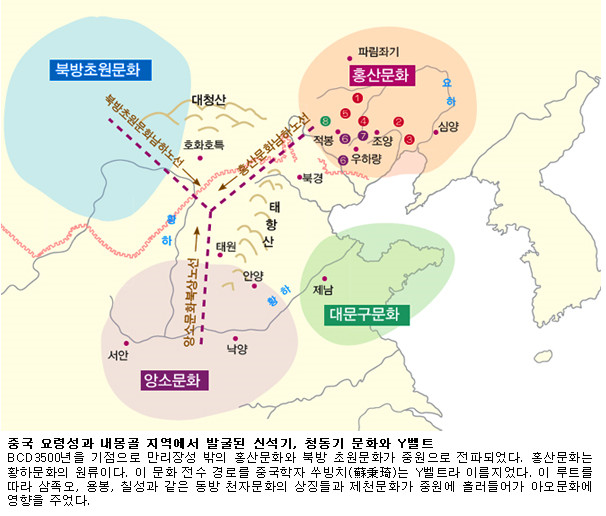
요서의 여러 신석기 문화 가운데 홍산 문화는 세간의 가장 뜨거운 관심을 끌었습니다. 요령성 조양시 건평현과 능원현의 접경지역에서 번창했던 홍산 문화는 신석기 말기의 문화로 ‘석기와 청동기를 섞어 사용한 BCE4500~BCE3000년경의 문명’입니다. 1954년에 중국학자 인다는 철광석으로 뒤덮여 산 전체가 붉게 보이는 ‘홍산’에서 이름을 따서 이 문화를 홍산 문화라 명명하였습니다.
이형구는 홍산 문화를 ‘발해연안문명’으로 부를 것을 제안했습니다. 발해연안이란 발해를 둘러싸고 있는 산동반도, 요동반도, 한반도를 말합니다. 세계 4대문명과 마찬가지로 이 문명은 북위 30~45도에서 발생하였습니다. 그는 “지중해 문명(지중해를 둘러싸고 태동한 이집트 문명, 에게 문명, 그리스로마 문명)이 서양 문명에 자양분을 공급했듯이, 동이족이 발해연안에서 창조한 문명은 중국은 물론 만주, 한반도, 일본의 고대 문명을 이루어 내는 젖줄이었다라고 밝혔습니다.
[총(塚), 묘(廟), 단(檀)이 모두 나타나는 홍산문화]
홍산 문화는 1979년 객좌현동 산취촌 발굴과 1983년 그 인근 우하량촌 발굴을 계기로 전 세계적으로 주목을 받게 되었습니다. 그것은 동산취에서 엄청난 제사 유적이 발견되고, 우하량에서 돌무덤, 신전, 제단이 한꺼번에 발굴되었기 때문입니다. 이형구 교수는 총.묘.단을 인류의 정신문화를 가능하게 하는 3요소라 합니다. 이 3요소가 모두 나온 것은 다른 신석기 문화에서는 볼 수 없는 전혀 새로운 모습이었습니다.
우하량의 16개 유적지 가운데 13곳이 돌무덤, 즉 적석총 유적지입니다. 적석총은 고대로부터 삼국 시대 때까지 계속 나타나는 동이족의 대표적 묘제로 황하 지역의 화하족 문명권에서는 전혀 출토되지 않은 것입니다. 중적층 지대인 황하 지역에 살던 화하족은 땅에 구덩이를 파고 직접 주검을 묻거나 관을 묻는 형식의 널무덤(토광묘)을 지었고, 산악과 평지가 공존하는 요서지역에 살던 동이족은 주로 돌무덤을 지었습니다.
우하량의 돌무덤은 약 5,500년에서 5,000년경 전에 조성된 것이라 합니다. BCE4천 년대에 요서에서 돌무덤을 짓고 문명을 일군 동이족은 바로 배달의 백성입니다. 우하량의 여러 적석총 무덤 중에서 특히 주목을 받는 것은 제2지점의 방형 적석총입니다. ‘중심에 큰 적석총(돌무지무덤)’과 그것을 에워싼 ‘27기의 석관묘(돌널무덤)’로 이루어져 있습니다. 최고 통치자의 무덤으로 추정되는 중앙 대료를 주변의 작은 무덤들이 에워싸고 있는 것입니다. 이러한 무덤 양식은 홍산인들이 이미 씨족사회를 넘어서 계급이 분화된 국가 단계의 문명을 누렸음을 시사합니다.
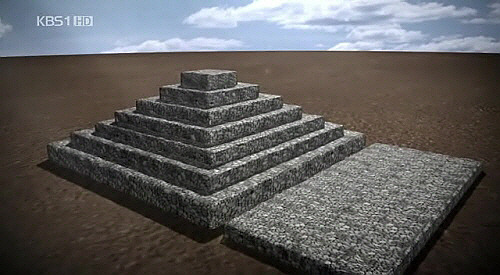
이 대형 무덤군의 바로 옆 자리에서 원형으로 쌓은 적석총도 함께 발굴되었습니다. 조사 결과, 원형 적석총은 원래 최하단의 직경이 22m에 달하는 3단 높이로 지어진 것이었습니다. 일반적인 돌무덤의 양식과 다른 이 건축물의 용도는 과연 무엇이었을까요?
중국 학자들은 이 적석총의 용도에 대한 실마리를 명.청의 황제들이 천제를 지내던 북경 천단공원에서 찾았습니다. 그곳 원구단이 우하량 적석총과 동일한 형태의 원형 3단이기 때문입니다. 우하량 적석총도 천단공원의 원구단과 마찬가지로 삼신 상제님께 천제를 올릴 때 사용하는 제단으로 지어진 것입니다. 우하량 제2지점의 이원형 제단이 홍산인의 정신문화를 보여 주는 또 다른 요소인 단을 대표합니다. 각 층의 둘레를 따라 늘여 세워진 원통형 토기 또한 이 원형 건축물이 제단이었음을 말해 줍니다.
요령성 조양시의 덕보박물관 왕동리 관장은 이 독특한 토기에 대해 “토기의 위쪽에 덮개가 없고 아래쪽에 바닥이 없는 것은 천지가 하나로 통한다는 의미를 지니고 있다. 제사장은 제단의 주변에 원통형 토기를 둘러 세워 하늘과 통하는 소통로를 만들었다”라고 해석합니다.
방형으로 짜여진 대형 무덤 군과 천제를 올리던 제단을 함께 갖춘 우하량 제2지점 유적은 또 한 가지 중요한 메시지를 던지고 있습니다. 그 전체 구조가 ‘하늘은 둥글고 땅은 방정하다’는 동양의 천원지방 사상을 표현한다는 사실입니다. 천원지방 구조는 배달 시대 이후 고조선 때 지은 강화도 마니산의 참성단, 명나라 때 지은 북경의 환구단, 조선 말기에 고종 황제가 세운 원구단 등 제천단에서 공통적으로 나타납니다. 그러므로 5,500년 전에 배달 동이족이 세운 우하량 제단은 동북아 제천단의 원형이고, 나아가 배달의 천제 문화는 동북아 천제 문화의 뿌리인 것입니다.
홍산문화를 일군 배달 동이족의 놀라운 수준을 보여 주는 셋째 요소인 신전은 우하량 제1지점에서 발굴되었습니다. 그런데 신전의 주인공은 뜻밖에도 여신이었습니다. 이형구는 홍산인들이 여신을 모신 사당을 지어 지모신에게 제사 지냄으로써 풍년과 다산을 기원했다고 말합니다. 여신묘가 상당히 좁은 것으로 보아, 이곳에 들어갈 수 있는 사람은 극소수 특권층이었을 것으로 추정됩니다. 신전에 들어가 제를 지낸 이는 제정일치의 고대 사회에서 하늘과 인간을 이어 주는 중매자 구실을 한 정치적, 종교적 수장으로 단 한 사람이었을 수도 있습니다.
총.묘.단이 모두 나타나는 우하량은 홍산인의 성지였고 제정일치 시대였던 당시에 임금이 하늘과 소통하던 곳이었습니다. 한마디로 우하량은 당시 정치와 종교의 중심지였던 것입니다. 이러한 점은 우하량이 동서 10KM, 남북 5KM에 걸쳐 있는 홍산문화 유적지의 한가운데에 위치한 데서도 알 수 있습니다.
[곰을 숭상한 홍산인]
그런데 반지하식 구조로 지은 우하량의 여신묘 터에서 여신상과 함께, 홍산인의 토템 신앙을 보여주는 곰 소조상과 새 소조상이 발굴되었습니다. 곰 소조상은 여신묘의 주실에서, 새 소조상은 북실에서 출토되었습니다. 우하량뿐 아니라 광범위한 인근 지역에서 ‘옥으로 만든 곰, 용 혼합 형태의 형상물’이 출토되는 것으로 보아 당시에 곰 토템이 아주 성행하였음을 알 수 있습니다.
홍산문화 유적지 전체에서 발굴된 옥기 가운데 응룡이 상당히 많은데, 이것은 주로 죽은 자의 가슴 위에 놓여 있었습니다. 가슴팍에는 가장 등급이 높은 옥기가 놓인다는 점에서 곰을 얼마나 신성시하였는지 짐작할 수 있습니다. 또한 여러 적석총 무덤에서 새 모양의 옥기가 출토되었는데 이것은 홍산인이 새 토템 신앙도 하였음을 보여 줍니다.
여신을 모시고 곰과 새를 신성시한 홍산인을 환단 시대의 배달 동이족과 연관 지을 수밖에 없는 역사적 사건을 [환단고기]에서 전하고 있습니다. 바로 배달이 세워진 직후, 호족와 웅족이 환웅천황을 찾아와 환족으로 교화되기를 청한 사건입니다.
호족은 호랑이를 토템으로 하는 남권 중심의 사나운 부족이고, 웅족은 곰을 토템으로 하는 여권 중심의 우매한 부족이었습니다. 삼신이 도를 깨쳐 광명 인간이 되기 위해 두 부족은 일체의 활동을 금하고 수행 공부에 들어갔습니다. 하지만 호족은 공부를 중도에 그만 두었고 웅족은 굶주림과 추위 속에 무사히 수행을 마치고 환족이 되었습니다.
이처럼 요서 지역의 유물과 환단고기가 밝히는 내용을 종합해서 볼 때, 홍산 문화는 환단의 문화로 볼 수밖에 없습니다.
[Neolithic Cultures of Northeast Asia]
Just as the Sumerian civilization was unearthed in the Middle East through 130 years of archaeological work in Iraq, the discovery of Neolithic and Bronze Age cultures in the Liaoxi (western Liaoning) region along the Bohai Sea stands as the most significant archaeological event in 20th-century Northeast Asia.
French archaeologist Émile Licent discovered 22 Neolithic sites in the Chifeng area of Inner Mongolia between 1922 and 1924, sparking ongoing excavations into the 21st century. The oldest Neolithic culture uncovered in Liaoxi is the Xiaoshanliang Culture, dating back about 8,500 years. Located in a remote area where even locals struggled to navigate, the Xiaoshanliang site was brought to light by residents following heritage reporting policies.
China has designated this culture as “the oldest Neolithic culture of humankind.” Interestingly, the Xiaoshanliang artifacts coincide in age (7,000–8,000 years old) with comb-patterned pottery found along the Bohai Sea, which is similar in material and style to comb-patterned pottery unearthed in Manchuria and the Korean Peninsula. This suggests a strong connection between the Xiaoshanliang civilization and the Dongyi people of East Asia.
Among the Neolithic cultures in Liaoxi, Hongsan Culture has garnered the most attention. Thriving in the border area between Jianping and Lingyuan Counties in Chaoyang, Liaoning Province, Hongsan Culture represents a late Neolithic civilization that combined stone and bronze tools, dating back to around 4500–3000 BCE. Chinese scholar Yin Da named it “Hongsan Culture” in 1954 after the region’s “Red Mountain,” which appears red due to iron ore deposits.
Hyung-gu Lee proposed referring to Hongsan Culture as the “Bohai Coastal Civilization.” The Bohai coast encompasses the Shandong Peninsula, Liaodong Peninsula, and the Korean Peninsula. Much like the world’s four great ancient civilizations, this culture emerged between latitudes 30°N and 45°N. Lee asserted, “Just as Mediterranean civilizations (Egyptian, Aegean, and Greco-Roman) nourished Western culture, the civilization created by the Dongyi people along the Bohai coast was the lifeblood of ancient cultures in China, Manchuria, Korea, and Japan.”
[Tombs, Temples, and Altars in Hongsan Culture]
Hongsan Culture drew global attention after significant discoveries were made in Dongshanzui, Kezuo County (1979), and nearby Niuheliang Village (1983). Dongshanzui yielded extensive ritual sites, while Niuheliang revealed stone tombs, temples, and altars. Professor Hyung-gu Lee identified these three elements—tombs, temples, and altars—as the cornerstones of human spiritual culture. The coexistence of these three features marked Hongsan Culture as unique among Neolithic cultures.
Of the 16 sites excavated at Niuheliang, 13 contained stone tombs, also known as stone cairns. Stone cairns, a hallmark burial tradition of the Dongyi people, were absent in the Yellow River region, where the Huaxia people lived. The Huaxia typically dug burial pits or built wooden caskets, while the Dongyi of Liaoxi, residing in a landscape of mountains and plains, primarily constructed stone cairns.
The stone tombs at Niuheliang are believed to date back 5,500–5,000 years. Among these, the rectangular stone cairn at Site 2 is particularly notable. It consists of a large central stone tomb, presumed to belong to the supreme ruler, surrounded by 27 smaller stone coffin graves. This hierarchical layout suggests that the Hongsan people had progressed beyond clan-based society into a stratified state-level civilization.
Adjacent to this large burial complex, a circular stone cairn was also discovered. Originally a three-tiered structure with a base diameter of 22 meters, this circular cairn deviates from typical tomb designs. Chinese scholars have speculated that its purpose aligns with Beijing’s Temple of Heaven, where Ming and Qing emperors conducted heavenly rituals. Like the Yuanqiutan (Round Altar) in the Temple of Heaven, the circular cairn at Niuheliang was likely an altar for offering sacrifices to Shangdi (the Supreme God of the Three Deities). Artifacts such as cylindrical pottery found at the site further support this interpretation.
Wang Dongli, curator of the Debo Museum in Chaoyang, interprets the unique cylindrical pottery as symbols of cosmic unity. He explained, “The open tops and bottoms of these pottery pieces signify the connection between heaven and earth. Ritual leaders placed them around the altar to create pathways for communication with the heavens.”
The rectangular burial complex and the circular altar at Site 2 convey another important message: their structure reflects the Eastern cosmological concept of “Heaven is round, Earth is square.” This idea is also embodied in later cultural landmarks such as the Chamseongdan altar on Mount Mani in Gojoseon, the Temple of Heaven in Beijing, and the Wongudan (Round Altar) built by King Gojong in late Joseon. Thus, the Niuheliang altar, built by the Dongyi people 5,500 years ago, is the archetype of Northeast Asian heavenly altars and the foundation of the region’s celestial worship culture.
[Hongsan People and the Reverence for Bears]
Excavations at Niuheliang revealed that the underground Goddess Temple housed not only statues of a goddess but also figurines of bears and birds, reflecting the totemic beliefs of the Hongsan people. A bear figurine was found in the temple’s main chamber, while a bird figurine was unearthed in the northern chamber. Additionally, jade objects combining bear and dragon motifs were widely discovered across the region, indicating the prevalence of bear totemism.
Among the jade artifacts from Hongsan sites, Ungnyong (bear-dragon hybrids) were particularly prominent and were often placed on the chests of the deceased in burials. The placement of these sacred jade artifacts on the chest, the highest-ranking position in burial rites, underscores the reverence for bears. The discovery of bird-shaped jade artifacts further suggests that the Hongsan people also practiced bird totemism.
The Hongsan people’s worship of a goddess and reverence for bears and birds closely aligns with historical accounts in Hwandangogi that link Hongsan Culture to the Dongyi people of the Baedal era. According to Hwandangogi, shortly after the establishment of Baedal, the Ho (Tiger) Tribe and Ung (Bear) Tribe sought to join the Hwanung people. While the tiger-worshipping Ho Tribe abandoned their spiritual training midway, the bear-worshipping Ung Tribe persevered and became assimilated into the Hwanung lineage.
Considering the archaeological findings from Liaoxi and the historical narratives of Hwandangogi, Hongsan Culture is undeniably part of the cultural legacy of Hwandan.