[세계 최고의 옥玉 문화]
6천여 년 전에 벌써 국가 단계의 복잡한 문명을 일구었다는 사실도 인류의 창세사를 다시 쓸 만큼 충격적인 일이지만, 홍산문화가 세계인을 정말 놀라게 한 것은 바로 정교하고 다양한 옥문화입니다. 특히 발해연안 지역의 무덤에서 공통적으로 옥기 부장품이 쏟아져 나왔습니다. 이에 대해 이영구는 다음과 같이 전합니다.
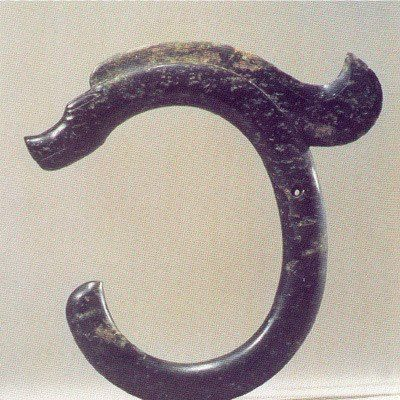
“발해연안 고대 문화 중에서 가장 큰 특징은 옥문화입니다. 고대인들의 신앙적인 마음에서 옥을 선호하고 중요하게 여긴 것으로 생각합니다. 변하지 않고 영원불멸하는 옥의 특징을 보면, 용 신앙이라든지 새 신앙이 우리 민족, 동이족과 매우 밀접한 관계가 있다고 봅니다. 우리나라 영덕 강구면 오포리에서 나온 곡옥을 보면, 그 모양에 입이 있고 구멍도 나 있어서 어떤 사람은 태아라고 하고 어떤 사람은 누에 같다고도 하지만 저는 용이라고 봤습니다. 홍산문화 대릉하 유역에 적석총이나 석관묘에서는 약 20cm의 옥이 나오는데 고리에다 끼워서 가슴에 걸었던 것으로 이 또한 용의 형상입니다“
부장품이 나온 31기의 묘 가운데, 신석기 시대 무덤에서 흔히 보이는 토기와 석기는 단 한 점도 없이 옥기만 발굴된 묘가 26기나 됩니다. 특히 제2호지점 21호 묘의 남성 인골은 옥으로 옷을 해 입은 듯합니다. 옥거북, 옥베개, 옥패, 옥벽 등 무려 20점의 옥 장식이 머리에서 발끝까지 시신을 치장하고 있습니다.
제5지점 중심 대묘에 누워 있는 남성 인골은 양 귀 밑에 옥벽, 가슴팍에 옥장식, 오른팔에 옥팔찌, 양손에 옥거북이 치장되어 있었습니다. 신령한 거북을 손에 쥐고 있는 것은 죽어서도 신과 소통하고 있음을 상징합니다. 이 무덤의 주인공은 제정일치 시대의 제사장이자 정치적 수장으로 간주됩니다. 부장품으로 옥기를 사용한 것은 옥이 변하지 않는 보석으로 영생불멸을 뜻하기 때문입니다.
[설문해자]에서 옥을 ‘오덕을 갖춘 아름다운 돌’이라 하였고, 공자는 ‘군자는 옥으로 덕을 견준다’고 하였습니다. 그리고 주역 설괘전에서는 팔괘의 첫째인 건괘의 성격을 옥으로 표현하였습니다. 그 까닭은 옥이 하늘의 빛깔과 하나님의 신성을 상징하기 때문입니다. 그래서 홍산인들은 옥을 고귀한 신분을 나타내는 장신구, 신과 소통하는 신물, 천제에 사용하는 제기 등의 소재로 사용하였습니다.
흔히 고대를 석기-청동기-철기의 3단계로 구분합니다. 하지만 발해연안 영역에서 옥기로 뒤덮인 수천 년의 유적지가 대량 발굴됨에 따라 중국학자들은 청동기 이전에 옥기 시대를 설정해야 한다고 주장하고 있습니다.
고대 동북아의 옥은 홍산 문화보다 더 오래된 흥륭와 문화(BCE6200~BCE5200)에서 발견되기 시작합니다. 내몽골의 자치구의 오한기에 위치한 흥륭와촌에서 세계 최초의 옥결玉玦(옥 귀걸이)이 발굴되었습니다. 이 옥결에 사용된 옥은 요동반도의 수암에서 나온 수암옥입니다. 수암은 흥륭와촌에서 동쪽으로 450km나 떨어진 곳으로 압록강에서 멀지 않습니다. 당시 만주의 동쪽에서 난 옥을 서쪽으로 가져가 옥제품으로 가공할 만큼 만주의 동서가 서로 긴밀한 관계를 맺고 있었던 것입니다.
그런데 흥륭와문화와 비슷한 시기에 만들어진 옥결이 한반도 동해안과 남해안지역에서 발견되었습니다. 특히 강원도 고성군 문암리 선사유적지의 옥결은 그 외양이 흥륭와문화의 그것과 아주 유사합니다. 이러한 유사성은 BCE6천 년 경부터 요서, 요동, 한반도가 하나의 문화권이었음을 뜻합니다. 그리고 흥륭와문화에서 시작된 옥 문화가 후대의 홍산문화에서 더욱 다양하고 화려해진 점은, 하나의 연속된 문명이 3,4천 년 동안 지속적으로 발전을 거듭하였음을 보여줍니다
홍산문화의 옥기 유물을 보면 재질은 수암옥(청황옥)이 대부분인데 그 색상은 천연 옥색만 있는 것이 아니라 도료와 같은 것으로 채색을 한 것도 있습니다. 검은색의 흑피옥도 출토되었는데, 흑피옥은 중국의 신석기 유적에서는 출토된 바가 없습니다. 요컨대 홍산문화는 동북아 신석기 문화의 최고봉으로서 중국 한족의 것과는 계통이 전혀 다른 문화입니다. 오히려 그들 문화에 지대한 영향을 끼친 환단시대 배달 동이족의 독자적인 문화인 것입니다.
시베리아과학원의 고고학자 세르게이 알킨 교수도 홍산문화의 독자성에 대해 “홍산문화는 중원문화에 많은 영향을 끼쳤지만 중원 문화가 홍산문화에 영향을 주었다고 보기는 어렵다”라고 주장하였습니다. 그리고 용 문화에 대하여 “중국의 용 문화는 독자적으로 발생하지 않았다. 고대 중국의 기록을 보면 북방 이민족 가운데 용 토템으로 하는 민족도 있었다고 하는데, 바로 홍산문화의 주인공들을 이야기하는 것이다”라고 구체적으로 밝혔습니다
홍산문화는 환단 시대를 인정하지 않고서는 올바르게 해석할 수 없습니다. 환국.배달.고조선이라는 동북아 시원역사를 인정해야 홍산문화를 포함한 발해연안의 그 엄청난 유적과 유물을 해석할 수 있는 것입니다.
[왜 홍산문화를 알아야 하는가]
이렇게 유적과 유물이 대부분 ‘사상 처음’이고 ‘인류사 최고’인 홍산문화를 중국은 황하문명보다 2~3천 년 앞선 황화문명의 원류로 규정하였습니다. 그런데 황하문명의 원 뿌리가 오랭캐 땅이라 치부하던 만리장성 이북에서 발견되었다는 점이 중국을 곤혹스럽게 만들었습니다. 중국은 이 난처함을 다민족 역사관으로써 해결하였습니다. 한족과 55개 소수민족으로 이뤄진 중국 땅에서 발견되는 소수민족의 문화와 역사는 모두 중국의 문화와 역사라는 것입니다.
현재 중국은 홍산문화를 요하문명이란 이름으로 전 세계에 소개하면서 중국을 이집트, 메소포타미아, 인더스 문명보다 앞서는 세계 最古 문명국으로 내세우고 있습니다. 환단 시대의 한민족 문화를 자신들의 문화로 둔갑시켜 이제 경제대국에서 문화대국까지 꿈꾸는 것입니다.
중국이 미래의 중심 국가 되려는 야망을 노골적으로 드러내고 있는 이때, 환단시대를 인정하지 않는 한국의 강단사학자들은 홍산문명에 대해 침묵하거나 우리 역사와 관계없는 것으로 부정하고 있는 실정입니다. 한민족, 특히 이 땅의 젊은이들이여, 거짓 역사의 미몽에서 깨어나 잃어버린 시원 역사와 문화를 되찾읍시다! 그것만이 역사의 정의를 회복하는 대도의 길입니다.
————–
[The World’s Finest Jade Culture]
The revelation that the Hongsan Culture developed a complex, state-level civilization over 6,000 years ago was shocking enough to rewrite humanity’s creation story. Yet, what truly astonished the world was its refined and diverse jade culture. Particularly notable were the jade burial artifacts unearthed in tombs along the Bohai coast. On this subject, Hyung-gu Lee offered the following insights:
“The most prominent characteristic of the ancient cultures along the Bohai coast is their jade culture. The ancient people valued jade deeply, likely for spiritual reasons. Jade’s immutable and eternal qualities align with their reverence for dragons and birds, which were closely tied to the Dongyi people and our ancestors. Consider the curved jade ornament unearthed in Opo-ri, Ganggu-myeon, Yeongdeok, South Korea. Some interpret it as a fetus, others as a silkworm, but I see it as a dragon. Similarly, the 20 cm jade pieces discovered in stone cairns and stone coffin tombs of the Daling River region were likely worn on the chest, also resembling dragons.”
Out of 31 excavated tombs containing burial artifacts, 26 included only jade objects, with no pottery or stone tools typically found in Neolithic burials. In particular, Tomb 21 at Site 2 contained the remains of a male adorned as though wearing a robe of jade. The body was decorated with over 20 jade artifacts, including jade turtles, jade pillows, jade pendants, and jade discs, from head to toe.
In Tomb 5, the central grand tomb, another male skeleton was adorned with jade discs beneath each ear, a jade decoration on the chest, a jade bracelet on the right arm, and jade turtles in both hands. Holding a sacred turtle symbolized communication with the divine even in death. This tomb’s occupant is presumed to have been a priest-king of the theocratic era, simultaneously serving as a spiritual and political leader. The use of jade as burial artifacts signified eternal life and the belief in immortality due to jade’s unchanging nature.
In Shuowen Jiezi (an ancient Chinese dictionary), jade is described as “a beautiful stone embodying five virtues.” Confucius stated, “A gentleman uses jade to symbolize virtue.” The I Ching (Book of Changes) refers to the characteristics of the Qian hexagram—the first of the eight trigrams—as being like jade. This is because jade symbolizes the light of heaven and the divinity of God. Consequently, the Hongsan people used jade as adornments for the elite, sacred objects for communicating with deities, and ritual vessels for heavenly offerings.
[A Pre-Bronze Jade Age]
Traditionally, ancient history is divided into the Stone Age, Bronze Age, and Iron Age. However, the extensive jade relics unearthed along the Bohai coast have led Chinese scholars to propose an additional Jade Age preceding the Bronze Age.
Jade artifacts in Northeast Asia predate the Hongsan Culture, originating in the Xinglongwa Culture (circa 6200–5200 BCE). The world’s first jade ring pendant was discovered in Xinglongwa Village in Inner Mongolia. The jade used for this pendant was sourced from Xiuyan in the Liaodong Peninsula, located 450 km east of Xinglongwa near the Yalu River. This indicates a robust cultural exchange between eastern and western Manchuria during this period.
Interestingly, jade pendants from a similar period have also been found along the eastern and southern coasts of the Korean Peninsula. The jade pendant excavated from the prehistoric site at Munam-ri in Goseong County, Gangwon Province, bears striking resemblance to those of the Xinglongwa Culture. Such similarities suggest that, as early as 6000 BCE, the regions of Liaoxi, Liaodong, and the Korean Peninsula formed a unified cultural zone. The jade culture that began in Xinglongwa flourished into the highly sophisticated jade artistry of the Hongsan Culture, illustrating the continuous development of a single civilization over 3,000 to 4,000 years.
Hongsan jade artifacts are primarily composed of Xiuyan jade (green-yellow jade), although some were colored using paint-like substances. Black jade (heipi yu) has also been discovered, a type absent from Chinese Neolithic sites. This distinction highlights the Hongsan Culture as the pinnacle of Northeast Asia’s Neolithic period, representing a cultural lineage entirely distinct from the Han Chinese civilization. In fact, the Hongsan Culture was an independent culture of the Dongyi people from the Hwandan era, profoundly influencing the cultures of its neighbors.
Sergey Alkin, an archaeologist at the Siberian Academy of Sciences, emphasized the uniqueness of the Hongsan Culture:
“The Hongsan Culture significantly influenced Central Chinese civilizations, but it is difficult to argue that the reverse is true. Regarding dragon culture, ancient Chinese texts note northern ethnic groups with dragon totems. These records likely refer to the creators of the Hongsan Culture.”
The Hongsan Culture cannot be accurately interpreted without acknowledging the Hwandan era. Recognizing the foundational histories of Hwan Guk, Baedal, and Gojoseon is essential to understanding the vast archaeological discoveries of the Bohai coastal region, including those of the Hongsan Culture.
[Why Understanding Hongsan Culture Matters]
Despite being home to many of the “world’s first” and “humanity’s greatest” cultural artifacts, the Chinese government has designated the Hongsan Culture as the precursor to the Yellow River Civilization, predating it by 2,000 to 3,000 years. This poses a significant challenge to China, as the root of its civilization was discovered north of the Great Wall, in what was once considered “barbarian land.” To reconcile this, China adopted a multi-ethnic historical perspective, claiming that the cultures and histories of all ethnic minorities within its borders belong to Chinese civilization.
Today, China introduces the Hongsan Culture to the world as the “Yanghe Civilization,” presenting itself as the oldest civilization, surpassing Egypt, Mesopotamia, and the Indus Valley. In doing so, China is co-opting the culture of the Korean people from the Hwandan era to bolster its aspirations of becoming not only an economic superpower but also a cultural powerhouse.
At a time when China openly displays its ambition to become a global leader, Korean academic historians remain silent or deny any connection between the Hongsan Civilization and Korean history.
Korean people, especially the youth, must awaken from the illusions of distorted history and reclaim the origin of our heritage and culture. This is the only path to restoring historical justice.