중용 제3장에서 공자께서 말하길…
“중용, 그것은 지극하도다! 그러나 백성들이 너무도 그것을 오래 실천하지 못하는구나!”
민선능구(民鮮能久)에서 ‘능구(能久)’란 오래 지속한다는 말을 의미한다. 한마디로 끈질긴 힘이다. 습관이란 같은 행동을 오래동안 반복하여 몸이 익숙해지는 것이라고 했다. 나는 이런 점에서 중용에서 나오는 ‘능구’란 말이 습관과 같은 맥락이라고 생각한다.
그렇다면 얼마나 오래 지속을 해야 습관이 형성될까?
공자는, 그의 제자 안회가 공부함에 있어 3개월을 절대 어기는 법이 없다고 말했는데, 공자 본인도 1개월을 지속하기도 어렵다고 말했다. 공자는 안회의 끈질김이 매우 훌륭하다고 칭찬을 하면서, 3개월이란 측면을 강조한 것이다.
1년도 아니고, 6개월도 아니고, 고작 3개월이다. 중용을 실천하는데 3개월의 노력이면 누구나 중용의 도를 깨우칠 수가 있다는 것인데, 사람들이 그 3개월을 견디지 못하는 것이다. 공자 스스로도 그리 하지 못한다고 했으니 말이다.
어쩌면 중용의 실천이 어려워서 그럴지도 모르겠다. 그럼 우리가 일상 생활에서 좋은 습관을 들이기 위해선 얼마나 오래 지속해야만 할까?
런던대학 (University College London)에서 사람들이 얼마나 자동적으로 반복 행동하게 되는가에 대해 아래와 같이 습관에 대한 연구를 실시하였다. 그리고 나서 사람들이 과연 습관이 형성되었는지를 확인하기 위해 아래와 같은 설문 조사를 하였다.

그 결과 연구에 참여한 사람들이 습관을 형성하는데 걸린 평균 기간이 고작 66일뿐이 안된다고 밝혀졌다. 즉, 이번 연구를 통해, 행동을 충분히 오랫동안(66일 이상) 반복하기만 하면 습관은 자동적으로 만들어진다는 것을 알 수 있게 되었다. 공자가 말한 3개월도 되지 않는다.
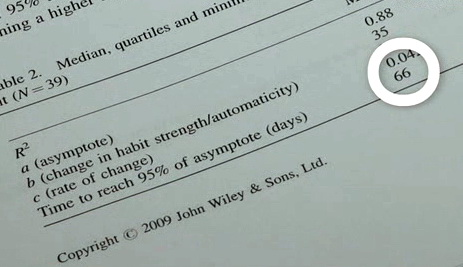
66일간의 지속적이고 반복적인 행동과 노력이라면, 이제 우리는 얼마든지 좋은 습관을 새롭게 형성할 수 있는 것이다.
지금 나의 모습은 과거 나의 습관의 결과이고, 지금 나의 습관은 미래의 나의 모습이 될 것이다. 그렇다면 장래의 나를 위하여 과연 지금 우리는 어떤 습관을 만들어야 할까? 깊이 생각해야 할 일이다.
———-
In Chapter 3 of the Doctrine of the Mean (Zhongyong), Confucius states:
“The Doctrine of the Mean is profound indeed! Yet how rarely people manage to practice it consistently for long.”
The term “Neng Jiu(能久)” in “Min Xian Neng Jiu (民鮮能久)” refers to the ability to persist over time, or in simpler terms, enduring perseverance. Habits, as commonly understood, are formed through repetitive actions until they become second nature. From this perspective, the “Neng Jiu” mentioned in the Doctrine of the Mean resonates closely with the concept of habit formation.
Confucius once remarked that his disciple, Yan Hui, maintained his commitment to learning and moral practice without deviation for three months—a feat that even Confucius admitted was challenging for himself to achieve for a single month. By praising Yan Hui’s steadfastness and emphasizing the period of three months, Confucius highlighted the importance of sustained effort over time.
It’s worth noting that the period Confucius mentioned was not a year or even six months—just three months. In other words, Confucius suggested that anyone could grasp and embody the principles of the Doctrine of the Mean with consistent practice for three months. Yet, as Confucius himself admitted, enduring even this relatively short period of time proved difficult for many.
Perhaps the difficulty lies in the profound and nuanced nature of the Doctrine of the Mean. But what about forming good habits in our daily lives? How long must we persevere to make positive changes stick?
A study conducted at University College London investigated how long it takes for people to perform repeated actions automatically—essentially, how long it takes to form habits. Participants were surveyed to assess whether certain behaviors had become habitual.
The results revealed that, on average, it took only 66 days for participants to form a habit. This means that with sustained repetition of a behavior for just over two months (less than the three months Confucius mentioned), one can successfully develop new habits.
With 66 days of consistent effort, anyone can cultivate good habits. This principle reminds us that our current state reflects the habits we have formed in the past, and the habits we practice today will shape the future version of ourselves.
This prompts a critical question: What kind of habits should we form today to become the person we aspire to be in the future? It is a question worth pondering deeply.