3. 치우천황은 황제헌원을 굴복시키고 서방 한족에게 동방의 신교와 천자 문화를 전해 준 대제왕으로서 兵法의 鼻祖입니다. 한고조 유방이 풍패에서 병사를 일으킬 때 치우천황께 제사를 지냈습니다. 유방이 동이족은 아니지만 풍패에 치우천황께 제사를 지내는 풍속이 있었기 때문에 그 풍속에 따랐던 것입니다.
“유방이 풍패에서 군사를 일으킬 때 치우씨에게 제사를 지냈다” [포박자]
규원사화에서는 이렇게 말하고 있습니다. “병주는 치우씨에게 제사를 지내니, 치우씨는 만대에 걸쳐 굳세고 용감한 군사의 조상이다”[규원사화-단군기]
“지금 한서-지리지에 따르면 치우의 묘는 동평군 수장현 궐향성에 있으며 높이는 5장이라 한다. 진한 시대에 주민들이 항상 10월이면 제사를 지냈는데, 반드시 붉은 기운이 진홍색 비단처럼 뻗치므로 이를 치우기라 불렀다”[규원사화-태시기]
황람에 “치우의 묘는 동평군 수장현 궐향성에 있으며 높이는 7장이다. 백성들이 항상 10월에 제사를 지냈는데, 붉은 기운이 진홍색 비단처럼 뻗치므로 이를 치우기라 불렀다“라고 하였다[사기집해]
“천주는 삼신에게 제사를 지내고 병주는 치우천황에게 제사 지내니, 삼신은 천지만물의 조상이시며 치우는 만고에 없는 무신용간의 비조이시다.” [환단 고기-신시본기]
“치우기는 혜성(살별)과 비슷하나 뒤가 굽어 그 모습이 깃발과 같다. 이 별이 나타나면 임금이 사방을 정벌한다“[사기-천관서]
“치우기는 혜성(살별)과 비슷하나 뒤가 굽어 그 모습이 깃발과 같다. 이 별이 나타나는 지방에서는 전쟁이 크게 일어난다“[진서-천문]
주 나라 혁명의 일등 공신이며 병법의 중시조인 동이족의 재상 강태공도 제 나라에 왕으로 분봉된 뒤 팔신께 제사를 올리면서 치우천황을 병주로 모셨습니다. 팔신은 천주, 지주, 병주, 양주, 음주, 월주, 일주, 사시주를 말합니다. 천주는 천지만물의 조상인 삼신상제님을 병주는 병가의 원시조인 치우천황을 뜻합니다(사기-봉선서)
이후 진. 한 대에 이르기까지 동이족과 한족은 10월에 치우천황의 능에서 제사를 지냈는데 그때마다 붉은 기운이 뻗쳐올랐는데, 그 붉은 기운을 치우기라 불렀습니다(사기집해)
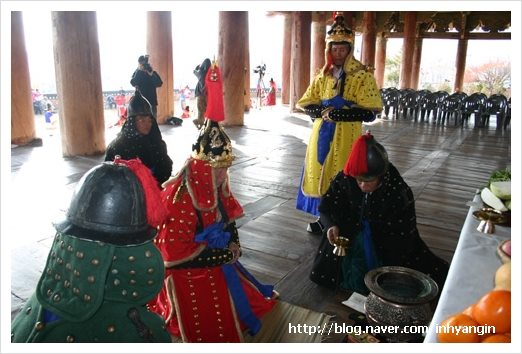
조선시대에는 둑제(纛祭)를 지냈는데, 둑은 임금의 가마 또는 군대의 대장 앞에 세우는 기를 말합니다. 둑제란 고대로부터 전쟁의 승리를 기원하기 위해 군신 치우를 상징하는 깃 발에 제사를 올리는 의식입니다.
치우의 머리를 형상화한 둑기는 소의 꼬리나 검은 비단으로 만들어 대조기라고도 불렀습니다. 조선은 둑제를 국가제사인 소사의 하나로 정비하고 전국에 둑소를 마련하여 매년 정기적으로 제사를 지냈습니다. 둑제는 서울과 각 지방의 병영.수영에서 각각 시행하였습니다.
이순신 장군은 난중일기에 전쟁 중 둑제를 세 차례 거행하였다고 기록했습니다. 서울의 뚝섬에는 원래 둑제를 지내던 둑신사가 있었는데, 뚝섬이라는 이름은 이 둑신사에서 비롯된 것입니다. 둑신사에는 높이 6자 폭 36자의 벽화가 있었는데, 치우천황과 황제헌원의 싸움인 탁록대전을 그린 그림으로 일제 말기까지 있었으나 분실되었다고 합니다.
———————–
- Chiwoo Cheonhwang was the great emperor who subdued the Yellow Emperor Xuanyuan and conveyed the Eastern divine teachings and imperial culture to the Han people of the West, and he is regarded as the progenitor of military strategy (bingfa). When Liu Bang, the founder of the Han Dynasty, raised troops at Fengpei, he offered sacrifices to Chiwoo Cheonhwang. Though Liu Bang himself was not of Dongyi origin, the custom of worshipping Chiwoo existed in Fengpei, and he followed this tradition.
“When Liu Bang raised an army at Fengpei, he sacrificed to Chiwoo.” (Baopuzi)
The Gyuwon Sahwa states:
“Bingju offered sacrifice to Chiwoo, for Chiwoo is the eternal forefather of steadfast and valiant warriors.” (Gyuwon Sahwa – Dangun-gi)
It also records:
“According to the Hanshu – Treatise on Geography, the tomb of Chiwoo was at Guelhyang Fortress in Suchang County, Dongpyeong Commandery, rising five jang in height. During the Qin and Han dynasties, the people always held sacrificial rites there in the tenth month, and invariably a red aura stretched forth like scarlet silk, which they called ‘Chiwoo-gi.’” (Gyuwon Sahwa – Taesi-gi)
Similarly, the Huanglan states:
“The tomb of Chiwoo was at Guelhyang Fortress in Suchang County, Dongpyeong Commandery, seven jang in height. The people always held sacrifices in the tenth month, and a red aura stretched forth like crimson silk, so they called it ‘Chiwoo-gi.’” (Collected Commentaries on the Shiji)
The Hwandan Gogi records:
“Tianzhu is the sacrifice to the Three Divine Spirits, and Bingzhu is the sacrifice to Chiwoo Cheonhwang. The Three Divine Spirits are the progenitors of all things in heaven and earth, while Chiwoo is the unparalleled forefather of military might and valor.” (Hwandan Gogi – Annals of Shinshi)
The Shiji – Tian Guan Shu describes:
“The Chiwoo star resembles a comet but with a bent tail, resembling a banner. When this star appears, the sovereign campaigns on all sides.”
The Jinshu – Astronomy echoes:
“The Chiwoo star resembles a comet but with a bent tail, like a banner. When it appears in a region, great wars erupt.”
Jiang Taigong, the famed Dongyi statesman, founding hero of the Zhou revolution, and patriarch of military strategy, was enfeoffed as King of Qi. There he offered sacrifices to the Eight Spirits, among whom he revered Chiwoo Cheonhwang as Bingzhu. The Eight Spirits are Tianzhu (Lord of Heaven), Dizhu (Lord of Earth), Bingzhu (Lord of War), Yangzhu, Yinzhu, Yuezhu, Rizhu, and Shizhu. Tianzhu signifies the Three Divine Spirits, progenitors of all creation, while Bingzhu refers to Chiwoo Cheonhwang, the primal ancestor of the military tradition. (Shiji – Fengshan Shu)
Throughout the Qin and Han dynasties, both the Dongyi and the Han people held annual rites at Chiwoo’s tomb in the tenth month. Each time, a red aura would rise, called Chiwoo-gi. (Collected Commentaries on the Shiji)
During the Joseon Dynasty, the dukje (纛祭) was performed. A duk was a banner placed before the king’s palanquin or the commander-in-chief’s army. The dukje was a ritual of offering sacrifice to the war deity Chiwoo, symbolized by the banner, to pray for victory in battle.
The dukgi, modeled after Chiwoo’s head, was made from an ox’s tail or black silk, and was also called the daejogi. Joseon institutionalized the dukje as one of the national rites under the category of sosa, establishing shrines across the country where annual sacrifices were offered. The dukje was conducted at military garrisons both in Seoul and in the provinces.
Admiral Yi Sun-sin recorded in his Nanjung Ilgi that he conducted the dukje three times during the war. In Seoul’s Ttukseom, there originally stood the Duk Shrine, where the ritual was held. The name Ttukseom itself derives from this shrine. The shrine contained a mural, six ja high and thirty-six ja wide, depicting the Battle of Zhuolu between Chiwoo Cheonhwang and Xuanyuan. This mural remained until the late Japanese colonial era, when it was lost.