Episode 14 : 돈은 사는 데 필요한 도구일 뿐이다.
옛날에는 사람이 사는 데 필요한 것들을 자연에서 거저 얻었습니다. 물가에 사는 사람은 물고기를 잡아먹고, 산에 사는 사람은 사냥을 해서 살았고, 조금씩 발전해서 농작물을 심어서 먹게 되었습니다. 스스로 얻을 수 없는 것이라면 내 것과 남의 것을 바꾸는 물물교환을 했겠지요.
결국에는 돈이라는 것이 만들어지고 이를 통해 교환물의 가치를 비교하고 결정하는 세상이 되었지만 요즘처럼 금본위주의가 해체되면서는 돈이라는 물건에는 실상 가치가 존재하지 않게 됩니다. 단지 모든 사람이 가치가 있다고 믿고 있을 뿐입니다. 그리고 돈은 그저 물건 등을 교환할 수 있는 도구로만 활용되고 있습니다.
이 도구는 우리가 살아있는 동안에는 매우 활용도가 높지만 삶이 끝나면 아무짝에도 쓸모 없는 물건일 뿐입니다. 또한 이 도구가 많다고 해서 더 오래 살 게 되거나 하는 것도 아닙니다. 돈은 그저 살아가는 데 필요한 도구일 뿐 그 이상도 이하도 아니라는 것입니다.
그래서 돈에 대한 근거 없는 욕심이 아니라 살아가는 데 필요한 돈을 잘 관리하고 활용하는 데 초점을 맞추지 못하면 우리 삶은 항상 불행할 수밖에 없을 것입니다.
Episode 15 : 고인 돈은 썩는다.
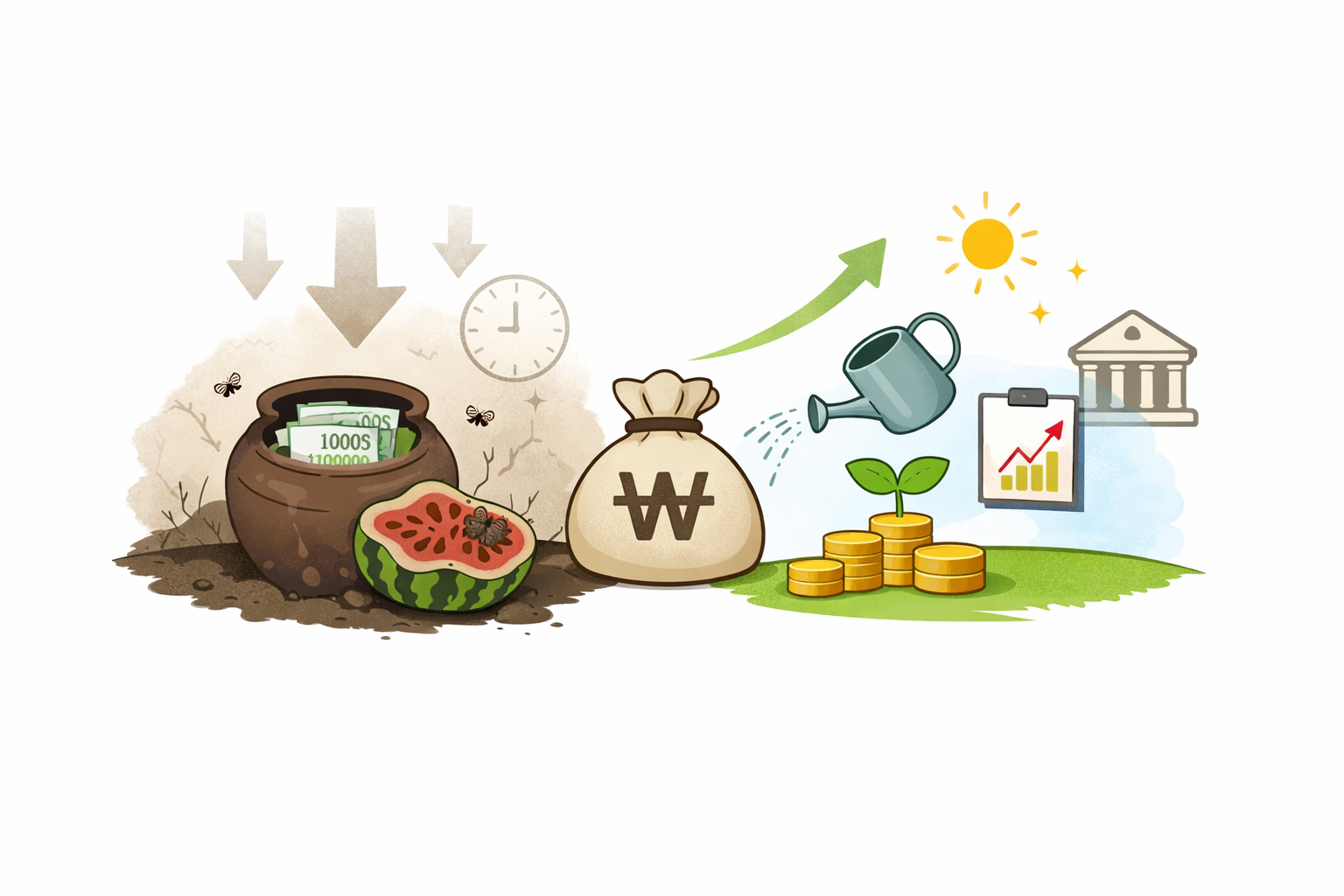
십 년 전에 저는 100만원을 장독에 넣어 두었습니다. 그 때는 100만원으로 수박을 100통 살 수 있었습니다. 오늘 저는 장독에서 100만원을 꺼내어 시장에 갑니다. 그런데 그 돈으로 수박을 사려고 하니 50통밖에 못 산답니다.
왜일까요?
지나 온 십 년 동안의 물가상승율로 수박의 가격이 올랐고, 결국 그 만큼 돈의 가치가 하락했기 때문이지요? 물가상승율이 연 7%라면 10년 후 100만원의 가치는 50만원 정도의 가치로 하락하고, 연 5%라면 70만원 정도의 가치로 하락할 것입니다.
우리가 매일 소중하게 써야 하는 돈은 이제 가치가 있는 물건이 아닙니다. 쓰지 않고 묻어둔다면 하루하루 가치가 하락하는 도구일 뿐이지요. 그래서 매일매일 어떻게 하면 돈을 제 가치를 가지고 쓸 수 있는 지를 고민해야 하지요.
돈도 자동차처럼 매일 닦고 조이고 기름칠을 해야 그 가치가 유지되는 관리의 대상일 뿐입니다. 이런 관리를 하는 곳이 바로 금융입니다. 금융업과의 거래를 통해 우리는 돈의 가치를 보존하고 나아가서 가치를 상승시키고 항상 필요한 때에 쓸 수 있는 준비를 해야 하는 것입니다.
하지만 우리는 돈을 잘 활용할 방법에 대해서 잘 모르거나 편견을 가지고 있지요. 하지만 고인 돈이 썩지 않도록 잘 관리할 수 있는 방법을 찾아야 하니 큰 고민이 아닐 수 없습니다.
이것이 바로 돈의 실체입니다.
처음에 돈은 그 자체로 가치를 지닌 물건이었으나 이제 돈은 그저 돌고 도는 유통수단으로 전락하고 말았습니다. 또한 금의 생산량 이상으로 많은 돈을 발행하고 이를 통해 경제의 활력과 생활수준의 향상 등 많은 부분이 발전해 온 것은 분명히 긍정적인 측면이지만 인플레이션 등 다양하고 복잡한 문제들이 돈 때문에 발생하게 되었으니 돈에 대한 실체를 명확히 규정지을 수 없게 된 것입니다.
사회가 발전하면서 돈의 개념이 모호해지고 그 흐름이 복잡해짐에 따라 돈을 유통하는 업종인 금융업도 처음의 설립목적에서 많은 변용이 생기고 분화, 통합되고 있습니다. (계속)
————–
Episode 14: Money Is Merely a Tool Necessary for Living.
In the past, people obtained what they needed to live directly from nature. Those who lived near water caught fish, those who lived in the mountains survived by hunting, and as society gradually developed, people began to cultivate and consume agricultural crops. If there was something they could not obtain on their own, they likely engaged in barter, exchanging what they had for what others possessed. Eventually, money was created, and the world became one in which the value of goods for exchange could be compared and determined through it. However, as the gold standard has been dismantled as in modern times, money itself no longer possesses intrinsic value in reality. People simply believe that it has value. And money is merely utilized as a tool for exchanging goods and similar items.
This tool is highly useful while we are alive, but once life ends, it becomes nothing more than a useless object. Moreover, having more of this tool does not mean that one will live longer. Money is simply a tool necessary for living, nothing more and nothing less.
Therefore, if we fail to focus not on groundless greed for money but on managing and utilizing the money necessary for living, our lives will inevitably remain unhappy.
Episode 15: Stagnant Money Decays.
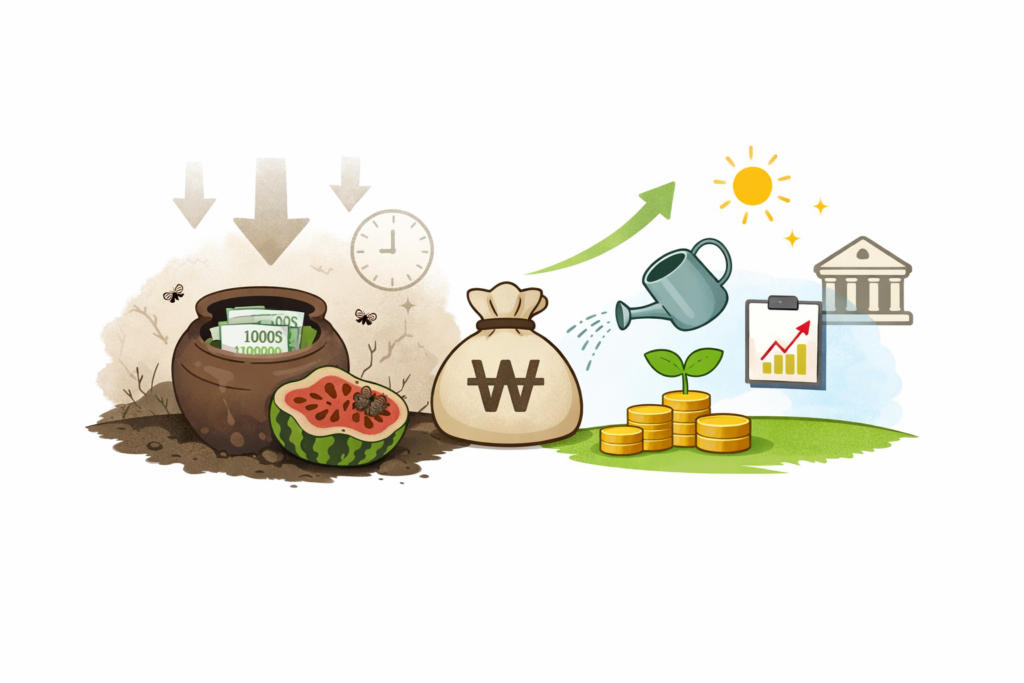
Ten years ago, I placed 1,000,000 won in a jar. At that time, 1,000,000 won could buy 100 watermelons. Today, I take the 1,000,000 won out of the jar and go to the market. However, when I try to buy watermelons with that money, I am told that I can only buy 50.
Why is that?
Because over the past ten years, the price of watermelons has risen due to inflation, and as a result the value of money has declined by that amount. If the annual inflation rate is 7%, the value of 1,000,000 won after 10 years falls to about the equivalent of 500,000 won, and if it is 5% per year, it falls to about the equivalent of 700,000 won.
The money we must use carefully every day is no longer an asset that inherently holds value. If it is buried and left unused, it is merely a tool whose value declines day by day. Therefore, we must think every day about how money can be used while preserving its proper value.
Money, like an automobile, must be cleaned, tightened, and lubricated regularly to maintain its value; it is simply an object that requires management. The place where such management occurs is finance. Through transactions with the financial industry, we must preserve the value of money, further increase that value, and remain prepared to use it whenever necessary.
However, we often do not know effective ways to utilize money well or we hold prejudices about it. Yet we must find methods to manage money so that stagnant money does not decay, and this becomes a significant concern.
This is precisely the substance of money.
At the beginning, money itself was an object that possessed intrinsic value, but now money has been reduced to merely a circulating medium of exchange. In addition, it is clear that issuing money beyond the production volume of gold has contributed positively to many aspects such as economic vitality and improvements in living standards, yet various complex issues such as inflation have arisen because of money, making it difficult to clearly define the true nature of money.
As society develops, the concept of money becomes ambiguous and its flow grows increasingly complex. Accordingly, the financial industry, which circulates money, has undergone many transformations from its original founding purpose, becoming diversified, integrated, and restructured.