Episode 18 : 보험회사의 탄생
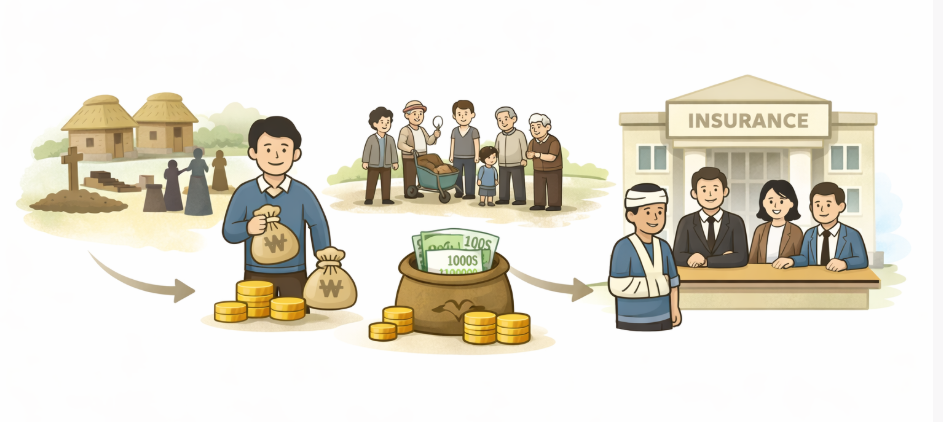
한 마을에 100명이 살고 있었습니다.
모두들 오랫동안 이 마을에서 살아오며 친분을 다진 사람들이어서 어느 집에 밥숟가락이 몇 개인지 누구네 집 강아지가 어제 새끼를 낳았는지 모두 아는 평화로운 마을이었습니다.
어느 날 마을에서 가장 존경받던 촌장님께서 돌아가셨습니다. 존경받던 분의 장례였으므로 대충대충 치를 수도 없고, 비용도 만만치 않게 들어가겠지만 온 마을 사람들이 합심하여 부조금도 걷고 이것 저것 힘든 일을 십시일반으로 도와 촌장님의 장례식을 훌륭하게 마칠 수 있었답니다.
장례식이 끝난 후 똘똘하고 의협심 강한 공명이가 이렇게 말합니다. “여러분, 이번 일에 모두 합심해서 훌륭하게 장례를 치르는 것을 보고 저는 정말 감동스러웠답니다. 그런데 앞으로는 촌장님뿐 아니라 우리 모두가 이런 일을 당하면 서로 도울 수 있도록 상조회를 만들어서 참여하면 어떨까요?”
이 마을 사람 모두가 그러면 참 좋겠다고 생각을 했지요. 그래서 상조회를 만들어 매월 만원씩 회비를 걷기로 합니다. 그러려니 자연히 회비를 걷고 지출을 집행할 사람이 한 명 필요하겠지요? 그래서 처음 의견을 낸 그 공명이가 총무를 맡게 되었습니다.
총무는 매월 정해진 날짜에 회원들에게서 회비를 걷고, 경조사가 있는 회원들에게 축하금과 부조금을 지급하는 일을 하였습니다. 물론 연말에는 지난 일 년 동안 회비를 어떻게 걷고 집행했는지 회원들에게 보고하고 모자란 돈은 조금 더 걷고, 남은 돈은 돌려주거나 해야 합니다.
그런데 시간이 흐르다 보니 상조회의 최고 노총각인 갑돌이는 기분이 나빴습니다. 왜냐하면 이미 부모도 다 돌아가시고 변변한 여자친구도 없어 남들 다 받는 결혼 축하금, 자녀 돌 반지, 부모 회갑, 칠순 등 회비는 똑같이 내는 데 자기에게 돌아오는 돈은 한 푼도 없었기 때문입니다. 조금 치사하다 싶긴 했지만 갑돌이는 공명이에게 불만을 털어 놓았답니다. 이야기를 듣고 보니 그럴 수도 있겠다 싶었던 똘똘하고 의협심 강한 공명이는 고민고민 하다가 갹출할 회비를 회원의 가족상황에 따라 차등해서 징수하기로 합니다.
그런데 문제는 총무가 해야 할 일이 무척이나 늘어난다는 것이겠지요? 똘똘하고 의협심 강한 공명이가 마을의 일을 대충대충 할 수도 없는 일이고, 그렇다고 제대로 하자니 몸이 열 개라도 모자란 지경에 이르러 이제는 매일 회원들을 볼 때마다 힘들어 죽겠다고 하소연을 하게 됩니다. 공명이의 고생을 알고 있는 회원들은 그저 고생이 많은 공명이를 다독거려 줄 수밖에 없었지요.
이제 더 큰 문제가 생깁니다. 이 마을의 상조회가 분위기 좋다고 소문이 나서 이웃동네에 사는 사람들까지 가입하게 해달랍니다. 회원은 이미 300명을 넘어가기 시작하고, 생업에 종사하며 총무를 맡아 하던 공명이가 드디어 만세를 부릅니다. 이제는 더 이상 힘들어서 못하겠다는 것이지요.
총무로 가장 적임이던 공명이가 총무를 못 하겠다고 하는 데 누가 나서서 이 힘든 일을 하겠습니까? 비상상황에 맞닥뜨린 회원들이 며칠을 머리를 맞대고 회의를 한 결과
“우리가 아예 총무에게 월급을 주자.”고 결정합니다.
회원들은 공명이에게 회비에서 일정한 비율로 월급을 주겠으니 계속 총무를 맡아 줄 것을 간청하였고, 이에 공명이는 마지못해 계속 총무를 하기로 하였답니다. 이제 공명이는 다니던 회사를 그만 두고 회원들이 낸 상조회비 중에서 일정 비율의 금액을 떼어 월급으로 가져가고 남은 돈으로 상조회의 돈을 운용합니다.
마을사람들로부터 사랑받고 있다는 기쁨과 회원이 많아질수록 월급이 늘어날 것이므로 당연히 더 많은 회원을 모집하고 더 좋은 상조회를 만들기 위해 온 힘을 다 합니다. 하지만 점점 더 회원이 늘어 이제 500명이 되자, 이제 똘똘한 공명이도 더 이상은 혼자 할 수 없을 것 같습니다.
그래서 공명이가 중대 결심을 내립니다.
“여러분 우리 이러지 말고 사람을 좀 더 씁시다. 회원이 늘어서 여러분이 내신 회비에서 갹출하는 금액이 이제 3명분의 월급이 될 것 같습니다. 그래서 제가 2명을 고용해서 아예 회사를 만들었으면 합니다.”
마을사람들은 그렇게 해도 지금과 별 차이가 없었겠지요. 그래서 이구동성으로 총무가 하고 싶은 데로 하라고 수락해 주었지요.
이렇게 상조회가 상호회사(Mutual Company)가 되었습니다.
상호회사는 모든 회원이 주인인 회사이므로 일은 월급쟁이 총무가 다 하지만 손실을 보면 회원들이 조금씩 더 회비를 내고, 이익이 남으면 모두에게 돌려주는 상조회와 똑같은 형태의 회사입니다.
일반적인 보험회사의 형태가 바로 이 상조회와 같다는 것을 여러분은 아십니까? 원칙대로 라면 보험회사는 금융회사가 아니라 상조회일뿐입니다. 회원들이 회비를 내면 일부분을 상조회를 운영하기 위한 경비로 쓰고 손해가 나면 회비를 조금 더 내고 이익이 남으면 모두에게 돌려주는 상조회. 보험회사는 바로 이렇게 출발한 금융회사인 것입니다.
보험회사는 회원이 납입하는 회비(보험료)에서 일정 부분(부가보험료)을 월급으로 쓰고, 나머지(순보험료)를 운용하여 보험금으로 지급하는 금융회사입니다.
많은 오해가 있지만 회원들에게서 받은 회비를 운용하여 이익이 남으면 돌려주고(배당), 손실을 보면 회비를 더 걷는 아름다운 상조회지요. (계속)
————–
In a certain village, 100 people lived together.
They had all lived in the village for a long time and had built close relationships with one another. It was a peaceful village where everyone knew how many spoons each household had and even knew that someone’s dog had given birth to puppies the day before.
One day, the most respected village chief passed away. Because he was such a respected person, the funeral could not be conducted carelessly, and although the expenses were considerable, all the villagers worked together—collecting condolence money and helping with various tasks—and were able to hold a proper funeral ceremony for the chief.
After the funeral, a clever and righteous man named Gongmyeong spoke up.
“Everyone, I was truly moved to see how we all came together to hold such a wonderful funeral. But what if, from now on, not only for the chief but for any of us, we create a mutual aid association so that we can help each other when such events occur?”
All the villagers thought that would be a great idea. So they created a mutual aid association and decided to collect a membership fee of 10,000 won every month. Naturally, someone was needed to collect the fees and manage the expenditures, so Gongmyeong, who had proposed the idea, became the treasurer.
The treasurer collected the monthly fees from members on a fixed date and paid congratulatory gifts and condolence money to members who had family celebrations or mourning events. At the end of the year, he also reported to the members how the fees had been collected and spent during the year, collecting additional money if there was a shortage or returning the remaining balance.
As time passed, however, the village’s oldest bachelor, Gapdol, began to feel unhappy. His parents had already passed away, and he did not even have a proper girlfriend. Although he paid the same membership fee as everyone else, he never received any benefits such as wedding gifts, a baby’s first-birthday ring, or support for parents’ milestone birthdays like their 60th or 70th. Although he felt it might seem petty, Gapdol eventually expressed his dissatisfaction to Gongmyeong. After listening, Gongmyeong realized that the concern was reasonable. After much thought, he decided to adjust the membership fees according to each member’s family circumstances.
However, this created another problem. The amount of work the treasurer had to do increased tremendously. Gongmyeong could not handle the village’s affairs carelessly, but doing everything properly made it feel as though even ten bodies would not be enough. Eventually, he began to complain every day that the work was overwhelming. The members, who knew how hard he was working, could only console him.
Then an even bigger problem arose. News spread that the village’s mutual aid association had such a great atmosphere that people from neighboring villages asked to join as well. Membership quickly exceeded 300 people, and Gongmyeong—who had been managing the association while maintaining his own job—finally declared that he could no longer continue because it had become too exhausting.
Since Gongmyeong, the most suitable person for the role, said he could no longer continue as treasurer, who else would volunteer for such a demanding job? Facing this emergency situation, the members held several meetings and finally reached a decision:
“Let’s simply pay the treasurer a salary.”
The members asked Gongmyeong to continue serving as treasurer, promising to pay him a salary based on a certain percentage of the membership fees. Gongmyeong reluctantly agreed to continue. He then quit his job and began to take a portion of the membership fees as his salary while managing the remaining funds for the mutual aid association.
Because he was happy to be loved by the villagers and because his salary would increase as membership grew, Gongmyeong worked even harder to recruit more members and improve the association. However, when the number of members eventually reached 500, even the capable Gongmyeong realized he could no longer handle everything alone.
So he made an important decision.
“Everyone, instead of continuing like this, let’s hire more people. Now that membership has increased, the portion of fees collected from all of you would be enough to pay salaries for three people. I propose hiring two additional staff members and formally establishing a company.”
For the villagers, this would not change much from the current situation, so they unanimously agreed and told Gongmyeong to proceed as he saw fit.
In this way, the mutual aid association became a Mutual Company.
A mutual company is a company owned by all its members. Although salaried managers run the operations, if losses occur the members contribute additional fees, and if profits remain they are returned to the members—essentially the same structure as the mutual aid association.
Did you know that the typical structure of an insurance company is exactly like this mutual aid association? In principle, an insurance company is not merely a financial institution but essentially a mutual aid association. Members pay contributions, a portion is used as operating expenses, losses are covered by collecting additional contributions, and any profits are returned to members. Insurance companies originated from this very structure.
An insurance company is a financial institution that uses part of the members’ contributions (insurance premiums) as operating expenses (loading premiums) and manages the remaining portion (net premiums) to pay insurance claims.
Although there are many misunderstandings, insurance companies originally functioned as a beautiful mutual aid system—operating with members’ contributions, returning profits to members as dividends when gains occur, and collecting additional contributions when losses arise.