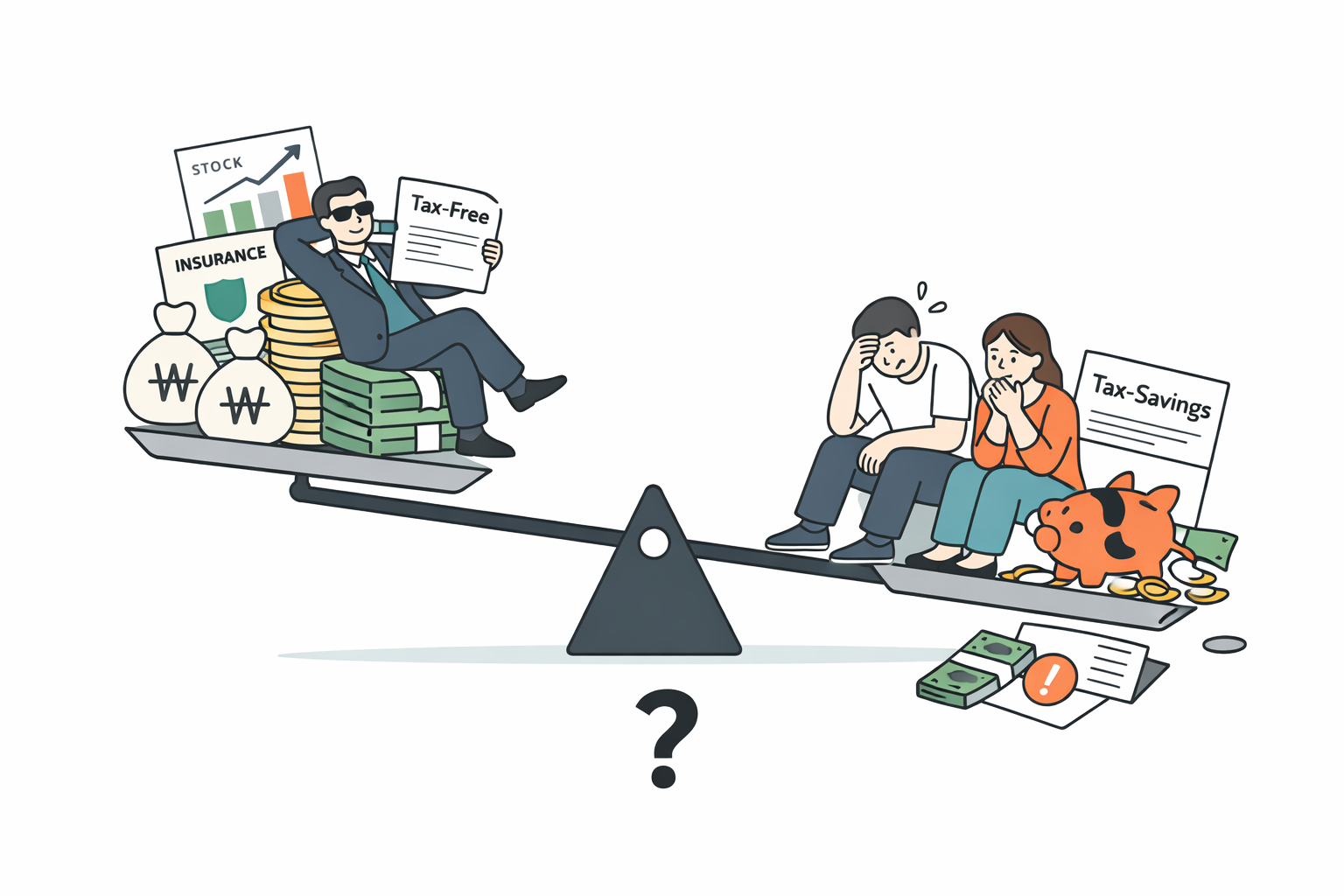
연 5% 이자율의 비과세 상품은 100만원을 넣어두면 1년 후에 5만원의 이자를 받습니다. 연 6% 이자율의 일반과세상품은 6만원의 이자를 받지요.
우리나라는 이자소득에 대해 15.4%의 세금(14%의 소득세와 1.4%의 주민세)을 부가하는 데, 5%의 비과세상품에 대해서는 세금이 없지만, 6%의 과세상품에 대해서는 이자 6만원의 15.4%인 9,240원의 세금을 내야 합니다.
결국 5% 비과세 상품의 경우 105만원을 찾게 되고, 6% 과세상품의 경우 105만 760원을 찾게 됩니다. 어느 것이 더 이익인 상품일까요?
일반적으로 이자 소득세를 면제해 주는 비과세 상품은 은행의 장기적금이거나 생계형 저축상품, 증권회사의 주식(주식은 이자를 주는 상품이 아니므로 이자소득세의 대상이 아니지만 편의상 언급하도록 하겠습니다.), 보험회사의 장기저축상품입니다.
절세상품은 금융기관에서 주는 혜택이 아니라 오랫동안 이 돈을 찾지 않고 장기간 저축하겠다고 약속하는 사람에게 국가에서 주는 혜택입니다. 물론 일반 소비자가 이런 상품의 가입을 통해 아주 작은 차이만큼 이익을 볼 수도 있지만(실제로 생계형 저축의 경우 일정한 조건 하에서 우대금리를 조금 더 주기도 합니다.), 문제는 그 상품의 이익과 손실을 정확히 알고 가입하는 사람보다는 모르고 가입하는 사람들이 훨씬 많다는 것입니다.
특히 생활의 형편이 어려운 사람일수록 급하게 돈 쓸 일이 자주 발생하는 데 이런 경우 가입한 절세상품을 해지하는 것은 큰 손실을 가져온다는 것입니다. 절세상품은 해지하게 되면 그 동안의 절세 혜택뿐 아니라 계약 위반에 대한 손실까지 부담해야 하는 경우가 많습니다.
어쩌면 생활이 어려운 사람들에게 장기 절세 상품의 가입을 통해 목돈을 마련하고 재활의 의지를 심어줄 수 있다는 측면에서 좋은 부분도 있지만 그런 것 보다는 한참 뒤에 쓸 돈을 저축하기 위해 현재의 삶을 더 궁핍하게 만드는 문제가 더 크다고 저는 생각합니다,
게다가 대부분 갑작스런 생계의 어려움은 유지하던 절세상품을 해지하게 만들고, 이런 경우에 봉착하면 사람들은 자기 잘못이라고 느끼게 되고, 자신의 무능을 탓하게 마련입니다. 생활이 곤란한 사람들이 무리한 저축을 하게 되고, 그로 인해 더 어렵게 생활하게 되지만 결국은 저축도 제대로 못하게 되는 상황이 된다는 것이지요.
실제로 이런 절세 상품은 서민을 위한 것이 아니라 부자들을 위한 상품이랍니다. 왜냐하면 절세상품에서 발생한 수익은 금융종합과세에서 제외한다는 것이지요.
금융소득 종합과세란 이자소득이 연 4,000만원 이상일 경우(2013년부터는 3,000만원으로 줄어들게 됩니다.) 그 초과 금액의 이자를 다른 소득과 합산하여 전체 금액에 대해 소득세율을 적용하겠다는 제도입니다. 은행의 이자율이 연 4%라면 예금에 10억 원 이상 넣어 둔 사람이 과세 대상이 되겠지요.
소득이 많고 자산이 많은 분의 경우 소득세율이 최고 41.8%에 달하므로 이자소득이 소득에 합산되면 41.8%에 해당하는 세금을 내야 하므로 이자소득세 15.4%를 내는 것보다 훨씬 불리해지는 데 다가, 금융소득종합과세 대상이 되면 자산의 변동내역이 국세청에 통보되어 특별관리 되므로 피하고 싶어합니다.
바로 그런 분들에게 이자소득세 비과세상품인 장기저축상품과 주식, 보험 같은 상품들이 매우 유리한 상품이라는 것입니다.
그럼에도 불구하고 이자의 15.4%를 세금으로 내는 것이 아까워서 더 적은 이자를 주는 상품을 선택하고, 심지어 이자소득세가 원금과 이자에 같이 붙는 것이라고 믿고 비과세 상품의 가입에 목숨 거는 분들이 의외로 많다는 것을 어떻게 받아들여야 할까요?
형편이 어려운 분들이 장기 비과세상품이나 소득공제 상품에 가입하는 것은 이익보다는 손실이 훨씬 큽니다. 앞에서 이야기했듯이 이런 상품은 보통 장기 상품이고 적금의 경우 단리 상품이므로 보기보다 수익도 매우 적은 편입니다.
세금 혜택을 조금 보겠다고 장기적으로 돈을 묶어 두어 필요할 때 돈을 쓰지 못하는 고통을 당하고 결국 해지를 하며 큰 손실을 보게 되는 것이지요.
수입과 자산이 적은 분이라면 비과세 혜택보다는 아무 때나 찾아 쓸 수 있고 수익이 더 큰 상품을 찾는 것이 현명한 돈 관리 방법임을 알아 차려야 합니다.
—————–
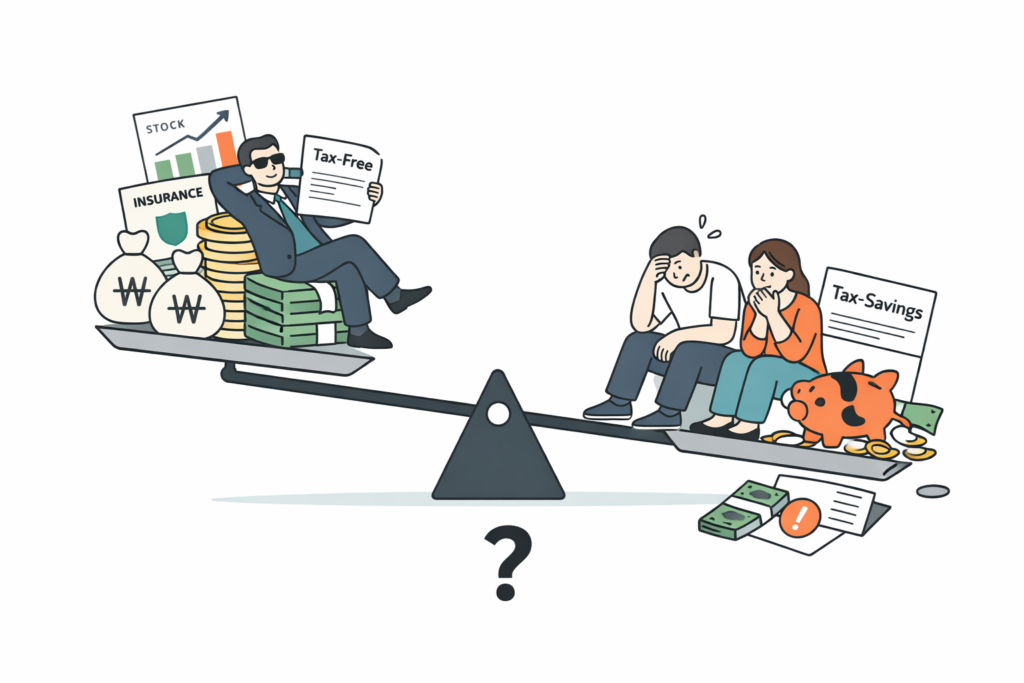
A tax-exempt product with an annual interest rate of 5% yields 50,000 won in interest after one year when 1,000,000 won is deposited. A taxable product with an annual interest rate of 6% yields 60,000 won in interest.
In Korea, interest income is subject to a tax of 15.4% (14% income tax plus 1.4% resident tax). While the 5% tax-exempt product incurs no tax, the 6% taxable product requires paying 15.4% tax on the 60,000 won interest, which amounts to 9,240 won.
As a result, the 5% tax-exempt product returns a total of 1,050,000 won, while the 6% taxable product returns 1,050,760 won. Which one is the more profitable product?
Generally, tax-exempt products that exempt interest income tax include long-term bank savings plans, livelihood-type savings accounts, stocks offered through securities companies (stocks do not provide interest and therefore are not subject to interest income tax, but they are mentioned here for convenience), and long-term savings products offered by insurance companies.
Tax-saving products are not benefits provided by financial institutions. They are benefits granted by the government to individuals who promise to keep their money deposited for a long period without withdrawing it. Of course, ordinary consumers may gain a small advantage through such products (in fact, livelihood-type savings sometimes offer slightly higher preferential interest rates under certain conditions). However, the real issue is that far more people subscribe to these products without fully understanding their benefits and disadvantages than those who do understand them.
In particular, people with financial difficulties tend to encounter urgent situations requiring money more frequently. In such cases, canceling a tax-saving product can lead to significant losses. When these products are terminated early, one often loses not only the tax benefits received but also may have to bear penalties for violating the contract.
In some respects, encouraging financially struggling individuals to build a lump sum through long-term tax-saving products could be viewed positively because it promotes savings discipline and motivation for financial recovery. However, in my view, the larger issue is that people often make their present lives more difficult in order to save money that they will only use far in the future.
Moreover, unexpected financial hardship often forces people to cancel the tax-saving products they had maintained. When this happens, individuals tend to blame themselves and feel that it is their own fault or incompetence. People with financial difficulties end up attempting excessive savings, which makes their daily lives even harder, and eventually they find themselves unable to maintain those savings at all.
In reality, many of these tax-saving products are not designed for ordinary people but rather for wealthy individuals. This is because the income generated from such products is excluded from comprehensive financial income taxation.
Comprehensive taxation of financial income means that when annual interest income exceeds 40 million won (this threshold was reduced to 30 million won starting in 2013), the excess amount of interest income is combined with other income and taxed according to the overall income tax rate. If the bank interest rate is around 4% per year, a person who deposits more than 1 billion won would become subject to this taxation.
For individuals with high income and large assets, the maximum income tax rate can reach 41.8%. Therefore, if their interest income is combined with other income, they may have to pay taxes at this higher rate instead of the standard 15.4% interest income tax. In addition, once someone becomes subject to comprehensive financial income taxation, details of their asset movements are reported to the National Tax Service and monitored more closely, which many wealthy individuals prefer to avoid.
For this reason, tax-exempt products such as long-term savings plans, stocks, and insurance products become very advantageous for such individuals.
Nevertheless, many people choose products that offer lower interest rates simply to avoid paying the 15.4% interest income tax. Some even believe that the interest income tax is applied to the combined total of principal and interest, and they become extremely determined to subscribe to tax-exempt products.
How should we interpret this phenomenon?
For individuals with limited income and assets, subscribing to long-term tax-exempt products or income-deduction products often results in far greater losses than gains. As mentioned earlier, these products are typically long-term in nature, and installment savings accounts usually apply simple interest, which means that the actual returns are much lower than they appear.
People lock their money away for long periods in order to gain small tax benefits, suffer the inconvenience of not being able to use the money when they truly need it, and eventually cancel the product while incurring significant losses.
If a person has limited income and assets, a wiser approach to money management is to look for financial products that provide higher returns and allow funds to be withdrawn at any time, rather than focusing solely on tax-exempt benefits.