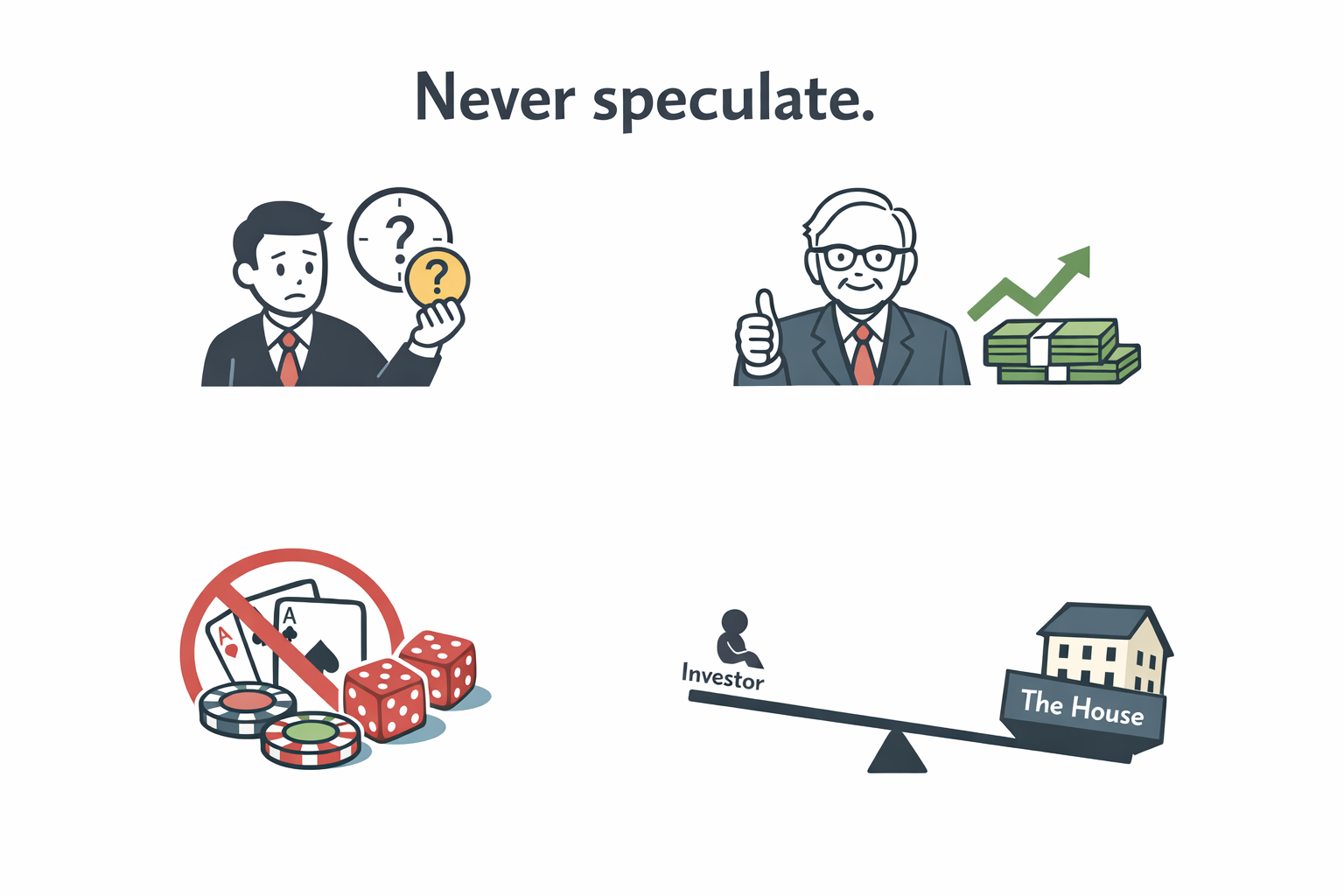
(5) 절대 투기하지 않는다.
투기가 무엇일까요?
만일 투자를 생각하면서 수익을 낼 확률과 투자의 기간을 고민하고 있다면 투자하지 마십시오. 확률과 기간을 고려하는 순간 이미 당신은 잠재적인 투기꾼이 되어 있는 것입니다. 시장이 출렁일 때마다 신문과 방송에서 떠드는 말이 있습니다. “기관투자자는 큰 수익을 얻었는 데 개미들은 쪽박을 찬다.”는 류의 말입니다. 그러나 실상 시장이 출렁일 때 손실을 보는 투자자라면 이미 그는 투자자가 아닙니다.
주식시장에서 투자수익을 얻고 싶다면 투기가 아닌 투자를 해야 합니다. 투자한 돈이 손실을 보게 되었다면 절대 팔지 마십시오. 내가 처분하지 않는 한 그 손실은 그저 장부상의 손실일 뿐입니다. 이익이 날 때까지 기다리십시오. 기다릴 수 없는 상황이라면 당신은 투기를 하고 있는 것입니다.
워렌 버핏이 세계 최고의 투자자로 추앙 받고 있는 이유는 바로 그가 투자의 원칙을 100% 지키고 있기 때문입니다. 여유자금으로 가격이 오를 상품에 장기 투자하는 사람이 투자에 실패할 일은 절대 없습니다.
도박의 마력이 무엇일까요? 적은 돈을 걸고 짧은 시간에 많은 돈을 딸 수 있다는 것이지요? 그런데 아무리 많이 따도 한 판만 잃으면 원금까지 날릴 수 있다는 것, 그것이 바로 도박(투기)입니다. 도박에는 불문율이 있는데요, 돈은 도박사가 아닌 하우스가 번다는 것이지요. 투자를 할 거라면 이 말을 절대 잊지 않아야 합니다.
(6) 증권회사와 보험회사의 간접투자상품 이해
중단기 투자는 증권회사에서, 장기투자는 보험회사에서 하는 것이 유리하다고 말하는 것에 대한 이유가 필요할 것 같습니다. 그 이유는 바로 두 회사가 수수료와 보수 등을 받는 방법 때문입니다.
간접투자상품에 대한 투자를 예로 들어보겠습니다.
증권회사가 만들어 판매하는 펀드상품에서는 이런 비용이 지출됩니다.
첫째 판매수수료 및 보수
둘째 운용보수
셋째 수탁보수
넷째 사무관리보수 등인데요, 이 외에도 많은 사항들이 있지만 대략 이렇습니다.
판매수수료는 고객에게 이 펀드를 판매한 사람에게 주는 비용이고, 운용보수는 이를 운용하는 사람 (펀드매니저와 운용사)에게 주는 비용이고, 수탁보수는 펀드를 보관하고 있는 사람에게 주는 비용이고, 사무관리수수료는 제반 사무처리를 해 주는 사람에 주는 비용입니다.
공히 이 비용들은 고객이 총 투자한 금액에 비례해서 받아갑니다.
즉, 총 보수율이 3%인 펀드에 매월 100만원씩 투자한다면 첫 달에 3만원/12개월, 둘째 달엔6만원/12개월, 이렇게 해서 1년 동안 받는 비용은 총 234만원/12개월=약20만원 정도라는 겁니다. 그런데 그 다음 해에도 투자가 계속된다면 이 비용이 지속적으로 늘어나게 되어서 만약 총 금액이 1억 원 일 때는 매년 300만원의 비용이 지출될 것이라는 것이지요.
물론 수익률에 따른 자산의 변동 내역을 고려하지 않았을 때 이야기입니다. 이렇게 증권회사의 투자비용은 총 자산에 비례하여 지불되는 것이므로 기간이 길어질수록 보수로 지불하는 금액도 많아집니다.
하지만 보험회사의 변액유니버설보험의 수수료 체계는 이렇습니다. 보험회사의 펀드상품에서는 이런 비용이 지출됩니다.
첫째 보험상품의 신계약비
둘째 보험상품의 유지비와 수금비
셋째 펀드의 운용보수
넷째 펀드의 수탁보수
다섯째 펀드의 사무관리보수 등이지요.
증권회사의 판매수수료 및 보수 대신 신계약비, 유지비 수금비 등이 들어가 있는 형태지요?
그런데 이를 청구하는 방법이 증권회사와는 조금 다릅니다. 보험회사는 부가보험료(신계약비, 유지비, 수금비)를 받는 회사이고, 이 중 신계약비는 먼저 쓰고 나중에 청구하기 때문에 100만원의 변액유니버설보험에 가입하면 첫 달에 700만원 정도를 부가보험료의 신계약 비용으로 써버립니다. 이 돈을 7년 동안 상각하므로 고객은 일년에 약 100만원 정도씩 이 비용을 부담해야 합니다.
그리고 매월 납입하는 보험료의 약 3%정도를 유지비와 수금비로 써야 하기 때문에 역시 매년 36만원의 비용이 발생합니다. 또한 펀드에 투자하므로 증권회사의 비용인 운용보수와 수탁보수, 사무관리보수 등도 총 투자비용에 비례하여 지불해야 합니다.
언뜻 보면 보험회사의 비용이 매우 많아 보이지요? 그런데 보험회사의 부가보험료 중 신계약비는 7년이 지나면 사라지는 비용이고, 유지비와 수금비는 납입하는 보험료에 비례하는 돈이므로 기간이 길어져도 매년 36만원입니다. 또한 보험회사의 펀드를 운용하는 보수율은 증권회사의 보수율에 비해 1~2% 정도 낮습니다.
그러다 보니 10년 정도가 지나면 증권회사에 투자하는 비용보다 보험회사에 투자하는 비용이 훨씬 저렴해지는 것이지요. 펀드의 수익률을 감안하지 않고 계산한다면 회사와 펀드의 종류에 따라 다르겠지만 약 10~12년 정도면 증권회사에 준 보수와 보험회사에 준 보수가 비슷해지고, 그 이상이 되면 보험회사에 투자하는 것이 유리해지는 상황이 되는 것입니다.
그래서 5년 정도의 중단기 투자라면 증권회사가 훨씬 유리하고, 10년 이상의 장기투자라면 보험회사가 훨씬 유리하다는 것이지요.
———–
(5) Never speculate.
What is speculation?
If you find yourself considering the probability of returns and the investment period while thinking about an investment, then you should not invest. The moment you factor in probability and timing, you have already become a potential speculator. Whenever the market fluctuates, the media often repeats statements such as, “Institutional investors make large profits while individual investors suffer losses.” However, in reality, if someone incurs losses during market volatility, that person is no longer an investor.
If you want to generate returns in the stock market, you must invest, not speculate. If your invested capital incurs a loss, never sell. Unless you dispose of the asset, the loss remains merely a book loss. Wait until it turns profitable. If you are unable to wait, then you are engaging in speculation.
The reason Warren Buffett is regarded as the world’s greatest investor is that he adheres 100% to the principles of investing. Anyone who invests long-term in assets with growth potential using surplus funds will not fail in investing.
What is the allure of gambling? It is the possibility of winning a large amount of money in a short period with a small stake. However, no matter how much you win, a single loss can wipe out even your principal. That is gambling (speculation). There is an unwritten rule in gambling: the money is made not by the gambler, but by the house. This is something you must never forget when investing.
(6) Understanding indirect investment products of securities companies and insurance companies.
It is necessary to explain why mid- to short-term investments are more suitable for securities firms, while long-term investments are more advantageous with insurance companies. The reason lies in how these institutions charge fees and expenses.
Let us take indirect investment products as an example.
In fund products created and sold by securities companies, the following costs are incurred:
First, sales fees and commissions
Second, management fees
Third, custodial fees
Fourth, administrative fees, among others
Sales fees are paid to the person who sells the fund to the client. Management fees are paid to those who manage the fund (fund managers and asset management companies). Custodial fees are paid to the institution that holds the fund assets, and administrative fees are paid to those handling operational tasks.
All these costs are charged in proportion to the total invested amount.
For example, if you invest 1 million won per month in a fund with a total expense ratio of 3%, the fees would accumulate progressively—30,000 won divided by 12 months in the first month, 60,000 won divided by 12 months in the second month, and so on. Over one year, the total cost would amount to approximately 200,000 won. If the investment continues into the following year, the total cost increases accordingly. For instance, with a total investment of 100 million won, annual fees would reach 3 million won, assuming no changes in asset value. Since securities company fees are proportional to total assets, the longer the investment period, the higher the cumulative fees.
In contrast, the fee structure of Variable Universal Life (VUL) insurance products offered by insurance companies is as follows:
First, initial contract costs
Second, maintenance and collection costs
Third, fund management fees
Fourth, custodial fees
Fifth, administrative fees
Instead of sales commissions, insurance products include initial contract costs, maintenance costs, and collection costs.
However, the method of charging these costs differs from securities firms. Insurance companies collect additional premiums (initial contract costs, maintenance costs, and collection costs). Among these, the initial contract cost is incurred upfront and amortized over time. For example, if you subscribe to a VUL policy with a monthly premium of 1 million won, approximately 7 million won may be used as initial contract cost in the first month. This amount is amortized over seven years, meaning the customer effectively bears about 1 million won per year for this cost.
Additionally, about 3% of the monthly premium is used for maintenance and collection costs, resulting in an annual cost of approximately 360,000 won. Since the funds are invested, management fees, custodial fees, and administrative fees—similar to those of securities firms—must also be paid in proportion to the invested amount.
At first glance, the costs of insurance companies may appear significantly higher. However, the initial contract cost disappears after seven years, and maintenance and collection costs remain constant at around 360,000 won annually, regardless of the investment duration. Furthermore, the fund management fee rates of insurance companies are typically 1–2% lower than those of securities firms.
As a result, after approximately 10 years, the total cost of investing through an insurance company becomes significantly lower than that of a securities firm. Although exact figures vary depending on the company and fund type, the total fees paid to both institutions tend to become similar after about 10–12 years, and beyond that point, insurance-based investments become more advantageous.
Therefore, for mid- to short-term investments of around five years, securities firms are more beneficial, while for long-term investments exceeding ten years, insurance companies are more advantageous.
Interestingly, many individuals who hold negative views toward stock market investments tend to have highly positive attitudes toward real estate investment.