그리고 전략은 미래지향적이어야 한다는 것을 간과해서는 안된다. 대부분의 영업인들은 당장의 매출에 급급해서 숲을 보지 못하고 나무만 보는 경향이 있다. 영업의 선택과 집중 전략의 일환으로 거래선을 등급별로 분류하는 기준에서도 당연히 현재의 실적이 중요하지만, 사실 그 보다 더 중요한 변수는 미래의 잠재력에 대한 평가이다. 앞서 말했지만 가장 영업사원에게 중요한 고객은 “파트너”, 즉 현재에 실적도 좋고 미래 잠재력도 높은 사람이다. 이런 점에서 우리는 현재와 미래라는 두가지 가능성을 변수로 두고 고객의 등급분류를 해야 한다.
- 현재 매출실적 (Current Use)
현재 실적은 너무도 쉽게 구할 수 있는 수치로써, 우수한 매출 순서대로 ABC로 나누는 것은 어린아이 장난과 같이 누구나 할 수 있을 것이다. 그러나 보다 자세히 심도 있게 하기 위해서는 고객의 질적 수준도 평가해서 우수한 순서에 따라 A1, A2, A3, B1, B2, B3, C1, C2, C3로 나누는 게 바람직하다. 이런 질적 평가는 정성적인 것이므로 리서치를 통해 객관적인 평가를 하면 더욱 좋겠지만, 그리 거창하게 하지 않아도 고객을 가장 잘 알고 있는 영업담당자의 주관적인 의견에 의존해도 무방하다. 그러나 그냥 생각나는 대로 하는 것보다 아래와 같은 척도를 가지고 평가하면 더욱 좋을 것이다.
– 자사 제품의 고객별 현 매출실적
– 고객이 보유한 매장에 대한 수치화 된 질적 평가
예) 적극적임, 중간 정도임, 낮음.
혁신자(Innovator), 초기 채택자(Early Adaptor), 후기 채택자(Late Adaptor).
회사에 대한 긍정적, 부정적 마인드에 대한 척도 등….
- 미래의 잠재적인 매출 가능성 (Potential Use)
고객에 대한 미래의 제품판매 잠재력을 측정하는 일은 고객의 제품 판매 능력을 평가하고 다른 고객들에 비해 기여할 수 있는 사업 규모 정도를 측정하는 일로써, 사실 평가하기가 매우 애매모호하다. 하지만 충실히 고객을 접하고 커뮤니케이션을 한다면 아래와 같은 기준들을 참고로 하여, 미래 잠재력, 즉 매출 증가의 가능성을 평가할 수 있을 것이다.
– 매월 구입한 소비자의 수, 소비자 매출 규모.
– 바이어의 연령, 관심 분야, 영향력.
– 대금 결재 능력, 구매력 등….
이에 따라서 Y축을 구매 잠재력(Potential Use), 가로축을 현재 실적(Current Use)으로 하는 아래와 같은 도표를 그릴 수 있다. 혹시 지금의 회사에서 ABC분석을 현재 실적(Current Use) 하나만으로 분류하고 있다면, 이글을 보는 순간부터 당장 바꾸기 바란다. 그리고 이 표는 여러 산업이나 회사의 특성에 따라 경우가 다를 수 있으므로, 단순화된 기본적 모델로써 참고삼아 이해해 주기를 바란다.
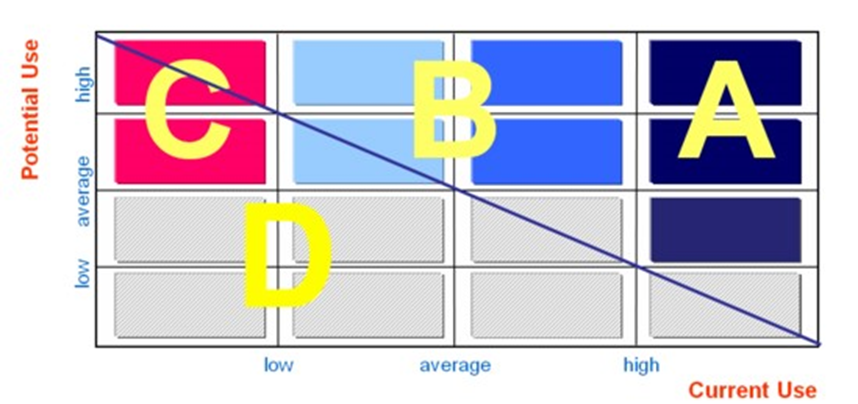
상기 표를 보면, A등급과 B등급이 Potential Use가 평균 이상은 되며 Current Use도 평균 이상인 고객으로서, 우리가 가장 중점을 두어야 할 고객임을 보여주고 있다. 하지만 그래도 의아해할 수도 있는 부분은 지금 평균은 팔고 있는 고객도 미래 잠재력이 낮으면 D급에 속한다는 것이다.
그렇기 때문에 여기서 말하는 ABCD 등급의 의미를 잘 이해하여야 한다. D급이라고 해서 문제가 있는 거래선이라 반드시 거래를 중지하라는 것은 아니다. 미래 가치가 없기 때문에 영업활동을 적게 하거나 중지한다는 것이다. Current Use만 보면 A급 B급 수준이지만, 나의 노력으로 더 이상 미래에 매출이 증가할 것 같지 않으며, 가만히 놔둬도 자연 발생적으로 그 정도 매출은 꾸준히 나올 것 같다면, 그 고객은 D급으로 분류하여 영업의 노력을 적게 써도 된다는 의미이다.
즉, 이 표는 고객의 현재 상태에 대한 관점이라기 보다, 역동적으로 움직이는 고객의 흐름에 맞춰 변화하고자 하는 영업의 능동적 행동이라는 측면의 등급임을 명심해야 한다. “내가 어디에 더 집중해야 미래에 더 좋은 성과를 낼 수 있겠는가”에 촛점을 맞춘 결과, 고객의 미래 잠재력에 더 많은 힘을 쏟아 붓는 것이 더 좋은 성과를 낼 수 있다는 것이 바로 영업전략임을 뜻한다.
——————
And we must not overlook the fact that strategy must be future-oriented. Most salespeople tend to focus on immediate sales, missing the forest for the trees. While current performance is important in classifying clients as part of the strategy of selection and concentration in sales, a more critical variable is the assessment of future potential. As previously mentioned, the most important customer for a salesperson is a “partner,” meaning someone who performs well currently and has high future potential. In this regard, we need to classify clients using both current and future potential as variables.
Current Sales Performance (Current Use)
Current performance is an easily obtainable figure, and anyone can classify clients into ABC order based on excellent sales. However, for a more detailed and in-depth evaluation, it is desirable to also assess the qualitative level of clients and categorize them in order of excellence into A1, A2, A3, B1, B2, B3, C1, C2, and C3. Since this qualitative evaluation is subjective, it would be ideal to conduct objective assessments through research, but relying on the subjective opinions of sales representatives who know the clients best is acceptable. Instead of doing it off the cuff, it would be better to use the following criteria for evaluation:
- Current sales performance by client for our products
- Quantified qualitative evaluation of the stores the client owns e.g., proactive, average, low. Innovator, Early Adopter, Late Adopter.
- Scale for positive or negative mindset towards the company, etc.
Future Potential Sales (Potential Use)
Measuring the future sales potential of a client involves evaluating the client’s product sales capability and assessing the potential business scale compared to other clients, which can be quite ambiguous. However, by diligently engaging with and communicating with clients, we can evaluate future potential, or the possibility of sales increase, using the following criteria:
- Number of consumers purchasing monthly, consumer sales volume.
- Buyer’s age, areas of interest, influence.
- Payment ability, purchasing power, etc.
Based on this, we can create a chart with the Y-axis representing potential use and the X-axis representing current use. If your company is currently using ABC analysis based solely on current use, change it immediately upon reading this. This chart should be understood as a simplified basic model that can vary depending on the characteristics of different industries or companies.
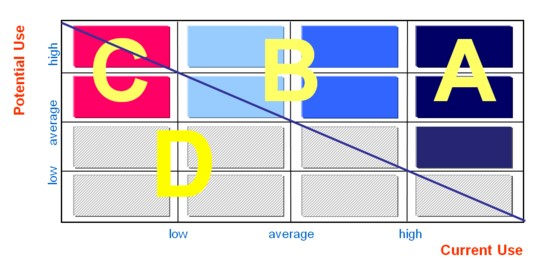
As shown in the chart, clients with an A or B rating are those whose potential use and current use are above average, indicating that they should be our primary focus. However, a point that might be puzzling is that even if a client currently has average sales, if their future potential is low, they fall into the D grade.
Therefore, it is important to understand the meaning of the ABCD grades discussed here. A D-grade client does not necessarily imply a problematic client whose transactions should be stopped. It means that due to their lack of future value, sales activities should be reduced or ceased. Even if current use alone would place them at A or B grade levels, if future sales are unlikely to increase due to your efforts and they will maintain their current sales naturally, classify that client as D grade and reduce your sales efforts.
In other words, this chart is not about the client’s current status but about the dynamic and proactive actions of sales to adapt to the changing flow of clients. The sales strategy implies that focusing more on the future potential of clients will yield better results. “Where should I concentrate more effort to achieve better results in the future?” The answer lies in investing more effort into clients with higher future potential.