- 우리 손으로 파괴한 우리 역사
학계에서 인정하고 가르치는 대한민국의 대표적인 사서는 삼국사기와 삼국유사입니다. 삼국사기는 고려중기의 유학자 김부식이 왕명을 받아 기록한 책이나, 그는 중국적 유교 질서의 구현을 내세운 중화주의와 사대주의 사관을 바탕으로 삼국사기를 편찬하였습니다. 때문에 북방을 다스리며 중국을 제압하던 고구려를, 진한 이후로 중국의 동북 모퉁이에 끼어있던 나라로 정의하고, 중국의 국경을 침범하여 중국을 한민족의 원수로 만든 적대국으로 표현하였습니다.
그리고 신라귀족의 후손인 김부식은 신라를 한국사의 정동 계승국으로 만들기 위해, 신라와 어깨를 나란히 하던 대진(발해)의 역사를 단 한줄도 기록하지 않았습니다. 이 사실을 신채호는 “동.북 부여사를 빼 버려 조선 문화의 근원을 진흙 속에 묻어 버리고, 발해를 버려서 삼국 이래로 결정된 문명을 짚더미에 내던져 버렸다”고 통탄했다고 합니다.
삼국유사를 쓴 일연은 스님이라서, 불교 관점에서 역사를 기록하고 주석을 남긴 일연은 옛날에 환국이 있었다는 사실을 전하면서 “이는 제석을 말한다”라는 주석을 붙였습니다. 환국을 불교 제석신의 나라로 풀이한 것이죠.
이러한 일연의 잘못으로 그전까지 분명히 실존한 나라로 기록된 환국의 역사가 부정되었습니다. 요컨데 삼국유사에서 일연은 한국인의 시원 역사를 신화 속 이야기로 전락시키는 중대한 오류를 범한 것입니다.
그리고 조선시대에는 유교 질서 구현을 위해, 왕명에 의해 고서 수거령을 내려 상고사나 고비서를 가지고 있으면 중형을 받기도 했습니다.
- 일본에 의한 역사 왜곡
역사학자 토인비는 다음과 같은 말을 했습니다,
“어떤 민족을 멸망시키기 위해서는 그 나라의 역사를 말살하라는 것이 식민주의자들의 철학이다”
1910년 일본이 조선을 강제로 병합한 직후, 초대 조선총독부 총독 테라우치 마사타케는 불온서적을 수색한다며 군사작전을 하듯 전국 각지에서 20만권의 사서를 강탈해서 소각했습니다. 남산 식물원 자리에서 며칠을 태웠다고 합니다. (김진학, 한철영<제헌국회사> 25Page, 문정창<군국일본조선강점36년사> 80Page)
그리고 1916년부터 3년동안 조선사를 편찬한다는 명목으로 또 한 차례 사적을 거둬들여, 그 가운데 희귀한 사서들을 일본으로 가져가서 깊이 감춰둡니다.(일본 궁내성의 왕실 도서관에서 12년동안 근무했던 박창화에 의해 폭로된 사실)
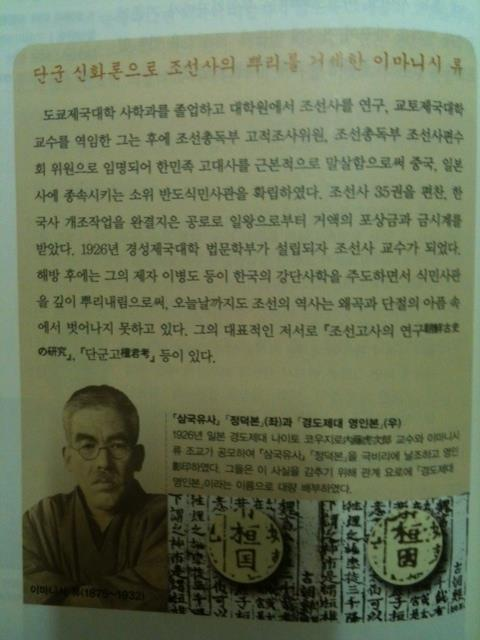
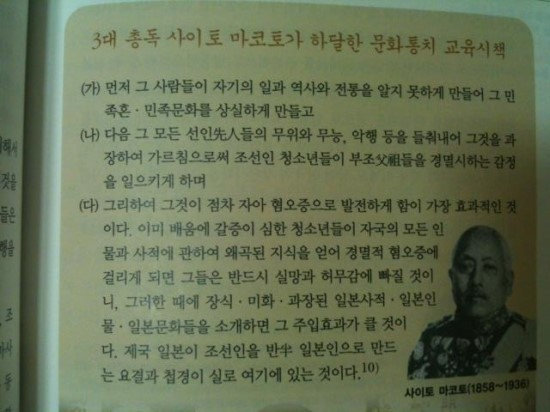
3대 총독 사이토 마코토는 조선인을 반 일본인으로 만드는 문화통치 교육시책을 하달합니다. 또 일제는 역사학자 이마니시 류를 하수인으로 내세워, 우리의 상고사를 신화로 만들어 버렸습다. 이 망할 망령에서 우리는 아직도 벗어 나지 못하고 있는 것입니다.
이마니시 류의 수제자가 이병도였고 이병도는 이마니시 류를 도와 자국의 역사 왜곡에 주역이 됩니다. 그리고 이마니시류와 이병도가 만들어 놓은 날조된 역사 틀 안에서 수많은 이병도의 제자들은 공부를 했습니다.
그래서 탄생 된 많은 강단사학자들은 환단고기를 제대로 읽어보지도 않고서, 현대적 단어 몇가지를 가지고 위서라고 우기기를 멈추지 않습니다. 학자적 양심과 밥줄에 큰 걸림돌이 되니까요.
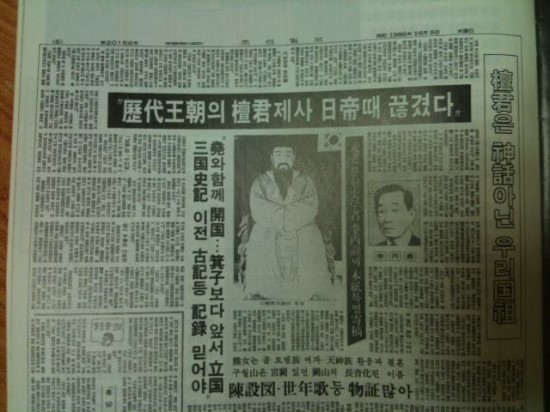
이병도가 최태영 박사의 끊임없는 충고로 죽기 전에 신문에 기고를 합니다. “고조선은 신화가 아니다” 라고…. 이를 보고 이병도의 제자들이 말했다 합니다. “스승이 망령이 들었다”
강단사학자들이 실증주의를 내세우며 위서론을 제기하지 못하는 이때에도, 환단고기에 대한 부정은 온전히 밥줄이 걸린 일이기 때문이라고 밖에는 생각할 수가 없습니다. 왜곡된 역사와 함께 학자적 양심마져 사라져 버린 것입니다.
——————
Korean Self-Destruction of Korean History
In the academic world, the representative historical texts of Korea are Samguk Sagi and Samguk Yusa. Samguk Sagi was written by Kim Bu-sik, a Confucian scholar of the Goryeo dynasty, under royal orders. However, Kim, driven by Sinocentrism and a pro-China perspective rooted in Confucian ideals, compiled the text with a bias. As a result, he portrayed Goguryeo, a northern kingdom that once dominated China, as a small nation on the northeastern edge of China after Jinhan. He described Goguryeo as an enemy state that invaded China’s borders and made China the eternal enemy of the Korean people.
Kim Bu-sik, a descendant of the Silla aristocracy, did not record a single line about Balhae, a kingdom that was contemporaneous with Silla, as he sought to position Silla as the legitimate successor of Korean history. Historian Shin Chae-ho lamented this omission, stating, “By excluding the history of Dongbuyeo, the roots of Korean culture were buried in the mud, and by omitting Balhae, the civilization that had been established since the Three Kingdoms was thrown into a heap of straw.”
Monk Il-yeon, who wrote Samguk Yusa, recorded history from a Buddhist perspective. While he mentioned the existence of an ancient kingdom called Hwan-guk, he added a note, “This refers to the Kingdom of Je-seok,” interpreting Hwan-guk as a mythical land of the Buddhist deity. This mistake led to the denial of the existence of Hwan-guk as a real historical kingdom. In essence, through Samguk Yusa, Il-yeon made the significant error of reducing the founding history of the Korean people to mere myth.
In the Joseon dynasty, to establish Confucian order, royal decrees were issued to collect and destroy ancient books. Possessing ancient historical texts or documents could result in severe punishment.
Historical Distortion by Japan
The historian Arnold Toynbee once said, “The philosophy of imperialists is to obliterate the history of the nation they wish to destroy.”
Immediately after Japan forcefully annexed Korea in 1910, the first Governor-General of Korea, Terauchi Masatake, conducted a military-like operation, confiscating 200,000 historical texts from across the country under the guise of searching for subversive books. These books were burned for several days at the site of the current Namsan Botanical Garden. (Kim Jin-hak, Han Cheol-young First Republic of Korea Parliament 25Page, Moon Jeong-chang 36 Years of Japanese Imperial Rule in Korea 80Page)
Between 1916 and 1919, Japan once again collected historical records under the pretext of compiling the History of Korea. Among these were rare historical texts, which were taken to Japan and hidden away. This fact was revealed by Park Chang-hwa, who worked in the Japanese Imperial Household Library for 12 years.
The third Governor-General, Saito Makoto, issued cultural governance policies designed to transform Koreans into pro-Japanese citizens. Additionally, the Japanese used historian Imanishi Ryu as an agent to turn Korea’s ancient history into mere mythology. We have yet to escape from this lingering specter.
Imanishi Ryu’s disciple was Lee Byeong-do, who assisted him in distorting Korea’s history. Lee Byeong-do’s many students studied within this fabricated framework of history.
As a result, many modern academic historians, without properly reading Hwandan Gogi, dismiss it as a forgery based on a few modern terms. Their scholarly conscience is hindered by their dependence on their livelihood.
After constant urging from Dr. Choi Tae-young, Lee Byeong-do, before his death, published an article in a newspaper stating, “Gojoseon is not a myth.” Upon reading this, Lee’s students allegedly said, “Our master has lost his mind.”
Even in an era where modern historians promote positivism and struggle to present forgery theories, it is hard to see the rejection of Hwandan Gogi as anything other than an issue of livelihood. Both the truth of history and scholarly integrity seem to have vanished along with the distorted historical narrative.