[거발환 환웅의 건국]
환국 시대 말, 인구 증가와 물자 부족 등으로 백성들의 삶이 어려워지자 서자부 부족의 환웅이 새로운 터전을 개척하기를 갈망하였습니다. 이에 금악(알타이산)산과 삼위산과 백두산을 두루 살펴 본 환국의 마지막 임금 지위리 환인께서 백두산은 ‘인간 세상을 널리 이롭게 할 만한 곳’이라 하고, 환웅을 동방 개척의 선봉장으로 세우셨습니다.
환인은 백두산을 행해 떠나는 환웅에게 국통 계승의 상징으로 천부(天符)와 인(印)을 내려 주고, 문명 개척단 3천명을 붙여 주셨습니다(삼성기하,태백일사-환국본기, 삼국유사-고조선기). 문명개척단을 이끌고 마침내 백두산에 도착한 환웅은 천평(하늘의 땅)이란 곳에 우물을 파고 그곳을 중심으로 농사짓는 땅을 구획하였습니다.
그리고 신시(신의 도시)에 도읍을 정하여 나라 이름을 배달(倍達)이라 하고, 백두산 신단수(神檀樹) 아래에서 삼신상제님께 천제를 올려 나라 세움을 고하였습니다. 이것이 동북아 문화의 근원적 핵심인 주제천신(主祭天神)입니다. 이 배달을 처음 세운 분이 거발환 환웅이십니다. 이로써 동북아 한민족사의 최초 국가인 배달의 시대가 시작되었습니다.
배달은 밝음을 뜻하는 ‘배(밝)’와 땅을 뜻하는 ‘달’을 합친 말로서 ‘광명의 동북 땅’을 뜻합니다. 우리 역사를 ‘배달의 역사’라 하고, 우리 민족을 ‘배달겨레’라 하는 것은 한민족사의 첫 번째 나라인 배달에서 연유한 것입니다.
환웅이 무리를 이끌고 동방 백두산으로 떠날 무렵, 반고가 다른 한 무리를 이끌고 삼위산으로 향하였습니다. (삼위산은 산해경에 의하면 중국 감숙성 돈황현에 위치합니다) 삼성기(하)는 중국 한(漢)족의 창세 신화에 등장하는 반고를 환국에서 갈려 나가 한족 역사의 뿌리가 된 실존 인물로 분명히 밝히고 있습니다. 환인께 청하여 이주를 허락 받은 반고는 십간십이지의 신장(神將)과 여러 부족장과 백성을 거느리고 많은 재물과 보화를 꾸려 길을 떠나, 마침내 삼위산 납림 동굴에 이르러 반고가한(盤古可汗)이 되었습니다.
오늘의 중국인은 그들의 시원 조상인 반고가한을 천지를 창조한 조물주로 묘사하고, 대신에 4,200년 전 인물인 황제헌원을 시조로 알고 있습니다. 환단고기는 중국인들이 잃어버린 뿌리 역사까지 밝혀주고 있습니다.
여기서 하나 반드시 짚고 넘어가야 할 사실이 있습니다. 환국의 마지막 환인께서 환웅을 환국의 정통 계승자로 정하였다는 점입니다. 그 증표가 바로 천부와 인입니다.
천부란, 환인이 ‘세상을 다스리는 권한의 증표’로 환웅에게 내려 주신 태고의 문서입니다. 흔히 세상에서 말하듯, 그것은 무속세계에서 쓰는 방울이나 거울 같은 것이 결코 아닙니다. 그리고 인이란, ‘환국의 정통을 전한다’는 사실을 인증하는 도장으로 왕의 옥새와 같은 것입니다.
백두산과 삼위산에 각각 터전을 잡은 동방 한민족과 서방 한족은 그때부터 각기 동북아 역사를 개척하였습니다.
[홍익인간의 도(道)로 다스린 배달]
마지막 환인천제에게서 국통 계승의 증표로 천부와 인을 전수 받은 거발환 환웅은 또한 국가 통치이념도 이어받았습니다. 그 이념이 바로 ‘인간 세상을 널리 이롭게 하라’는 홍익인간입니다. 홍익인간 이념은 환국, 배달, 고조선 시대에 가장 강렬하게 실현되었지만, 오늘날까지 한민족의 국시로 또는 생활이념으로 면면히 이어져 내려왔습니다. 홍익 사상은 한민족이란 울타리를 넘어서 온 인류에 대한 헌신과 봉사, 자비와 사랑을 담고 있습니다. 그래서 홍익인간은 ‘온 인류의 생존 이념’이라 할 수 있습니다.
홍익 사상의 의미와 가치를 간파한 최인은 이렇게 말하였습니다 “한민족은 인류 역사상 최초로 인간 사상을 선언하였다. 홍익은 박애요, 박애는 편협한 민족애가 아니고 홍대(弘大)한 인류애이다. 최초로 홍익인간을 선언한 한민족은 인류 평화의 맹주가 된다고 할 것이다” (최인, [한국사상의 신발견] 5쪽)
거발환 환웅은 제세이화를 기반으로 홍익인간을 실천하였습니다. 다시 말해서 삼신상제님의 진리, 즉 신교로써 세상을 다스리고 깨우쳐서 널리 인간 세계를 이롭게 한 것입니다. 환웅이 제세이화와 홍익인간의 도를 실현하기 위해 취한 정치제도 또한 신교에 바탕을 두었습니다.
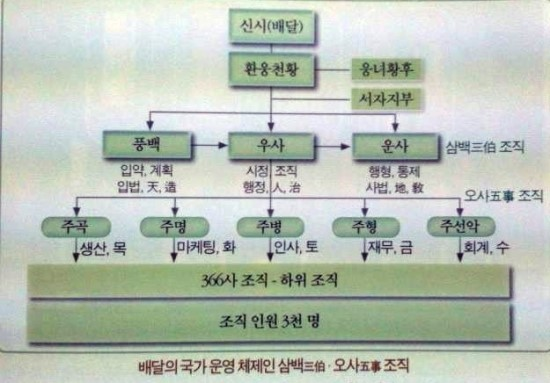
그 제도는 삼신오제(三神五帝) 사상에서 나온 삼백(三白), 오사(五事)입니다. 삼백은 입법부인 풍백, 행정부인 우사, 사법부인 운사를 말하고, 오사는 主穀, 主命, 主刑, 主病, 主善惡이라는 다섯 부서를 말합니다. 이때 오사에서 인간사를 360여 가지 항목으로 나누어 백성을 다스렸다고 하니, 환국 시대에 비해 인간 삶의 방식이 많이 복잡해졌음을 알 수 있습니다.
그리고 환웅천황은 천부경과 삼일신고를 강론하여 우주관, 신관, 인성론, 수행관에 관한 가르침을 베풀었습니다. 천부경은 환국 때에 구전되어 오다가 배달시대에 문자로 옮겨진 한민족 최고의 경전입니다. 여든 한자에 불과한 짧은 글이지만, 삼신 사상의 3수 원리를 근거로 하여 천지인 삼위일체에 대한 정의를 내려 주고 있습니다. 천부경은 우주론과 인간론의 진수가 압축되어 있는 인류사 최초의 계시록이라 할 것입니다.
삼일신고는 백성들을 교화하기 위해 환웅천황이 직접 지은, 다섯 장으로 구성된 신학서(神學書)입니다. 조물주 삼신, 그 삼신의 조화권을 자유자재로 쓰시며 하늘 궁궐에서 우주 살림을 주재하시는 삼신상제님, 삼신을 근원으로 하여 화생한 인간과 만물의 탄생 섭리, 그리고 인간의 진아 실현 등에 대한 이치를 밝혀 줍니다.
이로 보건대, 6천 년 전 상고 시대에 한민족은 이미 우주와 신과 인간에 대한 지극한 깨달음이 있었음을 알 수 있습니다. 그 깨달음은 백성들에게도 보편적이고 일상적인 것이었습니다.
————
[The Founding of Baedal by Geobalhwan Hwanung]
At the end of the Hwan-guk era, as the lives of the people grew increasingly difficult due to population growth and shortages of resources, Hwanung from the Seojabu tribe longed to pioneer a new homeland. Observing Geumak (Altai Mountains), Samwi Mountain, and Baekdu Mountain, Jiweiri Hwanin, the last ruler of Hwan-guk, declared Baekdu Mountain to be “a place worthy of widely benefiting the human world.” He appointed Hwanung as the pioneer leader for the eastern region.
Hwanin granted Hwanung the Cheonbu (Heavenly Talisman) and the In (Seal) as symbols of succession to national governance and sent him off with a team of 3,000 civilization builders (as recorded in Samseonggi-ha, Taebaek Ilsa – Hwan-guk Bon-gi, and Samguk Yusa – Gojoseon-gi). Leading this group, Hwanung reached Baekdu Mountain, where he dug a well in a place called Cheonpyeong (“Land of Heaven”) and organized farmland around it.
He then established the capital in Sinsi (“City of the Gods”) and named the nation Baedal. Under the sacred Dangun tree on Baekdu Mountain, he performed a heavenly ritual to Samsin Sangje, announcing the founding of the nation. This marked the beginning of Jujae Cheonsin, or the heavenly ritual tradition, which became the foundational cultural core of Northeast Asia. Geobalhwan Hwanung is credited with founding Baedal, thus ushering in the first era of the Korean people’s history in Northeast Asia.
The term “Baedal” combines the word “Bae” (meaning brightness) with “Dal” (meaning land), signifying “the land of radiant light.” The phrase “history of Baedal” stems from this first Korean nation, and the Korean people are often referred to as “Baedal people.”
When Hwanung led his followers to Baekdu Mountain in the east, Bango led another group to Samwi Mountain (identified in the Classic of Mountains and Seas as being in present-day Dunhuang County, Gansu Province, China). The Samseonggi-ha identifies Bango as a historical figure who branched off from Hwan-guk and became the progenitor of the Chinese Han people, who later mythologized him as a creator god.
Having received permission from Hwanin, Bango departed with guardian deities of the Ten Heavenly Stems and Twelve Earthly Branches, along with numerous tribal leaders, people, treasures, and goods. They eventually settled in the Nae Forest Cave of Samwi Mountain, where Bango became Pangu Kahan. Modern Chinese revere Pangu Kahan as a creator deity while tracing their ancestry to Huangdi Xuanyuan, who lived 4,200 years ago. Hwandangogi even sheds light on these forgotten roots of Chinese history.
A key fact that must be emphasized is that the last Hwanin of Hwan-guk designated Hwanung as the legitimate successor of Hwan-guk. The symbols of this legitimacy are the Cheonbu and the In.
The Cheonbu, bestowed by Hwanin, symbolizes the “authority to govern the world.” Contrary to common misconceptions, it is not a talisman like a bell or mirror used in shamanistic rituals. The In is equivalent to a royal jade seal, signifying the legitimate succession of Hwan-guk’s governance.
From the settlements at Baekdu Mountain and Samwi Mountain, the eastern Korean people and the western Han people began their respective historical developments in Northeast Asia.
[Baedal Governed by the Way of Hongik Ingan]
Geobalhwan Hwanung, having inherited the Cheonbu and the In as symbols of succession from the last Hwanin, also adopted a governing philosophy: the ideology of Hongik Ingan, meaning “widely benefiting humanity.” This philosophy was most fervently realized during the eras of Hwan-guk, Baedal, and Gojoseon, and it continues to resonate as a guiding principle for the Korean people.
The Hongik ideology transcends the boundaries of the Korean people, encompassing devotion, service, compassion, and love for all humanity. It is therefore considered a “universal ideology for the survival of humankind.” Recognizing its profound meaning and value, historian Choi In stated, “The Korean people were the first in human history to declare a human-centered ideology. Hongik embodies universal love, not narrow nationalism but an expansive love for humanity. The Koreans, as the first to declare Hongik Ingan, shall lead the cause of global peace.” (Choi In, Discovery of Korean Thought, p.5)
Geobalhwan Hwanung implemented the Hongik Ingan philosophy through Jese Ihwa (“Govern the World and Enlighten the People”). He governed the world and awakened the human realm with the truths of Samsin Sangje, the divine teachings known as Shingyo. Political systems under Hwanung also drew upon Shingyo principles.
These systems included the Sam-baek (Three Whites) and O-sa (Five Affairs), derived from the Samsin-Oje (Three Deities and Five Emperors) philosophy. The Sam-baek represented the legislative branch (Pungbaek), executive branch (Usa), and judiciary (Unsa). The O-sa encompassed five administrative divisions: Grain Management, Life Administration, Justice, Health, and Ethics. The fact that 360 categories of human affairs were managed within these systems illustrates the complexity of life compared to the Hwan-guk era.
Hwanung also taught Cheonbu-gyeong (The Heavenly Code) and Samilsingo (The Teachings of the Three Origins), offering insights into cosmology, divinity, human nature, and spiritual cultivation. The Cheonbu-gyeong, orally transmitted in the Hwan-guk era and recorded during Baedal, is Korea’s most ancient scripture. Despite its brevity—just 81 characters—it encapsulates the threefold Samsin philosophy and defines the trinity of Heaven, Earth, and Humanity. It is considered the first revelation in human history, encompassing both cosmology and anthropology.
The Samilsingo, composed by Hwanung himself in five chapters, is a theological text guiding the people’s enlightenment. It reveals the creative powers of Samsin, the supreme deity governing the cosmos, and elucidates the principles of creation, humanity’s origin, and the realization of the true self.
These texts demonstrate that 6,000 years ago, the Korean people possessed profound knowledge of the universe, divinity, and humanity, a wisdom that was universal and accessible even to the common populace.