

“지구에 있는 모든 것은 끊임없이 변화하고 있지. 이 지구는 살아있는 존재니까. 정기를 가진 땅덩어리란 얘기야. 우리는 그 정기의 일부분이고, 아주 가끔은 우리도 그 정기가 우리에게 작용하고 있음을 느끼곤 하지. 그런데 정말 중요한 것은, 자네가 그 크리스털 가게에서 일하는 동안 크리스털 그릇들 역시 자네의 성공을 위해 애를 썼다는 거야.”
코엘료의 소설 <연금술사>에서 연금술을 배우고 있는 영국인이 주인공 산티아고에게 한 말이다. 자아의 실현을 찾아 떠나 온 여정 중에 작은 크리스털 가게에서 일하게 된 산티아고의 긍정의 힘은 그 가게를 크고 번창하게 하였다.
그 얘기를 들은 영국인은 생명도 없는 크리스털 또한 산티아고를 위해 노력했기 때문에, 성공이 이루어진 것이라고 말도 안 되는 말을 하였다.
하지만 이 말도 안 되는 말이 사실은 이 세상에서 이루어지고 있음을 양자물리학 과학자들은 실험을 통해 입증하였다.
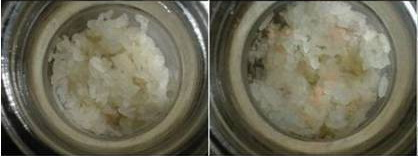
몇 년 전 한글날 특집으로 방영된 MBC 말의 힘이란 프로그램에서 MBC 아나운서들은 똑 같은 쌀밥을 두 개의 유리병에 넣고 한 쪽에는 ‘사랑해, 고마워’라는 좋은 글을 붙이고, 다른 쪽엔 ‘미워, 짜증나’라는 나쁜 글을 붙인 후 수시로 감정에 따라 각각의 쌀밥이 담긴 유리병에 좋고 싫은 말을 하는 실험을 보여주었다.
그리고 몇 주 후 뚜껑을 개봉한 결과 좋은 글과 말을 담은 쌀밥은 몸에 좋은 누룩이 핀 반면, 나쁜 글과 말을 전달한 쌀밥은 까맣게 썩어 간 것을 발견 하였다.

그런 점에서 특히 말은 정말로 잘 관리해야 하는 무서운 것이다. 말은 우리 안에 있는 것을 바깥으로 드러내는 힘이 있기 때문이다. 따라서 실패를 고백하면 실패를 할 것이고, 성공을 고백하면 성공이 우리 것이 될 수도 있다.
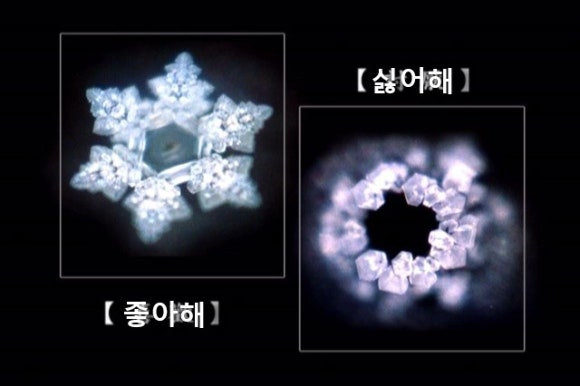
이 실험은 사실 이번이 처음이 아니었다. 김상운의 <왓칭(Watching)>이란 책을 보면 쌀밥에 대한 실험뿐만 아니라, 같은 방법의 물에 대한 실험에서도 몸에 좋은 육각수로 변한 물과, 분자가 분해되어 마실 수 없게 변한 물의 현미경 관찰 사진도 볼 수가 있다.

그것은 인간에게 내재된 긍정과 부정적인 힘이 가져다주는 놀라운 영향력이다. 오래 전 발표된 <시크릿(Secret)>이란 책에서도 사람이 간절히 바라는 힘은 우주의 기를 통해 전달되어 이루어진다는 주장을 하였는데, <시크릿>의 내용은 다분히 종교적이고 정신적이었던 반면, <왓칭>에서는 양자물리학 과학자들이 오랜 실험을 통해 과학적으로 입증한 결과를 보여주고 있어 더욱 신뢰감이 들었다.
양자물리학적인 측면에서 세상은 눈으로 보이지 않는 미립자로 이루어져 있으며, 사람, 동식물, 광물 등 지구상에 존재하는 그 어떤 사물도 모두 결국은 미립자 덩어리라 했다. 그리고 그 미립자들끼리는 서로 커뮤니케이션이 가능하다. 내가 사랑하는 마음을 동식물뿐만 아니라 이미 만들어진 밥이나 물조차도 느낄 수 있듯이, 세상은 어떤 정기로 서로가 상호작용을 하고 있다는 것이다.
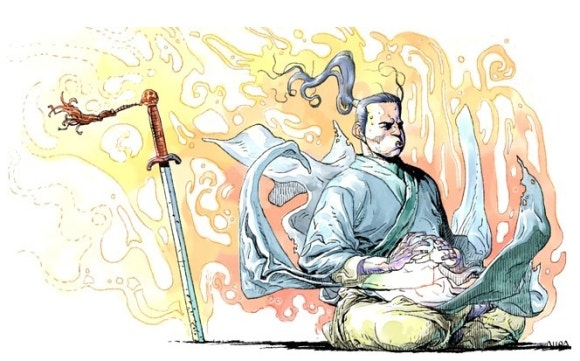
동양에서는 예로부터 ‘기가 통한다, 기가 막힌다’라고 말하며 눈에 보이지 않는 어떤 힘에 주목하였다. 설령 중국 무협영화나 소설처럼 하늘을 날고 장풍을 쏘는 것이 아닐지라도, 우리는 생활 속에서 사람과 사람 간의 기, 사람과 동물, 식물, 어떤 사물 간의 영향력 등을 느낄 수가 있다고 할 수 있다

———-
“Everything on Earth is constantly changing. This planet is alive, after all—a landmass imbued with energy. We are part of that energy, and sometimes, we feel it affecting us. But here’s the truly important part: while you were working at that crystal shop, the crystal bowls themselves were working hard for your success.”
This is a line spoken by the Englishman learning alchemy to Santiago, the protagonist of Paulo Coelho’s novel The Alchemist. During his journey in search of self-realization, Santiago briefly worked at a small crystal shop, and his positive attitude brought prosperity to the once-struggling business.
The Englishman suggested that even the inanimate crystal worked toward Santiago’s success—a seemingly absurd notion. However, quantum physicists have conducted experiments proving that such phenomena do indeed occur in this world.
A similar idea was illustrated in an MBC television program titled The Power of Words, aired as a special for Hangul Day a few years ago. In the program, MBC announcers conducted an experiment where they placed equal amounts of cooked rice into two glass jars. One jar was labeled with positive words like “I love you” and “Thank you,” while the other bore negative words like “I hate you” and “You’re annoying.” Over time, they would speak to the jars accordingly, either expressing kind or hostile emotions.
After several weeks, when the jars were opened, the rice in the jar with positive words and affirmations had developed healthy fermentation, while the rice in the jar with negative labels had turned black and rotted.
This experiment underscores the immense power of words. Words reveal what is inside us and have the power to shape the world around us. If we confess failure, we pave the way for failure. But if we declare success, success can become ours.
This was not the first experiment of its kind. Kim Sang-woon’s book Watching discusses similar experiments, not only with rice but also with water. Microscopic images showed that water exposed to positive affirmations transformed into beneficial hexagonal molecules, while water exposed to negative energy broke down into unstructured, undrinkable forms.
Such findings highlight the astonishing influence of human positivity and negativity. The book The Secret also proposes that deeply held desires are conveyed to the universe and realized through its energy. While The Secret is rooted in religious and spiritual perspectives, Watching builds credibility by presenting evidence supported by long-term scientific experiments conducted by quantum physicists.
From a quantum physics standpoint, the world is composed of invisible particles. Everything on Earth—people, animals, plants, and even inanimate objects—is ultimately a collection of particles. These particles are capable of communication with one another. Just as cooked rice or water can respond to love, the universe operates through a subtle energy exchange between all things.
Eastern traditions have long recognized this intangible force, referring to it as qi (氣), often expressed in phrases like “Qi is flowing” or “Qi is blocked.” While it might not manifest as dramatic abilities to fly or shoot energy blasts like in Chinese martial arts films, we often sense these energies in everyday life—between people, between humans and animals, and even between us and objects.