

어떻게 해야 나의 나쁜 습관을 고치고 좋은 습관을 들일 수 있을까? 먼저 습관을 만들기 위해서는 간절히 바라는 것이 있어야 한다.
건강하고 날씬한 몸매를 가지고 싶다는 간절한 열망을 가져야만, 먼저 그 열망을 이루기 위한 단계적인 목표를 수립하게 되고, 그 목표를 이루기 위해 매일 새벽 5시에 일어나 한 시간을 달리고, 저녁에는 밥을 반 그릇만 먹는다는 등의 구체적인 계획과 방법이 나오게 된다. 그리고 그 방법을 끊임없이 반복해서 실행하게 되면, 행동이 습관으로 형성되는 것이다.
“책 한 권을 출간하고 싶다”는 목표를 가졌던 나는 항상 바쁘다는 핑계로 마음만 있을 뿐, 행동을 하지 못했던 경우가 많았다. 그러던 어느 날 아침 5시에 일어나서 A4 한 페이지 분량의 글을 쓰기 시작했다.
하지만 매일 글을 쓴다는 일은 쉬운 일이 아니었다. 어느 날은 한 줄도 못 썼고, 어느 날은 한 페이지를 다 채워 뿌듯한 기분으로 아침을 시작한 적도 있었다. 그래도 매일 5시에 일어나는 일은 점점 습관이 되었고, 어느새 나는 매일 한 페이지 수준의 글을 쓸 수 있게 되었다.
그래서 지금은 4권의 책을 출간했는데, 직장을 다니며 이렇게 책을 출간한 내게 누군가 “어떻게 바쁜 와중에도 책을 출간할 수 있었습니까?”라고 질문을 한 적이 있었다. 그때 나는 이렇게 대답했다.
“책을 쓰는 건 쉽습니다. 매일 아침 한 페이지씩 글을 쓰기만 하면 되니까요.”


‘세살 버릇 여든까지 간다’, ‘바늘 도둑이 소 도둑 된다’라는 속담처럼 나쁜 습관에 한 번 길들여지면 헤어나기가 쉽지 않다. 언젠가 TV에서 한 동네에서 여성 속옷만 수천 벌을 훔친 사람에 대한 방송을 본 적이 있다.
중견기업체 임원까지 했던 멀쩡한 50대 남성이었는데, 실직하고 속상한 마음에 한 번 하기 시작한 여성 속 옷 낚시에 재미를 들인 게, 나중엔 습관이 되어 하루라도 하지 않으면 안될 정도가 된 사례였다. 그는 아슬아슬하게 남 몰래 속옷을 훔친 것에서 성취감과 희열감을 느꼈다고 했다. 이런 성취감이 그를 속옷도둑으로 습관들 게 만든 보상이었던 것이다.
로버트 치알디니의 <설득의 심리학>을 보면 마음을 움직이는 여섯 가지의 설득의 법칙이 나오는데, 나는 이중 습관을 고치기 위한 방법으로 ‘일관성의 법칙’에 주목하였다. 일관성의 법칙이란 일반적으로 사람들은 하나로 통하는 특정 기대치를 따라 행동하게 된다는 것이다.
예를들어 2000년 미국 대통령 선거 때 사람들에게 선거 당일에 투표할 것인가를 물어보았더니, 투표에 참가하겠다고 말한 사람들의 투표율이 그렇지 않은 사람들 보다 월등이 높았다. 즉, 대다수의 사람들은 자신이 뭔가를 하겠다고 공언하게 되면 그 일을 행하게 되는 경우가 많게 된다는 것이다.
따라서 만약 나쁜 습관을 고치고 싶거나 좋은 습관을 만들고 싶다면, 먼저 자신과의 약속을 여러 사람들에게 공언함으로써, 약속을 더 굳건히 다지고 책임감을 가지는 것이 필요하다. 특히 이때는 말로만 하는 것보다 서약서를 작성해서, 여러 사람들에게 증인을 서게 하면 더 큰 효과가 있다.


다음으로 기업이 매월 목표대비 실적을 체크하고 관리하는 것처럼 습관적인 행동도 목표관리가 되어야 한다. 어느 기업이나 1년 간의 사업계획이 제대로 진도가 나가고 있는지 수치적인 데이터 기록을 살펴보고, 문제점이 있으면 이를 수정 보완하며 계속적으로 사업을 하고 있다.
이와 마찬가지로 습관을 고치기로 공언을 하고 목표가 생긴 사람들은 자기가 습관적인 행동을 할 때 마다 기록을 하여 자신을 객관적으로 관찰할 필요가 있다. 이를 통해 자기의 습관이 어떻게 진행되고 고쳐지고 있는지를 스스로 인식하여 고질적인 습관의 고리를 끊고 바꿔 나갈 수 있게 된다.
마지막으로 행동에 대한 결과가 좋으면 자꾸 더 하게 된다는 효과의 법칙처럼, 나쁜 습관을 고치기 위해서는 스스로에게도 보상과 벌을 주어야 한다.
이때 상과 벌이란 자신이 약속을 잘 지켰을 때, 그 동안 사고 싶었던 좋아하는 것을 구입하거나 여행을 간다든지, 영화를 본다든지, 뭐가 되었든 하고 싶은 것을 하나씩 하거나 하지 않는 방식이라 할 수 있겠다.
또한 나쁜 행동을 또 하게 되면 행동 전에 불편한 행동을 하나 더 넣음으로써 나쁜 습관에 대해 제재를 가하는 벌을 줄 수도 있다.
결국 습관을 형성하려는 노력의 주체는 자기 자신이며, 습관을 정복하는 일은 바로 혹독한 자기 자신과의 싸움이 될 것이다.
우리가 생각하고, 느끼고 행동하고 성취하는 모든 것의 95%가 습관의 결과라는 조사가 있다. 어제의 습관이 오늘의 나를 만들었듯이 오늘의 습관이 10년 후의 나를 만든다. 그래서 올바른 습관을 만들어야 하는데, 그러기 위해선 목표가 필요하다.
또한 덱스터 예거는 이렇게 말했다.
“먼저 목표를 결정해야한다. 결정을 하고 나면 비젼이 따라온다. 비젼에 모든 것을 걸고 그것을 습관으로 만들어야 비젼이 삶의 방식이 된다.”
즉, 습관을 만들기 위해서는 간절히 열망(Desire)하는 것이 있어야 한다. 그리고 그 열망을 이루기 위해서 무엇을 왜 해야하는지 스스로가 인식(Knowledge)해야 비로소 어떻게 해야할지 방법(Skill)이 나온다.
그 방법을 끊임없이 반복해서 실행하면 그 행동이 습관이 될 수 있다. 올바른 습관을 창조하는 것은 세포가 기억할 수 있을 정도의 훈련뿐이다.

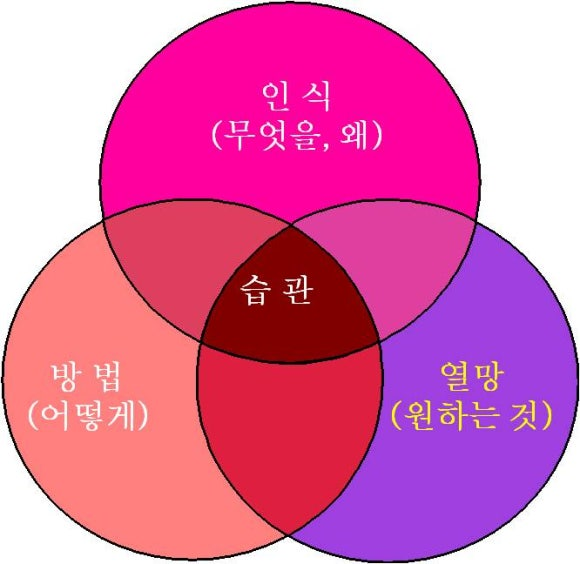
그래서 습관을 형성하는 공식은 아래와 같다.
< Habit = D x K x S >
   •      K : knowledge
   •      S : skill
   •      D : desire
위의 공식에서 각 요소들이 더하기(+)가 아닌 곱하기(x)로 이루어진 것은 세가지 요소 중 하나라도 빠지면 습관이 형성될 수 없기 때문이다.
——————
How can we break our bad habits and develop good ones? First, to create a habit, you must have something you deeply desire.
For example, you need a strong yearning to have a healthy and slim body. Only then will you set step-by-step goals to achieve that desire, such as waking up at 5 a.m. every day to run for an hour or eating only half a bowl of rice for dinner. Through this process, specific plans and methods to achieve the goal will emerge. And if you persistently repeat those methods, the behavior will eventually form into a habit.
When I had the goal of “publishing a book,” I often made excuses about being too busy and found myself merely thinking about it without taking action. Then one day, I began waking up at 5 a.m. and writing the equivalent of one A4 page each morning.
However, writing every day was not easy. Some days, I couldn’t write even a single line. On other days, I managed to fill an entire page and began the day feeling satisfied. Nevertheless, waking up at 5 a.m. each day gradually became a habit, and eventually, I found myself capable of writing one page of text daily.
As a result, I have now published four books. Someone once asked me, “How did you manage to publish books despite being so busy?” I answered, “Writing a book is easy. All you have to do is write one page every morning.”
Like the saying “A habit formed at three lasts until eighty” and “A petty thief becomes a grand thief,” once you develop a bad habit, it is not easy to break free from it. I once saw a TV program about a man who had stolen thousands of women’s undergarments in a single neighborhood.
He was a man in his 50s who had once been a middle manager at a midsize company. After losing his job, he started stealing women’s undergarments as a way to deal with his frustration, and the thrill eventually became a habit. Over time, he reached a point where he couldn’t go a single day without stealing. He confessed that he felt a sense of accomplishment and euphoria whenever he secretly stole undergarments. It was this sense of achievement that rewarded and reinforced his habit, turning him into a habitual thief.
In Robert Cialdini’s Influence: The Psychology of Persuasion, he discusses six principles of persuasion that influence people’s minds. Among them, I focused on the “principle of consistency” as a way to change habits. The principle of consistency states that people tend to act in accordance with a specific expectation once it has been established.
For example, during the 2000 U.S. presidential election, when people were asked if they would vote on election day, those who said they would vote showed a significantly higher voter turnout than those who didn’t. In other words, most people are more likely to take action when they publicly commit to doing something.
Therefore, if you want to break a bad habit or build a good one, start by making a promise to yourself and publicly announcing it to others. By doing so, you solidify your commitment and gain a sense of accountability. In particular, writing a pledge and having others act as witnesses can make the commitment even stronger.
Next, just as companies track and manage their progress toward goals on a monthly basis, habitual behaviors also require goal management. Companies review numerical data to ensure their annual business plans are progressing as expected, addressing issues and making adjustments as needed to maintain steady growth.
Similarly, individuals who publicly declare their intention to change a habit and set goals need to record their actions every time they engage in the habitual behavior. This allows for an objective observation of oneself. Through this process, individuals can recognize how their habits are progressing and take steps to break the cycle of entrenched behaviors.
Finally, according to the law of effect, when the results of an action are positive, people are more likely to repeat that action. Therefore, to break bad habits, you must give yourself both rewards and penalties.
Rewards can involve indulging in something you’ve been wanting to do, such as buying something you’ve desired, going on a trip, or watching a movie, as a way of reinforcing good habits when promises are kept. Conversely, penalties for engaging in bad habits could include introducing an additional inconvenient action before engaging in the behavior as a form of deterrence.
Ultimately, the key to forming habits lies with the individual, and the process of mastering one’s habits becomes a rigorous battle with oneself.
A study has shown that 95% of what we think, feel, do, and achieve is the result of our habits. Just as yesterday’s habits shaped who we are today, today’s habits will determine who we become 10 years from now. This is why it is crucial to develop proper habits, which requires having clear goals.
Dexter Yager once said:
“First, decide on your goal. Once you make a decision, a vision will follow. Commit everything to that vision and turn it into a habit. Only then will the vision become a way of life.”
In other words, to create a habit, you must have a desire. Then, to achieve that desire, you must develop an understanding of what and why you need to do it (knowledge). Only after this realization will you discover how to proceed (skill).
By persistently repeating those methods, the behavior can transform into a habit. Creating proper habits requires rigorous training to the point where the actions are imprinted in your cells.
Thus, the formula for habit formation can be summarized as follows:
Habit = D × K × S
D (Desire): A strong, passionate aspiration.
K (Knowledge): Awareness of what and why you need to do something.
S (Skill): The specific methods and steps needed to take action.
The use of multiplication (*) in this formula rather than addition (+) indicates that if even one of these elements is missing, the habit cannot be formed.