지난 포스팅의 문제에 대한 정답을 공개하겠다. 첫 번째 문제의 정답은 아래 <그림 4> 와 같다. 아마도 좀 허무하다고 생각했을지도 모르겠다. 하지만 잘 생각해보면, 나는 분명 앞에서 논센스 퀴즈라고 말하였다.
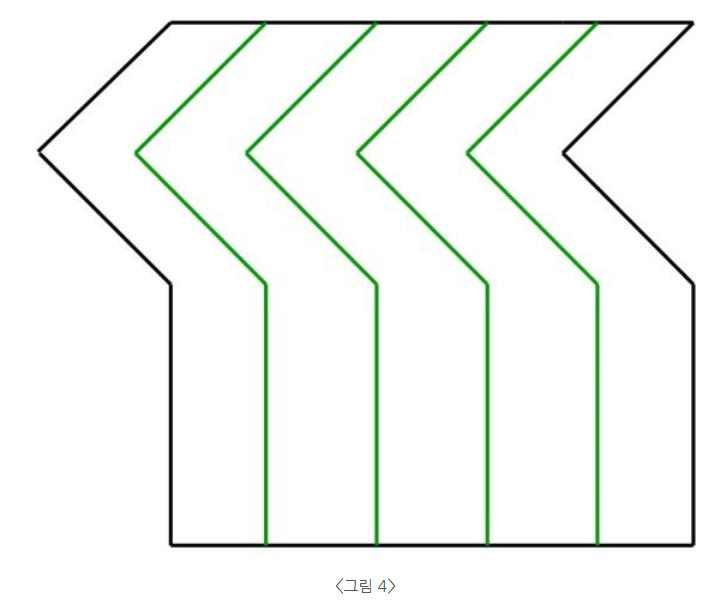
<그림4>처럼 만든다면 비단 5개뿐만 아니라 그 두 배인 10개 이상이라도 같은 모양으로 나눌 수 있을 것이다. 생각의 틀을 바꾸니 엄청난 효율성과 생산성이 기하급수적으로 올라가는 것이다.
아마도 이 문제를 푼 사람도 있겠지만, 바로 풀기는 쉽지 않았을 것이다. 지금까지 강의를 하며 수 백명에게 문제를 내어봤지만, 단 한 명만이 이 문제를 바로 풀었었다.
그렇다면 이처럼 간단한 정답을 수많은 사람들이 왜 풀지 못했을까? 그 이유는 내가 여러분들에게 암시를 하나 걸어 놨기 때문이다. 내가 지난 포스팅에서 문제를 냈을 때 <그림2> 처럼 4등분의 예를 보여준 것을 기억하는가?
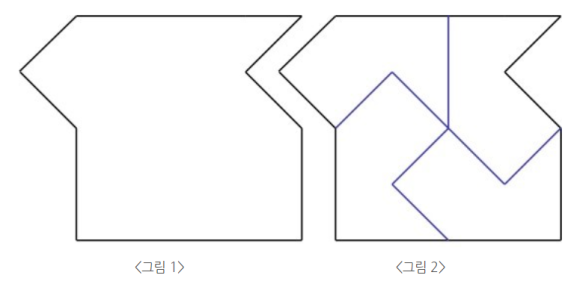
<그림2>에서 본 4등분한 모습은 매우 어렵다. 그리고 그것을 5등분하기는 더욱 어렵다. 그 함정에 여러분들은 빠진 것이다. 만약 내가 4등분한 모습을 보여주지 않고 바로 5등분하라는 문제만 주었다면 분명 많은 사람들이 정답을 쉽게 맞히었을 것이다.
하지만 복잡한 4등분이란 모습이 여러분들의 뇌 속에 순간적으로 고정관념이 되어, 문제해결 방법을 제대로 인지하지 못하고 틀 속에 사로잡히게 만들었기 때문이다.
그럼 이쯤 되면, 두 번째 문제는 <그림5> 처럼 쉽게 정답을 낼 수 있지 않았을까 생각된다. 실제로 강의 중에 첫 번째 문제보다 두 번째 문제를 푼 사람의 수도 많았다.
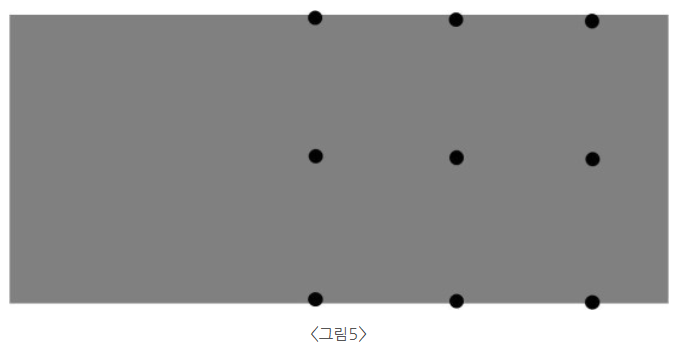
물론 나는 질문을 한 선으로 하라고 했지, 한 면으로 하라고는 하지 않았다. 하지만 우리 모두가 알다시피 면은 단지 두꺼운 선이다.
이번도 마찬가지로 내가 먼저 일반적인 가는 선을 세 개 보여줌으로써, 여러분을 하나의 틀에 메이게 한 것임을 이제 알 수가 있을 것이다. 여러분의 뇌를 내가 여러분도 모르게 살짝 조작하였기 때문이다.
——————-
Here are the answers to the previous post’s questions. The answer to the first problem is shown in <Figure 4>. You may find it anticlimactic—but remember, I clearly mentioned these were nonsensical quizzes.
As demonstrated in <Figure 4>, you can divide the shape not only into 5 identical sections, but even into 10 or more of the same shape and size. Shifting the way you think can lead to exponential improvements in efficiency and productivity.
Some may have solved this problem, but most probably didn’t get it right away. Through countless lectures, I’ve posed this question to hundreds of people, and only one person ever answered it immediately.
Why is it, then, that so many people fail to solve such a simple problem? It’s because I implanted a subtle suggestion. Do you recall that I showed an example of dividing the shape into four parts in <Figure 2> when I presented the question?
The division in <Figure 2> is quite complicated, and attempting a five-part version in that same manner is even harder. That’s the trap. Had I asked you to divide the shape into five parts without first showing the four-part example, many of you would have found the correct answer more easily.
But because that complex example was imprinted in your minds, it created an instant bias—a fixed idea that prevented you from perceiving the simpler solution. You were unknowingly boxed into that framework, unable to escape.
By now, the second problem should be easier to figure out—just as shown in <Figure 5>. In fact, more people solved the second problem during my lectures than the first.
Technically, I asked for a single line—not a single surface. But as we all know, a surface is simply a thick line.
This time, too, I manipulated your thinking by first showing you three conventional, thin lines. That visual served as another frame that trapped your thought process. Without realizing it, your brain was subtly manipulated—by me.