

Episode 21 : 돈맹은 지는 싸움만 한다.
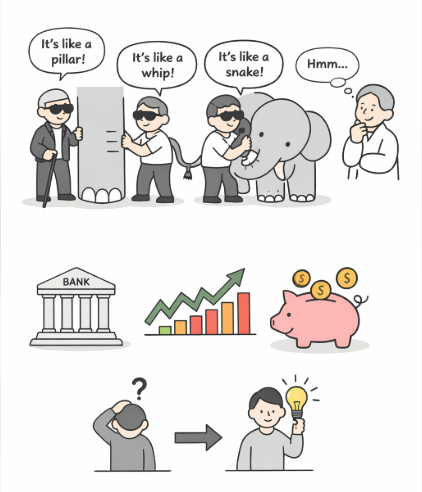
세 명의 맹인이 코끼리를 만납니다. 그리고 각자 코끼리를 만져보고 코끼리에 대한 이야기를 합니다.
다리를 만져 본 사람은 코끼리는 돌기둥처럼 생겼다고 하고, 꼬리를 만져 본 사람은 코끼리는 벽에 매달려 있는 채찍처럼 생겼다고 하고, 코를 만져 본 사람은 코끼리는 구렁이처럼 생겼다고 합니다.
서로 직접 만져보고 알게 된 느낌으로 코끼리에 대해 이야기 하니 자기가 알고 있는 코끼리가 제대로 된 코끼리라고 주장하고 싸우기만 할 뿐 결론이 나질 않습니다. 곁에서 이를 지켜보던 사람이 혀를 끌끌 차며 모두에게 코끼리의 본 모습을 설명해줍니다. 그제서야 맹인들은 코끼리의 본 모습을 알게 되었답니다.
사람들은 각자 자신의 느낌과 직관으로 상황을 판단하고 이해합니다. 이러한 주관성이 실제의 모습과 상황을 객관적으로 파악하는 것을 방해하지요. 각자 보고 싶은 것만 보고 믿고 싶은 것만 믿기 때문입니다. 이런 주관성이 객관성을 띠려면 이해의 폭을 전체적으로 넓게 만들어 주어야 하겠지요.
금융에 대한 이해도 마찬가지입니다.
금융업에 대해 잘 모르고 금융기관과 거래한다면 백 번을 싸워도 이길 수 없습니다. 그런데 많은 분들이 그렇게 싸우고 있습니다.
이제 왜 우리가 이길 수 없는 지에 대해 생각해 보아야 합니다. 그렇지 않으면 또 질 수밖에 없을 테니까요.
사실 싸움에 지는 대부분의 이유는 잘 모르는 것뿐 아니라 잘 못 알고 있기 때문입니다. 잘 못 알고 있는 것을 우리는 쉽게 편견이라고 하는데, 그저 편견이라고 하기에는 우리 삶에 미치는 영향력이 너무 크기 때문에 진실을 밝히는 노력이 필수적입니다.
Episode 22 : 나는 돈맹인가?
다음의 질문에 대해 (예 / 아니오)로 대답해 보십시오.
만일 문제를 잘 모르겠다면 “예”로 체크하십시오.
| 1. 여유자금이 생긴다면 수익이 높다는 증권회사보다는 예금자보호가 된다는 은행에 예금하겠다. 2. 대출은 되도록이면 안 받는 것이 좋다고 생각한다. 3. 만일 대출을 받아야 한다면 최우선으로 갚는 것이 좋다. 4. 증권회사는 투자위험 때문에 거래하기가 꺼려진다. 5. 만일 세금이 없고 적금의 이자율과 적립식 펀드의 수익률이 같다면 수익금도 같을 것이다. 6. 이자율이 5%인 비과세 적금과 6%인 일반 적금이 있다면 세금을 안 내는 비과세 적금에 가입하겠다. 7. 내가 하든 남이 하든 투기는 나쁜 짓이다. 8. 종신보험은 죽어서 받는 보험이다. 9. 죽어서 받는 보험보다는 살아서 받는 보험에 가입하는 것이 좋다. 10. 소멸되는 보험보다는 나중에 돌려받는 보험이 좋다. |
<돈맹 테스트의 해답>
이 테스트의 정답은 모두 ‘아니오’ 입니다.
이제 예라고 답한 개수를 세어 10을 곱하면 귀하의 돈맹지수가 되겠습니다. 10문제 모두 예라고 답하셨다면 100% 돈맹이겠지요?
의외의 결과인가요?
낙심하지 말고 왜 그런 지 다음의 Episode를 읽어보시기 바랍니다.

——————
Episode 21: The Financially Illiterate Only Fight Losing Battles
Three blind men encounter an elephant. Each one touches a different part of the elephant and then describes what an elephant is like.
The man who touched the leg says the elephant is shaped like a stone pillar. The man who touched the tail says the elephant is like a whip hanging on a wall. The man who touched the trunk says the elephant is like a snake.
Each of them speaks about the elephant based on the sensation they personally experienced, insisting that the elephant they understand is the correct one. As a result, they only argue with each other and never reach a conclusion. A bystander who has been watching them clicks his tongue and explains the true appearance of the elephant to all of them. Only then do the blind men finally understand what the elephant really looks like.
People tend to judge and understand situations according to their own feelings and intuition. Such subjectivity often interferes with objectively grasping reality and circumstances. This is because people tend to see only what they want to see and believe only what they want to believe. For subjectivity to become objective understanding, the breadth of one’s knowledge and perspective must be expanded to encompass the whole picture.
The same applies to understanding finance.
If someone deals with financial institutions without properly understanding the financial industry, they will never win—no matter how many times they fight. Yet many people continue to fight such battles. Now we must think about why we cannot win. Otherwise, we will inevitably lose again.
In fact, most defeats occur not only because people do not know enough, but also because they know things incorrectly. Incorrect knowledge is often called prejudice. However, its impact on our lives is far too significant to dismiss merely as prejudice, which is why efforts to uncover the truth are essential.
Episode 22: Am I Financially Illiterate?
Answer the following questions with Yes or No.
If you are not sure about a question, mark Yes.
- If I had spare money, I would deposit it in a bank that offers depositor protection rather than in a securities company that promises higher returns.
- I think it is best to avoid taking loans whenever possible.
- If I must take a loan, I should repay it as quickly as possible as my top priority.
- I hesitate to deal with securities companies because investing involves risk.
- If there were no taxes and the interest rate of a savings deposit were the same as the return rate of a systematic investment fund, the final profit would be the same.
- If there were a tax-exempt savings plan with a 5% interest rate and a regular savings plan with a 6% interest rate, I would choose the tax-exempt savings plan because there is no tax.
- Speculation is a bad thing, whether I do it or someone else does it.
- Whole life insurance is insurance that pays benefits only after death.
- It is better to subscribe to insurance that pays benefits while alive rather than insurance that pays after death.
- Insurance that returns money later is better than insurance that simply expires.
<Answers to the Financial Illiteracy Test>
The correct answer to all of these questions is “No.”
Now count how many times you answered Yes and multiply that number by 10. That will be your Financial Illiteracy Index.
If you answered Yes to all ten questions, your financial illiteracy index would be 100%.
Was that an unexpected result? Do not be discouraged. Please read the next episode to understand why.