

Episode 30: 투자가 위험하다고?
많은 분들이 주식 투자하는 것을 위험하고 나쁘다고 생각합니다. 그러나 요즘 같은 시기에 투자하지 않고 돈을 불리는 방법이 있을까요? 투자에 대해 잘 알지 못하면서 습관적으로 거부감을 갖는 것은 매우 위험한 일입니다. 그런데 우리나라 사람들은 왜 투자에 대한 거부감을 가지게 되었을까요?
1980년 1.4일 주가지수 100을 정하고 본격적으로 거래소업무를 시작한 이래 대한민국의 주식시장은 성장을 거듭하였습니다. 특히 86 아시안 게임과 88 올림픽을 거치며 주식시장은 폭발적인 성장을 거듭해 왔지요.
‘주식이 돈이 된다’ 라는 소문은 꼬리에 꼬리를 물고 주식이 뭔지도 모르는 사람들이 주식을 사기 시작했습니다. 사 두기만 하면 돈이 된다니 묻지도 따지지도 않고 투자를 시작했습니다.
증권회사는 이런 사람들에게 원금의 두세 배 돈을 빌려주었습니다. 100만원을 투자해서 주식을 사면 증권회사에서 300만원을 그저 빌려주었으니 내가 사 둔 주식은 오르기만 할 거라는 환상에 사로잡힌 사람들이 이 돈을 빌려서 400만원어치의 주식을 사 두었답니다. 만일 주가가 오른다면 네 배의 수익이 발생하겠지요.
그러나 만일 주가가 하락하면 어떤 일이 생길까요? 400만원이었던 주식이 320만원이 되었다면 300만원은 증권회사에 갚아야 할 돈이므로 내 돈은 20만원만 남는 상황이 됩니다. 주가는 20%가 하락했지만 내 돈은 80%를 잃은 것이지요. 만약 주가가 더 떨어진다면 내 돈을 몽땅 날리는 상황이 발생할 수 있습니다.
설상가상으로 주가가 25% 하락해서 400만원어치 주식이 300만원이 된다면 증권회사에서는 빌려준 돈을 받기 위해서 강제로 내가 보유한 주식을 팔아버릴 수 있습니다. 이를 반대매매라고 하는 데 이렇게 내 돈은 다 날아가고 갚아야 할 돈만 남은 계좌를 속칭 “깡통계좌”라고 합니다.
주식에 투자하면 큰 돈을 벌 수 있다는 소식을 듣고 있는 돈을 몽땅 투자한데다가 더 큰 이익을 보려고 남의 돈을 빌려 투자를 했으니 이는 분명히 투기입니다.
주식시장이 생기고 80년대 후반에 대규모의 “깡통계좌 정리”를 거친 시장에서 힘들게 모은 돈을 몽땅 날려버린 투자자들은 어디 가서 하소연할 곳도 없었습니다. 심지어 그런 규칙이 있다는 것조차 모르고 투자를 한 사람들도 있었습니다.
이렇게 피 같은 재산을 날리고 주식시장을 떠난 사람들이 한 마디씩 합니다.
“내가 이제부터 주식에 손을 대면 사람이 아니다.”라고 말입니다. 마치 도박 때문에 패가망신한 사람들처럼 말입니다. 실제로 이런 일이 지금도 비일비재하게 일어납니다. 본인들은 주가 상승기에 조금씩 이런 신용거래를 통해 수익률을 극대화할 수 있다고 믿고 했는 지 모르겠으나 단연코 이런 거래는 “투자”가 아닌 “투기”입니다.
너무 심한 이야기인지는 모르겠으나 그 동안 주식거래를 통해 큰 손실을 본 분들은 스스로 “투기꾼”이었다는 것을 인정해야 합니다. 만일 정상적인 투자자였다면 그렇게 큰 손실을 볼 일이 없었을 것입니다.
서브프라임 모기지론 사태로 전 세계의 증권시장이 폭락한 즈음에 TV에 등장한 한 신문사의 논설위원이 “큰 손실을 본 사람들은 스스로의 탐욕 때문”이라는 이야기를 했다가 여론의 뭇매를 맞은 적이 있었습니다. 그러나 만일 스스로의 탐욕이 아니었다면 그렇게 큰 손실을 보지 않을 것이라는 것 역시 분명합니다.
아직도 매번 주식시장이 요동칠 때마다 기관투자가는 돈을 벌고 개미투자자(일반인)는 돈을 잃는다는 소식이 들립니다. 그렇다면 대한민국의 개미투자자들은 정상적인 투자자가 아닌 투기꾼이란 이야기입니다. 정상적인 투자자라면 주가가 폭락했을 때 주식을 사들이고 주가가 오르면 팔아서 이익을 내야 하는 것입니다.
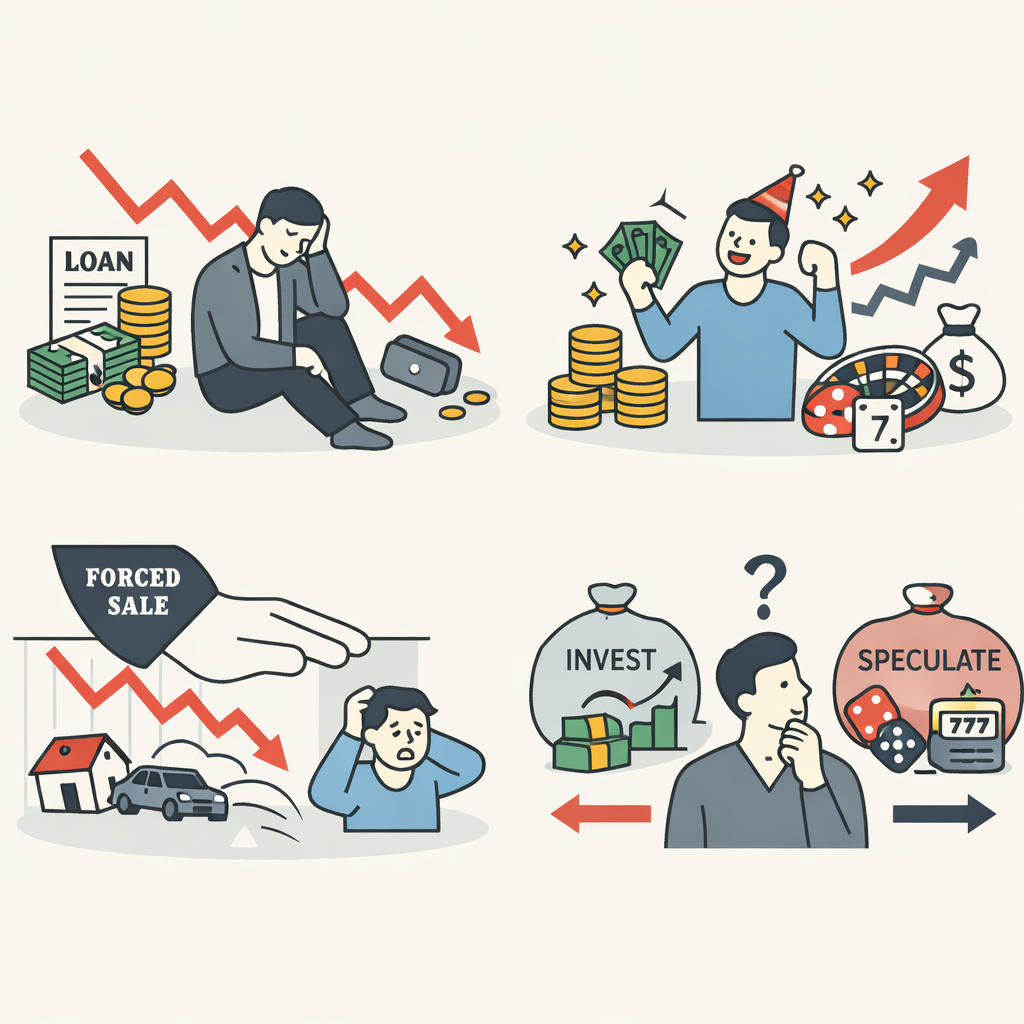
투자는 “쌀 때 사서 비쌀 때 파는 것”이니 말입니다. 가진 것을 몽땅 투자하는 일, 남의 돈을 빌려 투자하는 일, 써야 할 시한이 정해진 돈으로 투자하는 일, 이는 투자가 아닌 단연코 투기입니다. 투기는 도박이라는 말을 조금 순화시킨 단어이고, 열 번을 땄어도 한 번을 잃으면 몽땅 잃는 것이 도박입니다.
글자 그대로 Day Trader들은 초 단기 매매를 즐기지요. 그런데 초 단기 매매하는 분들 치고 끝까지 살아남은 분이 별로 없다는 것을 아시나요? 충분한 시간이 주어지지 않은 투자를 우리는 투기라고 해야 합니다.

——————
Episode 30: Is Investment Really Risky?
Many people consider stock investing to be dangerous and undesirable. However, in times like these, is there any way to grow wealth without investing? Developing a habitual aversion to investment without properly understanding it is, in itself, a very risky behavior. Then why have people in our country developed such resistance toward investment?
Since January 4, 1980, when the stock index was set at 100 and official exchange operations began, the Korean stock market has continued to grow. In particular, through the 1986 Asian Games and the 1988 Seoul Olympics, the stock market experienced explosive expansion.
As rumors spread that stocks could generate money, even those who had no understanding of stocks began investing. People started investing indiscriminately, believing that simply buying stocks would make them money. Securities firms even lent two to three times the principal to such investors.
For example, if someone invested 1 million KRW, the securities firm would lend an additional 3 million KRW, allowing them to purchase stocks worth 4 million KRW. Under the illusion that stock prices would only rise, investors borrowed money to maximize their positions. If prices increased, profits would indeed multiply fourfold.
But what happens if stock prices fall? If the 4 million KRW investment drops to 3.2 million KRW, the investor still owes 3 million KRW to the securities firm, leaving only 200,000 KRW of their own money. While the stock price declined by 20%, the investor effectively lost 80% of their capital.
If prices fall further, the investor may lose everything. Worse still, if the stock price drops by 25%, reducing the value to 3 million KRW, the securities firm may forcibly liquidate the holdings to recover the loan. This is known as a forced liquidation, and accounts left with no capital but only debt are commonly referred to as “margin call wipeout accounts.”
Investing all available funds after hearing that stocks can generate large profits—and furthermore borrowing additional money to amplify gains—is clearly speculation.
After the stock market experienced a large-scale wave of margin call liquidations in the late 1980s, many investors who lost their hard-earned savings had nowhere to turn. Some were not even aware that such rules existed when they began investing.
Those who lost their life savings and left the market often say, “If I ever touch stocks again, I am not human.” This sentiment resembles that of individuals who have lost everything through gambling. In fact, such situations still occur frequently. While some may believe that leveraging credit transactions during rising markets can maximize returns, such activities are undeniably speculation, not investment.
It may sound harsh, but those who have suffered major losses in the stock market must acknowledge that they were engaging in speculative behavior. A disciplined, long-term investor would not typically incur such catastrophic losses.
Around the time of the Subprime Mortgage Crisis, a newspaper editorialist appeared on television and stated that “those who suffered significant losses did so because of their own greed,” which sparked public backlash. However, it is equally true that without excessive greed, such large losses are unlikely.
Even today, whenever the stock market fluctuates significantly, news often reports that institutional investors profit while retail investors incur losses. This suggests that many retail investors are acting as speculators rather than true investors. A rational investor buys when prices fall and sells when prices rise to generate profit.
Investment is fundamentally about “buying low and selling high.” Investing all available funds, borrowing money to invest, or investing funds that are needed within a fixed timeframe—these are not investment behaviors but speculation. Speculation is merely a softened term for gambling; even if one wins multiple times, a single loss can wipe out everything.
So-called day traders engage in ultra-short-term trades, but very few sustain long-term success. Any activity that lacks sufficient time horizon should be considered speculation rather than investment.