성과를 창출하는 리더십은 내가 LG인화원에서 부장 진급자 교육과정에서 배운 내용을 바탕으로 하고 있다. 그후 대기업 부장에서 중소기업 임원과 CEO를 거치면서, 나는 성과창출 리더십을 직접 적용하고 실천하며 습관처럼 행하게 되어, 지금도 여전히 나의 리더십 스타일의 핵심으로 자리잡고 있다. 물론 이는 조직의 상황에 따라 다르겠지만, 지금 회사에서 팀장이든 임원이든 CEO이든, 리더의 입장에서 생각면서 취할 것만 취하면 좋을 것이다.
리더십은 나를 위한 것이 아니라 조직의 목표를 달성하기 위해 구성원들에게 행하는 과정이다. 그렇기 때문에 구성원들의 성과관리 프로세스로, 목표 설정(Goal Setting), 실행 촉진(Facilitating), 평가(Evaluating)의 3단계 과정의 정립이 필요하다.
1) 목표 설정(Goal Setting)
① 비젼과 미션
성과관리 프로세스의 첫 번째 단계인 목표설정은 조직의 비전체계 정립 및 목표 설정, 팀과 구성원의 개별목표 수립의 세가지 업무가 이루어져야 한다. 대부분의 중소기업에선 비젼(Vision)과 목표가 부족하거나 아예 없는 경우도 많다. 그러나 목표라는 것은 조직을 이끄는 이정표로써, 반드시 리더십을 발휘하기 위해서 기본적으로 수립되어야 하는 것도 중요한 목표이다.
도자, 영민 여상 동의(道者, 令民 與上 同意)란 말이 있다. “백성들로 하여금 윗 사람과 더불어 뜻을 같이 한다”라는 의미이다. 즉, 리더는 구성원들이 함께 뜻을 같이 하도록 만들어야, 목표를 달성하고 뜻을 이룰 수 있다는 말이다. 그래서 기업에서의 목표는 항상 전사적인 목표에서 부서 하부 단위로 나뉘어져서 구성원 개인까지 잘게 쪼개져야 한다.
회사의 비젼(Vision)과 미션(Mission), 중장기 전략과 목표에 따라 설정된 팀 상위조직의 사업목표를 달성할 수 있도록, 팀과 구성원 개인의 목표가 설정되어야 하는 것이다. 이 때 주의할 점은 팀 단위에서도 명확한 문제를 인식하고 이를 극복해야 하는 현실적인 목표가 수립되어야 하지, 위에서 떨어진(Top down) 무조건적으로 해야만 하는 뜬 구름 잡는 식의 목표는 구성원들의 열정을 오히려 해치는 방해요인만 될 것이다.
목표는 매출목표만을 의미하진 않는다. 영업부가 아닌 스탭(Staff) 조직에서도 매출 이외에 주어진 시간동안 해야 할 일들이 있는 만큼, 당연히 목표도 있어야 한다. 물론 영업도 단순히 매출목표 달성이 전부는 아니다. 매출목표가 양적인 것으로 ‘무엇을 해야 하는가(What to do)’라면, 목표달성을 ‘어떻게 해야 하는가(How to do)’ 라는 질적인 측면의 목표도 있어야 한다. 이것이 목표달성을 위한 바람직한 행동 지침이 되기 때문이다.
그래서 목표를 설정하기 위해선, 전사적인 비젼 및 미션과 연결된 팀 단위의 비젼과 미션도 정립할 필요가 있다. 물론 작은 기업이라도 당연히 비젼과 미션은 있어야 한다. 과거 나는 중국에서 화장품 법인을 설립했을 때, 회사의 비젼을 “아름다운 나, 아름다운 사회, 아름다운 세계”라고 정하는 것을 시작으로 사업을 시작했다. 이 비젼은 화장품을 매개로 해서 개인에게 아름다움이란 꿈도 제공해주지만, 나아가서는 기업이 속한 사회에 책임을 다하고 글로벌 진출 및 확대라는 꿈을 품고 있다. 이렇게 비젼이란 다분히 추상적인 이상과 같은 것으로써, 미래에 기업이 되고자 하는 것, 성취하고자 열망하는 것, 변화하여 나아가야 할 방향을 제시하는 것이다.
그리고 미션은 비젼을 이루기 위한 행동방식이라 할 수 있다. 이는 기업의 철학과도 연관되어 기업이 얻고자 하는 가치를 정의한 것으로써, 구성원들이 업무를 하면서 지켜야 할 지침이 되기도 한다. 즉, ‘아름다운 사회’라는 비젼에서 중국에서 번 돈을 한국으로 다 보내지 않고, 중국 사회를 위해 CSR(기업의 사회적책임) 활동에 노력을 기울이겠다는 약속도 함께 있는 것이다. 내가 몸담았던 LG그룹의 경영철학인 LG Way의 경우도, 정도경영(미션)을 실천하여 세계최고 수준의 일등LG(비젼)가 되겠다는 것이다.
팀의 비젼과 미션도 마찬가지다. 다만 기업의 비젼에 비해 지향점이 작고 세부적일 뿐이다. 팀의 설정된 목표는 팀원들의 행동 방향을 결정해주며, 조직이나 개인의 실적을 평가하고 보상하는 기준이 된다. 따라서 팀 목표를 설정하게 되면 자원이나 활동이 목표를 향해서 집중할 수 있게 되어, 팀원들의 활동과 자원의 활용을 정당화함으로써 합법성의 근거가 될 수 있다.
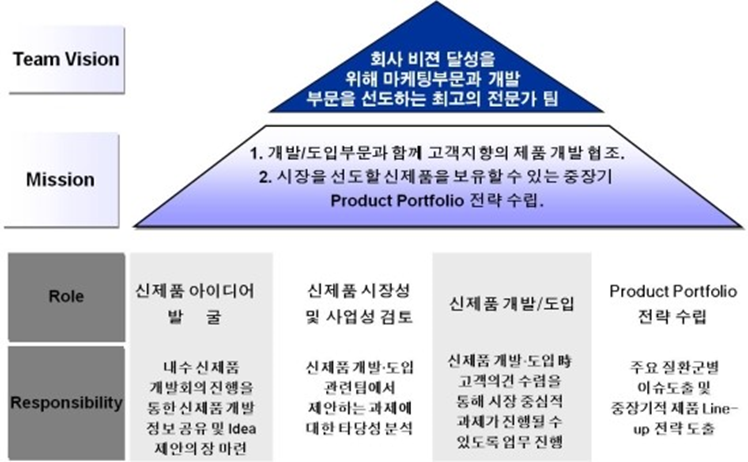
과거 대기업 마케팅전략팀장 시절에 나는 팀의 비젼과 미션을 아래 그림과 같이 만들었다. 회사의 비젼과 연결된 팀의 미래 모습을 비젼으로 설정하고, 이를 달성하기 위한 주요 행동원칙을 미션으로 넣었으며, 그 미션을 4가지 R&R(Role & Responsibility)로 더욱 세분화하여 팀원들에게 공유하였다. 이것이 근간이 되어 팀의 구체적인 목표와 공유가치가 이루어지게 되어, 마케팅전략팀은 자타공인 최고의 팀으로 성장할 수가 있었다고 나는 지금도 스스로 자부하고 있다.
———————————
The leadership I practice today is rooted in the content I learned during the manager promotion training course at LG Academy. After working my way up from a manager in a large corporation to an executive and CEO in smaller companies, I have consistently applied and practiced result-oriented leadership, making it a habit. As a result, it remains the core of my leadership style to this day. While this approach may vary depending on the organization’s situation, it is beneficial for leaders—whether they are team leaders, executives, or CEOs—to adopt and adapt what is most applicable to their role.
Leadership is not for personal gain but is a process carried out by leaders to achieve the organization’s goals through its members. Therefore, a performance management process for team members is required, encompassing three stages: Goal Setting, Facilitating, and Evaluating.
- Goal Setting ① Vision and Mission The first stage of the performance management process, Goal Setting, involves three key tasks: establishing the organization’s vision framework, setting objectives, and developing individual goals for the team and its members. In many small to medium-sized enterprises, there is often a lack of vision and objectives, or they may not exist at all. However, objectives are critical as they serve as milestones that guide the organization, making them an essential foundation for effective leadership.
There is a saying: “Leaders should guide the people to share the same intentions as those above them.” In other words, leaders must align their team members with shared goals to achieve success. In a corporate setting, objectives should always be broken down from the company’s overall goals into departmental and individual targets.
The team’s and individual members’ objectives should be set to achieve the business goals of the higher organizational level, which are aligned with the company’s vision, mission, and long-term strategy. It is crucial to recognize and address realistic challenges when setting team objectives, rather than imposing top-down, unrealistic goals, which can dampen the team’s enthusiasm.
Objectives do not only refer to sales targets. Even in staff organizations, rather than sales departments, there are tasks to be completed within a given timeframe, so objectives must exist. Similarly, sales objectives are not just about achieving sales numbers. If sales targets represent the quantitative aspect of “what to do,” there should also be qualitative objectives regarding “how to do it,” which serve as guidelines for desirable behavior in achieving these goals.
Therefore, to set effective objectives, it is necessary to establish a team vision and mission that align with the company-wide vision and mission. Even a small company must have a vision and mission.
For example, when I established a cosmetics subsidiary in China, I began by defining the company’s vision as “Beautiful Me, Beautiful Society, Beautiful World.” This vision represented the dream of providing beauty to individuals through cosmetics, fulfilling social responsibilities in the communities where the company operates, and expanding globally. A vision, inherently abstract and idealistic, presents what the company aspires to be, what it strives to achieve, and the direction in which it should evolve.
A mission, on the other hand, defines the approach to realizing the vision. It is closely related to the company’s philosophy, outlining the values the company seeks to achieve and serving as a guideline for team members in their work.
For example, the vision of “Beautiful Society” includes a commitment to not just sending all profits back to Korea but also contributing to CSR (Corporate Social Responsibility) activities in China. Similarly, LG Group’s management philosophy, known as the LG Way, involves practicing “Right-way Management” (mission) to become a world-class “Number One LG” (vision).
The same applies to a team’s vision and mission. The difference lies in the smaller and more detailed focus compared to the company’s vision. The goals set for a team determine the direction of team members’ actions and serve as criteria for evaluating and rewarding the performance of the organization or individuals. Therefore, by setting team goals, resources and activities can be concentrated towards these objectives, which justifies the activities and utilization of resources by the team members, thus providing a basis for legitimacy.
When I was the head of the marketing strategy team at a large corporation, I created a vision and mission for my team, as shown in the diagram below. I set a future vision for the team that aligned with the company’s vision and defined key behavioral principles to achieve it as our mission. This mission was further broken down into four R&Rs (Roles & Responsibilities), which I shared with the team members.
This became the foundation for setting concrete goals and shared values for the team, allowing the marketing strategy team to grow into one of the best teams, a fact of which I am still proud today.