

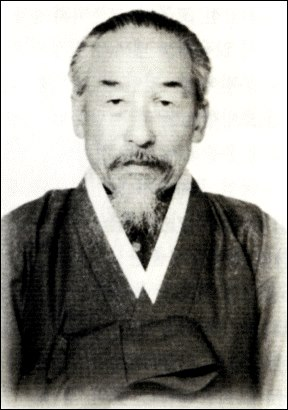
[환단고기]를 대중화시킨 이유립 (1907~1986)
압록강에 처참하게 버려진 계연수의 토막 난 시신이 수습될 때, 그 광경을 현장에서 지켜보며 말없이 눈물을 흘리던 14세 소년이 있었습니다. 바로 한암당 이유립이었습니다.
이유립은 계연수의 갑작스런 죽음으로 역사 속에 묻혀 버릴 뻔했던 [환단고기]를 굳게 지켜 오늘의 한국 사회에 널리 대중화시킨 인물입니다. 이암과 이맥의 후손인 이유립은 평안도 삭주의 유지이자 독립운동가였던 이관집의 넷째 아들로 태어났습니다.
세 살 때 천자문을 익힌 이유립은 여섯 살 때 [동몽선습]을 읽다가, “漢武帝討滅地(한무제토멸지)하시고”라는 구절에 이르러, “우리나라를 토멸한 한무제는 분명 우리나라 원수인데, ‘하시고’라는 토씨를 붙여 읽는 것이 나는 싫다”하고 동몽선습을 더 읽지 않았는데, 듣는 사람마다 이 이야기를 특이하게 여겼다고 합니다. 이유립은 계연수와 친했던 부친의 영향으로 어린 시절부터 역사에 눈을 뜬 것입니다.
이유립은 13세 때(1818) 배달의숙에 들어가 계연수와 최시흥, 오동진 등 독립운동가들에게 역사 강의를 듣고 [환단고기]를 공부하였습니다. 이듬해에는 조선독립소년단에 참가하여 단원을 통솔하는 단장이 되었습니다. 그 해는 계연수가 일제의 칼날에 참혹하게 도륙되던 해로, 그 무렵 이유립은 소년통신원으로도 뽑혀 독립군 사이의 통신 연락을 도왔습니다.
이유립은 독립운동을 계속하였습니다. 24세 때는 해학 이기의 신교육의 뜻을 이어받아 삼육사를 조직하고 잡지 <삼육>을 발행하며 일제의 역사 왜곡을 널리 알렸습니다. 하지만 이듬해 일제는 7월호의 내용을 문제삼아 <三育>을 폐간시키고 삼육사도 강제로 해체하였습니다. 33세에는 신풍학원을 세워 교사로 종사하며 학생들에게 조선의 얼과 역사를 가르쳤습니다. 그러나 일제는 학생들의 신사참배 거부, 창씨개명 불응, 무궁화 심기 운동 등을 이유로 들어 이마저도 중단시켰습니다.
1945년(39세) 광복을 맞은 후, 배달의 건국일인 10월3일에 단학회 동지들과 천마산에서 8.15 해방 경축 천제를 올리면서 단학회 기관지<태극>의 주간이 되었습니다. 이 잡지 역시 다음해 1월 신년호에 “신탁통치 반대론”을 실은 것이 문제가 되어 발행이 금지되고 말았습니다.
광복은 되었으나 여의치 않은 활동 여건 때문에 이유립은 1948년 5월 월남을 하다가 안내인의 배신으로 체포되어 해주 내무서에 수감되었습니다. 4개월여에 걸친 수감 기간에 고문과 급질로 죽을 지경에 이르러 소생 기미가 없자 내무서 인근에 버려졌습니다. 다행히 폭우 속에서 정신을 차린 이유립은 추석 바로 다음 날에 어렵게 삼팔선을 넘었습니다. 그 후 북한을 두어 차례 다녀왔는데, 이때 [환단고기]를 가져온 것으로 추정됩니다. 월남하여 친척집에 살다가 1963년(57세)에 대전 은행동에 정착하였고, 그 해 11월 단학회를 단단학회로 개칭한 이후에는 후학을 기르며 역사 연구와 강연에 전념하였습니다.
이유립이 남하한 직후, 한문과 역사에 해박한 그에게 여러 사람이 배움을 청하였는데, 그 중 한 사람이 오형기였습니다. 현 단단학회 회장이자 이유립의 제자인 양종현에 의하면, 오형기는 한국 고대사의 실상을 알고자 하는 구도자적인 의지를 가지고 환단고기 공부에 열성적이었다고 합니다. 1949년에 오형기는 이유립이 소장하고 있던 [환단고기] 초간본을 빌려 가서 필사하였습니다. 이때 오형기가 책의 말미에 발문을 붙여 썼는데, 책을 지은 사람이 쓰는 것이 상례인 발문을 오형기가 임의로 쓴 것에 대해 이유립은 매우 불쾌하게 여겼다고 합니다.
이유립은 대전 은행동 자택에 단단학회 본부를 두고, 1965년(59세)에는 기관지 <커발한>을 발행하기 시작하였습니다. 역사 관련 저술과 더불어 역사 교육을 실시하고, ‘국사 광복’을 외치는 전단도 만들어 돌였습니다. 이후에 ‘간도 땅’문제에 관심이 컸던 박창암(1923~2003)과 연결되어 1976년(70세)부터 월간 <자유>에 역사문제에 대한 글을 기고하기 시작했습니다. <자유>의 절반 정도를 자신의 글로 채우며 [환단고기]가 전하는 우리 역사 이야기를 세상에 알렸습니다.
1976년은 이유립에게 결코 잊을 수 없는 가슴 아픈 사건이 발생한 해이기도 합니다. 박창암의 배려로 의정부로 올라가 왕성하게 활동하던 중, 백내장 수술 차 5일간 집을 비운 사이에 집주인이 야반도주한 줄로 알고 밀린 집세 대신으로 이유립의 책을 모두 팔아 버린 것입니다. 이때 자신의 생명만큼 소중히 여기던 [환단고기] 초간본도 같이 사라져 버렸습니다. 하지만 천만다행으로 오형기 필사본이 있었기에 [환단고기] 전수 맥은 끊어지지 않았습니다.
그런데 뜻밖에도 [환단고기]대중화의 계기가 되는 일이 일어났습니다. 이유립의 젊은 문하생 조병윤이 1979년에 서울에 있는 ‘광오이해사’에서 오형기 필사본을 영인하여 100부를 출판한 것입니다. 이른바 ‘광오이해사본’ [환단고기]가 이유립의 허락도 없이 시중에 배포되자, 이유립의 단단학회는 사태 수습 차원에서 문제의 발문을 삭제하고 오자를 바로잡은 새로운 필사본을 만들었습니다. 원고는 1979년 그 해에 완료되었으나, 출판비가 없어 1983년에야 배달의숙을 발행인으로 하여 100부를 발간하였습니다. 이유립의 나이 77세가 되던 해였습니다. 평생 지키고 외쳐 온 [환단고기]를 인생의 마지막 순간에 세상에 공표한 것입니다.
그런데 배달의숙본이 나오기 전, 일본어로 번역된 [환단고기]가 일본에서 출판되어 나왔습니다. 가지마 노보루라는 일본인 변호사가 광오이해사본을 입수하여 검토하다가 [환단고기]를 동북아 역사와 일본 역사를 알 수 있는 소중한 책이라 여기고 일본어로 번역하여 출판한 것입니다. 가지마 노보루는 한문으로 적힌 [환단고기]를 번역하려고 고심하던 중 박창암과 인연이 닿아 한국을 방문하여 이유립을 대면하였습니다. 그 후 이유립이 우리말로 풀이하고 주석까지 붙인 [환단고기]원고를 박창암에게서 받아 본 후, 마침내 1982년에 ‘실크로도 흥망사’라는 부제를 붙인 일본어판 [환단고기]를 동경에서 출간하였습니다.
가지마는 환단고기를 아시아의 至寶라 극찬하였습니다. 하지만 번역에 오류를 범하였을 뿐 아니라 책의 핵심 내용을 훼손하고 왜곡시켰습니다.
환국->배달->고조선->북부여->고구려.백제.신라.가야->대진(발해).통일신라->고려로 이어지는 한국 역사를 배달->야마토일본->나라일본->헤이안시대로 이어지는 일본 역사로 둔갑시켜 번역하였고, 동방 한민족의 역사가 중동 유대족의 역사에서 발원하였다는 황당한 주장도 하였습니다.
그때 국내에서는 이유립, 임승국 등이 수년 동안 <자유>에 우리 고대사를 연재해 왔고 광오이해사본 [환단고기]가 이미 출시된 터라, 한민족의 상고 역사와 신교 문화가 조금씩 국민들에게 알려지고 있었습니다. 이러한 때에 일본인이 쓴 [환단고기]가 역수입되자, 한국 역사학계는 상당한 충격을 받았고 일반 대중도 환단고기에 대해 깊은 관심을 가지게 되었습니다.
그 후로 이유립은 군인과 일반인을 상대로 역사 강연과 저술 활동을 하다가 80세(1986년)를 일기로 타계하였습니다. 이유립은 평생 동안 일신의 영화를 구하지 않고 오로지 역사 광복에 매두몰신하였습니다.
추위와 굶주림 속에서도 역사 연구에 헌신하며 [환단고기]를 세상에 널리 알린 한암당 이유립! 그는, 환단고기의 모든 글을 감수하고 조선의 망운에 목숨으로써 답한 해학 이기와, 환단고기를 처음으로 발간하고 일제의 역사 도륙의 칼날에 무참히 죽어간 운초 계연수, 두 분과 마찬가지로 ‘국사학의 대부’입니다. 이분들의 고귀한 희생 덕분에 오늘날 한민족의 정통 사서 [환단고기]를 볼 수 있고, 9 천 년 한민족사의 정통 맥과 진실을 알 수 있게 된 것입니다.

————
Yi Yu-rip (1907–1986), Who Popularized Hwandangogi
When Gae Yeon-su’s mutilated body was retrieved from the Amnok River, a 14-year-old boy silently wept as he witnessed the tragic scene. That boy was Yi Yu-rip, later known as Hanamdang. Yi Yu-rip became the person who preserved Hwandangogi, which might have been lost to history after Gae Yeon-su’s sudden death, and he played a key role in popularizing it in modern Korean society.
A descendant of Yi Am and Yi Mak, Yi Yu-rip was the fourth son of Yi Gwan-jip, a prominent figure and independence activist in Sakju, Pyeongan Province. Yi Yu-rip showed his early intellectual prowess by learning the Thousand Character Classic at the age of three. At six, while reading Dongmongseonseup, he reached the phrase “漢武帝討滅地” (Emperor Han Wu conquered the land), and remarked, “Emperor Han Wu, who conquered our country, is surely our enemy, so why should I read this text with respect?” From that point on, he refused to continue reading it, a reaction that surprised those around him. Yi’s interest in history was sparked by his father, who was a close friend of Gae Yeon-su.
At the age of 13 (1920), Yi entered Baedal Academy, where he attended history lectures given by independence activists such as Gae Yeon-su, Choi Si-heung, and Oh Dong-jin, and studied Hwandangogi. The following year, he joined the Joseon Independence Youth Corps and was elected its leader. That same year, Gae Yeon-su was brutally murdered by the Japanese, and Yi Yu-rip, still a boy, worked as a messenger for the independence army.
Yi continued his independence activities. At 24, he followed Haehak Yi Gi’s vision of new education, organizing the Samyuk Society and publishing the magazine Samyuk to expose Japan’s historical distortions. However, in the following year, Japan banned Samyuk, citing its July issue as problematic, and forcibly dissolved the Samyuk Society. At 33, Yi founded the Sinpung Academy, where he taught students about Korean identity and history. But Japan suppressed these efforts too, using reasons like students’ refusal to worship at Shinto shrines, non-compliance with the name-changing policy, and the Mugunghwa tree-planting movement.
After Korea’s liberation in 1945, Yi, along with his colleagues from the Dangun Society, held a commemorative ritual at Cheonmasan Mountain on October 3, celebrating Korea’s independence. Yi also became the editor-in-chief of the society’s newspaper, Taeguk. However, the paper was shut down the following year after it published an article opposing the U.S. trusteeship.
Despite Korea’s liberation, Yi’s activities were hindered by difficult conditions. In 1948, while attempting to cross southward, Yi was betrayed by his guide, arrested, and imprisoned in the Haiju Department of Internal Affairs. During his four-month imprisonment, he was tortured and nearly died from acute illness. Believing he wouldn’t survive, his captors left him near death outside, but Yi miraculously regained consciousness during a rainstorm and managed to cross the 38th parallel the day after Chuseok. It’s believed that Yi retrieved Hwandangogi during a subsequent trip to North Korea. After living with relatives, he settled in Eunhaeng-dong, Daejeon, in 1963, and renamed the Dangun Society to the Dandan Society, dedicating himself to historical research and lectures.
Soon after moving south, many sought to learn from Yi due to his deep knowledge of classical Chinese and history. One of these students was Oh Hyeong-gi. According to Yang Jong-hyun, current president of the Dandan Society and a disciple of Yi Yu-rip, Oh was particularly passionate about studying Hwandangogi to uncover the truth about Korea’s ancient history. In 1949, Oh borrowed Yi’s original copy of Hwandangogi and transcribed it by hand. Oh even added a postscript to the book, which typically is written by the original author, and this greatly displeased Yi.
Yi Yu-rip based the headquarters of the Dandan Society in his home in Eunhaeng-dong, and in 1965 (at age 59), he began publishing the journal Keobalhan. Along with his historical writings, he continued educating others and distributed leaflets calling for the “restoration of Korean history.” Yi also began contributing to the monthly magazine Jayu in 1976, at age 70, writing articles on historical issues and using the magazine to inform the public about the history conveyed in Hwandangogi.
However, 1976 also marked a heartbreaking event for Yi. During a brief absence from his home for cataract surgery, Yi’s landlord, mistakenly thinking he had fled, sold all of his books to cover unpaid rent. This included the original edition of Hwandangogi, which Yi had cherished as dearly as his life. Fortunately, Oh Hyeong-gi’s handwritten copy remained, so the lineage of Hwandangogi was not entirely lost.
Unexpectedly, the circumstances for popularizing Hwandangogi improved. In 1979, Yi’s young disciple, Cho Byeong-yun, used Oh Hyeong-gi’s manuscript to print 100 copies at Gwang-o Publishing House in Seoul. This edition, known as the Gwang-o Publishing House Edition of Hwandangogi, was distributed without Yi’s permission, prompting the Dandan Society to correct errors and remove the problematic postscript. The new manuscript was completed in 1979, but due to a lack of funds, it wasn’t published until 1983. That year, 100 copies were printed under Baedal Academy, when Yi was 77 years old. Finally, Yi had succeeded in bringing Hwandangogi, which he had devoted his life to, to the public in the twilight of his years.
However, before this edition was released, a Japanese translation of Hwandangogi was published in Japan. A Japanese lawyer, Kajima Noboru, had acquired a copy of the Gwang-o Publishing House Edition, recognized its value for understanding Northeast Asian and Japanese history, and translated it into Japanese. Kajima, after receiving the original manuscript with Yi’s explanations and annotations from Yi’s colleague, Park Chang-am, published the Japanese edition in 1982, under the title The Rise and Fall of the Silk Road.
Kajima praised Hwandangogi as a “treasure of Asia,” but his translation contained errors, distorting and damaging the core message of the book. He reinterpreted Korean history—Hwan-guk -> Baedal -> Gojoseon -> Bukbuyeo -> Goguryeo, Baekje, Silla, Gaya -> Balhae, Unified Silla -> Goryeo—to align with Japanese history, claiming it followed the lineage of Baedal -> Yamato Japan -> Nara Japan -> Heian Japan. He also made absurd claims, suggesting that the history of the East Asian people originated from the history of the Jewish people in the Middle East.
By this time, Yi Yu-rip and others had been publishing articles on Korea’s ancient history in the magazine Jayu for years, and the Gwang-o Publishing House Edition of Hwandangogi was already in circulation. The upper echelons of Korean society were gradually becoming more aware of ancient Korean history and its cultural roots. When the Japanese edition of Hwandangogi was reimported into Korea, it caused significant shock within Korea’s academic community, and the general public became deeply interested in the text.
Yi Yu-rip continued his historical lectures and writings until his death at age 80 in 1986. He had spent his entire life with a singular devotion to the restoration of Korean history, never seeking personal fame or fortune.
Hanamdang Yi Yu-rip, who dedicated himself to spreading Hwandangogi despite hardship and poverty, stands alongside Haehak Yi Gi, who annotated all of Hwandangogi, and Uncho Gae Yeon-su, who first published the text and met a brutal death at the hands of the Japanese. Thanks to their sacrifices, we can now access Hwandangogi, the authentic history of the Korean people, and understand the 9,000-year legacy of Korean civilization.