

[수메르 문명의 전파]
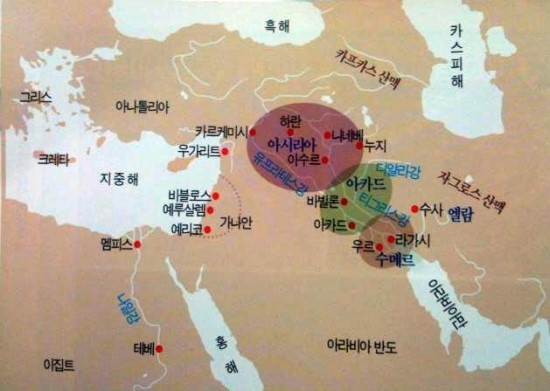
동방에서 온 수메르인들의 문명은 메소포타미아 땅에서 계속 전승되었을 뿐만 아니라 소아시아(지금의 터키), 시리아, 이집트 등지로 전파되었습니다. 이집트 문명은 수메르보다 대략 500년 후에 번성하기 시작한 것으로 이집트의 건축, 기술, 문자 등은 모두 수메르 문명에서 유래한 것입니다. 예를 들어 원기둥 모양으로 된 인장, 이집트의 건축술 가운데 받침대를 받치는 것 등은 수메르에서 영향을 받은 것입니다. 이집트의 문자도 수메르의 설형문자를 변형한 또 다른 설형문자였습니다.
이집트 문명을 일으킨 후 수메르 문명은 다시 크레타 섬으로 전파되었습니다. 크레타 섬에서 유럽의 최초 문명인 미노아 문명(BCE2700~BCE1420)이 탄생하였고 이 문명은 다시 그리스 문명으로 계승되었습니다. 때문에 수메르 문명을 ‘서양 문명의 모체’ 또는 ‘서양 문명의 창시자’라 부릅니다.
수메르 문명과 그것을 계승한 오리엔트 문명이 이집트와 크레타를 겨쳐 그리스까지 전파되는 데는 교역이 큰 역할을 하였습니다. 예를 들자면, 충적토로 이루어진 수메르 지역에는 청동의 원료인 구리와 주석이 나지 않기 때문에 수메르인은 이 두 금속을 모두 무역을 통해 조달하였습니다. 수메르인들은 일찍이 BCE4000년경부터 청동을 제조할 수 있었습니다. 만들어진 청동 제품은 높은 값에 팔려 나갔습니다. 수메르인들은 일찍부터 은을 화폐로 사용하였는데, 이것은 지금의 미국 달러가 그러하듯 당시 지중해 전역에서 통용되었습니다.
그리고 크레타인들은 BCE2000년경 이전부터 무역활동을 통해 이집트를 포함한 지중해 연안을 자주 왕래하였습니다. 그 과정에서 메소포타미아 문명과 이집트 문명을 접하여 이 이웃들의 문자, 신화, 건축술, 천문학, 수학 등 많은 문화를 받아 들였습니다. 그리고 이 문화를 다시 지중해 서부 지역으로 수출하였습니다. 동방에서 온 수메르 문명이 바닷길을 통해 서진하여 서양 세계로 전해진 것입니다.
이에 대해 김상일은 ‘그리스인들이 수메르 문화를 흡수하여 서쪽으로 통풍구를 만들어 주었다’고 표현합니다. 그리스는 그들의 황금 시기인 BCE 5세기에 들어올 때까지 예술, 건축, 철학, 문학 등의 적지 않은 분야에서 수메르 문화의 영향을 나타냅니다.
그리스를 거쳐서 그 후 서양 세계에 전수된 수메르 문명의 흔적은 여기저기서 나타납니다. 수메르의 왕들은 건물을 관리하고, 길을 수리하고, 여행자를 위해 여관을 만드는 일상적인 문제에서 정치 분쟁과 국제적인 거래 등 복잡한 문제에 이르기까지 모든 문제를 문서화하고 관련된 계약 문서를 작성하여 두었습니다. 이것이 서양의 초기 황실제도에 전승되어 서류 정리하는 법, 회계장부 쓰는 법 등으로 정착되었습니다. 오늘날 영국 황실제도도 수메르 황실제도의 모방에 불과하다고까지 말합니다.
또한 수메르 문명은 동쪽으로 인도에까지 전파되었습니다. 지금의 이란 북쪽 국경 너머의 카프카스 산맥에 살면서 인도-유럽어를 쓰던 한 종족이 BCE2000년경에 남쪽으로 대규모 이주를 시작하였습니다. 그들은 수메르의 도시국가에서 멀리 떨어져 북쪽에 살았지만, 당시 가장 부흥했던 수메르 문명과 무관하게 살 수는 없었을 것입니다. 그들이 남하한 때는 수메르 왕조 말기입니다. 수메르의 혼란한 상황이 그들로 하여금 새로운 보금자리를 찾아 떠나도록 하였을 것으로 짐작됩니다.
마침내 인더스 강 유역에 도착한 그들을 당시 인더스 사람들은 아리안Aryan(고귀한 사람)이라 불렀습니다. 아리안족은 BCE1500년경에 [베다]<브라만교와 힌두교의 경전)이야기를 인도에 구전으로 전하였습니다.
히브리(유대)문명도 수메르 문명과 직간접으로 연관되어 있습니다. 유대인의 역사가 기록된 [구약전서]의 <창세기>에 의하면, 그들의 조상 아브라함은 지금으로부터 4천여 년 전 갈데아 우르(이라크 남부)에 살던 사람입니다. 간단히 말해서 아브라함은 수메르의 거대 도시국가에 살던 전형적인 수메르인이었습니다.
그런데 아브라함이 살던 당시‘수메르의 우루’는 있었지만 ‘갈데아의 우르’는 없었습니다. 갈데아의 우르는 BCE9세기 초에 갈데아인이 남서부 메소포타미아 지역에 정착한 것에서 비롯되었습니다. 이때는 [구약전서] <창세기>가 기록되던 시기로 예산 아브라함이 살던 곳이 당시에는 갈데아인의 영역이었기 때문에 성서기록자들이 갈데아 우르라고 표기한 것입니다. (고야마 시게키-지도로보는 중동이야기 21쪽)
아브라함은 아버지 데라와 함께 우르로부터 400km 북쪽에 위치한 하란을 거쳐 가나안(지금의 팔레스타인과 시리아 남부 지역)지역으로 이주하였는데, 이때 유프라데스 강을 건너야 했습니다. 이 때문에 그의 후손들은 오늘날까지도 히브리인, 즉 강을 건너온 자라고 불리고 있습니다.(다까바시마사오-성서원형의 신비 41~42쪽).
히브리인들은 기원전 1700~기원전1300년 사이의 설형문자 기록(당시는 고 바빌로니아 시대)에 하비루란 종족 이름으로 끊임없이 나타납니다. 이들은 BCE1500년대 초기가 될 때까지 유목생활을 하며 메소포타미아 땅의 힘센 부족들 사이에서 용병으로 팔려다니곤 했습니다. 아브라함 종족이 가나안으로 이주한 지 5백 년의 세월이 지난 때 비로소 팔레스타인을 정복하고 거기에 정착하였습니다. 아브라함 종족, 즉 히브리인은 가나안 땅에 들어가서도 계속 수메르의 영향 속에서 살았습니다. 그들이 접촉한 가나안족이 수메르 문화와 똑같이 설형문자를 쓰고, 수메르의 교과과정을 그대로 따르는 등 수메르 문화에 깊이 젖어 있었기 때문입니다.
그 후 히브리인은 기원전 6세기의 바빌론유수幽囚사건 때, 수메르 문화에 더욱 더 밀착되었습니다. 바빌론의 포로로 살던 당시, 수메르를 계승한 바빌론의 문자와 학문은 히브리인의 마음과 사상 속에 깊이 침투해 들어갔습니다. 나중에 히브리인이 바빌론에서 돌아 왔을 때 그들은 수메르의 예배 의식, 교육, 법조문 등을 가지고 왔습니다.
그런데 [구약전서]에는 고대 중동의 종족이 많이 나오지만 수메르인은 단 한 번도 보이지 않습니다. 이집트인, 가나안인, 히아이트인, 아시이라인, 바빌로니아인 등 숱한 종족이 거명되지만 수메르인이라 불린 종족은 구약전서에 나오지 않는 것입니다. 이러한 사실은 수메르인이 바로 히브리인 자신들의 조상임을 고백하는 것과 다름 없습니다.
수메르 문명은 인도와 메소포타미아 사이에 있는 이슬람 문화(페르시아 문화)에도 영향을 미쳤습니다. 예를 들어 이란의 아라타Aratta란 도시는 수메르와 꼭 같은 정치적 조직과 종교적 신앙체계를 가지고 있었습니다. 이란의 고대 종족인 엘람은 수메르의 마지막 왕조인 우르 제 3왕조를 무너뜨린 침입자이지만, 엘람의 법률, 문학, 종교 등은 모두 수메르의 것이었습니다. 그리고 엘람족의 신 이름은 수메르 신들의 이름을 그대로 이어받은 것이었습니다.
이상에서 살펴보았듯이, 수메르 문명은 메소포타미아 문명, 이집트 문명, 그리스 문명, 유대 문명, 이슬람 문명의 근원이 되었고, 인도의 인더스 문명에 새로운 바람을 불러 일으켰습니다. 한마디로 수메르 문명은 오늘날 서양 문명의 요람인 것입니다.
수메르가 서양 문명에 끼친 영향은 오늘날 세계에까지 미치고 있습니다. 그 대표적인 것이 서양에서 수메르인이 최초로 사용한 바퀴와 수레입니다. 수메르인은 한 번 에 많은 흙이나 물건을 손쉽게 운반할 수 있는 네 바퀴 달린 수레를 발명하였는데 덕분에 로마 군인은 마차를 타고 유럽을 평정할 수 있었습니다.
서양의 천문학도 수메르에서 유래하였습니다. 수메르인들은 춘분과 추분을 따지고 달의 운행 법칙을 발견하는 경지에까지 이르렀습니다. 황소자리, 사자자리 등 별자리에 이름을 붙이는 것도 수메르인이 최초로 시작하였고, 점성술도 이미 이때 성행했습니다. 서양의 건축과 음악도 그 원형이 전부 수메르에서 나왔습니다. 서양 문명의 요소들 중에서 수메르에 뿌리를 두지 않은 것은 거의 찾아보기 어렵습니다.
기원전 4000년경에 혜성처럼 갑자기 나타난 수메르 문명을 서양에서는 인류 최고 문명으로 칭송합니다. 그렇다면 수메르 문명의 근원인 동방 환국 문명이야말로 진정한 인류 최고의 문명이 아닐까 합니다.
[수메르와 기독교]
수메르는 서양 문명 중에서도 특히 유대교와 기독교에 지대한 영향을 미쳤습니다. 우선 그들의 경전에서 말하는 ‘하느님이 흙으로 인간을 빚어 생명을 불어 넣음으로써 인간이 탄생했다’는 이야기의 근원은 수메르입니다. ‘인간은 하느님을 섬기도록 만들어졌으며 하느님의 창조적 힘은 그의 말씀 안에 있다’는 내용도 수메르에 근원을 두고 있습니다. ‘마지막 날에 하느님의 심판이 악한 자에게 임하고, 고난과 고통이 따를 것’이라는 내용도 마찬가지입니다. 특히 창세기에서 말하는 에덴동산, 대홍수와 노아의 방주, 카인과 아벨의 싸움, 바벨탑 등의 이야기는 수메르의 문학 작품에서 기원합니다.
하느님을 찬양하는 시로 채워진 시편은 수메르의 예배 의식 때 썼던 의례문이고, 유대인이 유월절 명절 때 낭송한 아가서는 수메르 마지막 왕조가 멸망할 때 읊던 바로 그것입니다. 잠언에 실린 속담과 금언은 수메르의 교훈 속담, 전설을 편집한 것입니다.
기독교의 신약에 기록된 예수의 탄생에서 죽음까지의 행적도 거의 수메르에서 나온 것입니다. 그 중 대표적인 것은 ‘처녀 잉태’, 아기 예수에게 동방박사를 인도한 별의 나타남, 아기 예수가 이집트로 피난한 일, 3일 만의 부활 같은 것이 모두 수메르의 영향입니다.
경전의 내용뿐 아니라 그들의 예배 의식도 수메르 문명에서 전해진 것이 많습니다. 유대교의 예배 의식은 오늘날까지도 바빌론에게 빌려 온 것으로 가득 차 있습니다. 유대인들이 속죄일 전야의 예배 때 읊는 기도문인 콜니드레는 수메르의 신년 예식문과 같습니다. 바빌론 유수 시절 히브리인들은 악마를 내쫓는 법을 배워 왔는데, 이것은 신약전서에 악마를 내쫓는 행위로 나타나 있습니다. 결론적으로 우리가 알고 있는 유대교와 기독교는 바로 수메르의 종교와 사상을 모체로 하고 있는 것입니다.

————
The Spread of Sumerian Civilization
The civilization of the Sumerians, who came from the East, not only continued to thrive in Mesopotamia but also spread to regions such as Asia Minor (modern-day Turkey), Syria, and Egypt. Egyptian civilization began to flourish around 500 years after Sumer, and its architecture, technology, and writing systems were all derived from Sumerian civilization. For example, the cylindrical seals and the architectural technique of supporting columns in Egyptian construction were influenced by the Sumerians. The Egyptian script itself was a variation of the Sumerian cuneiform writing system.
After the rise of Egyptian civilization, Sumerian civilization again spread to the island of Crete. It was there that the first European civilization, the Minoan civilization (BCE 2700–BCE 1420), emerged, which later evolved into Greek civilization. As a result, Sumerian civilization is often referred to as the “mother of Western civilization” or the “creator of Western civilization.”
The spread of Sumerian civilization and the Oriental civilizations it influenced reached Egypt and Crete, eventually spreading to Greece, largely through trade. For example, the Sumerian region, composed of alluvial soil, did not have copper or tin, the raw materials for bronze, so the Sumerians had to obtain both metals through trade. As early as around BCE 4000, the Sumerians were capable of manufacturing bronze. The products made from bronze were sold at high prices. The Sumerians also used silver as currency, which was accepted throughout the Mediterranean at the time, much like the U.S. dollar today.
Additionally, the Cretans, by around BCE 2000, frequently traveled along the Mediterranean coast, including Egypt, through trade. In doing so, they came into contact with both Mesopotamian and Egyptian civilizations, adopting many cultural elements such as writing, mythology, architecture, astronomy, and mathematics. These elements were then exported back to the western Mediterranean region. The Sumerian civilization, coming from the East, traveled westward by sea, bringing its culture to the Western world.
Kim Sang-il expresses this by saying that “the Greeks absorbed Sumerian culture and created a vent to the West.”
Until their Golden Age in the 5th century BCE, the Greeks demonstrated clear influences from Sumerian culture in various fields, including art, architecture, philosophy, and literature.
After Greece, the legacy of Sumerian civilization continued to pass into Western civilization. Sumerian kings documented everything from managing buildings, repairing roads, and establishing inns for travelers to dealing with political disputes and international transactions. These records, with related contracts, formed the foundation of Western monarchy systems, influencing how documents were organized and accounting books were written. Some even claim that today’s British monarchy is simply an imitation of the Sumerian royal system.
Sumerian civilization also spread eastward to India. Around BCE 2000, a group of people speaking an Indo-European language, living in the Caucasus Mountains north of modern-day Iran, began migrating southward in large numbers. Though they lived far from the Sumerian city-states, it is unlikely they could have been unaffected by the flourishing Sumerian civilization at the time. The Sumerian turmoil likely pushed them to seek new homes.
Eventually, when they reached the Indus Valley, the people there referred to them as Aryans (meaning “noble people”). The Aryans, around BCE 1500, brought the Vedas (the scriptures of Brahmanism and Hinduism) to India as oral traditions.
The Hebrew (Jewish) civilization is also indirectly or directly related to Sumerian civilization. According to the Bible’s “Genesis,” the patriarch Abraham lived around 4,000 years ago in the Sumerian city of Ur (in southern Iraq). In simple terms, Abraham was a typical Sumerian living in one of Sumer’s great city-states. However, during Abraham’s time, there was no such thing as “Chaldean Ur.” The Chaldean Ur was founded in the early 9th century BCE when the Chaldeans settled in southwestern Mesopotamia, and it was at this time that the Genesis was written. The biblical authors referred to it as “Chaldean Ur” because Abraham lived during this time.
Abraham, along with his father Terah, moved from Ur to Haran, located about 400 kilometers north, and then to the region of Canaan (modern-day Palestine and southern Syria), crossing the Euphrates River along the way. For this reason, the descendants of Abraham are still referred to as the Hebrews, meaning “the people who crossed the river.”
Between BCE 1700 and BCE 1300, the name “Habiru” (sometimes written as “Hebrew”) continuously appeared in cuneiform records (during the Old Babylonian period). They lived a nomadic life and were often hired as mercenaries among the powerful tribes of Mesopotamia. It was only after about 500 years of Abraham’s migration to Canaan that his descendants finally conquered Palestine and settled there. Even after settling in Canaan, the Hebrews continued to live under the influence of Sumerian culture, as the Canaanites they interacted with were deeply influenced by Sumerian culture, using cuneiform writing and following Sumerian curricula.
Later, during the Babylonian Exile in the 6th century BCE, the Hebrews became even more closely connected with Sumerian culture. While living as captives in Babylon, the Sumerian-derived Babylonian scripts and knowledge infiltrated Hebrew thought and beliefs. When the Hebrews returned from Babylon, they brought with them Sumerian-inspired religious rituals, education, and legal codes.
Interestingly, while the Old Testament mentions many ancient Middle Eastern peoples, the Sumerians are never explicitly named. Egyptians, Canaanites, Hittites, Assyrians, and Babylonians are mentioned, but there is no direct reference to the Sumerians. This absence is, in itself, a confession that the Sumerians were the ancestors of the Hebrews.
Sumerian civilization also influenced Islamic culture, which lies between India and Mesopotamia. For example, the Iranian city of Aratta had a political structure and religious system very similar to Sumer’s. The ancient Elamites of Iran, who invaded and destroyed Sumer’s final dynasty, the Third Dynasty of Ur, adopted Sumerian laws, literature, and religious practices. The names of their gods were also directly derived from Sumerian deities.
As seen above, Sumerian civilization was the foundation of Mesopotamian, Egyptian, Greek, Jewish, and Islamic civilizations, and it also introduced new ideas to India’s Indus Valley civilization. In short, Sumerian civilization is the cradle of Western civilization today.
Sumer’s Influence on Western Civilization
Sumer’s impact on Western civilization is still felt today. One of the most notable examples is the wheel and cart, invented by the Sumerians. They created a four-wheeled cart, which allowed them to transport large amounts of earth or goods easily. This invention enabled Roman soldiers to conquer Europe using chariots.
Western astronomy also originated from Sumer. The Sumerians were among the first to track the solstices and equinoxes and to discover the movements of the moon. They were the first to name constellations like Taurus and Leo, and astrology also began during their time. Western architecture and music also trace their roots to Sumer. It is difficult to find any aspect of Western civilization that does not have its origins in Sumer.
Around 4000 BCE, Sumerian civilization suddenly appeared like a comet, and the West has praised it as the greatest civilization in human history. Could it be that the true “greatest civilization” of humanity lies in the Eastern Han-Guk civilization that gave rise to Sumer?
Sumer and Christianity
Sumer had a profound impact on Western civilization, especially on Judaism and Christianity. For example, the biblical creation story, in which “God formed man from the dust and breathed life into him,” originates from Sumer. The concept that “man was created to serve God, and God’s creative power is in His word” is also rooted in Sumer. Similarly, the idea that “on the last day, God’s judgment will fall on the wicked, and suffering will follow” has its origins in Sumer. Notably, the stories of Eden, the Great Flood, Noah’s Ark, Cain and Abel’s conflict, and the Tower of Babel in Genesis all have their roots in Sumerian literature.
The Psalms, filled with hymns praising God, are based on Sumerian ritualistic prayers. The Passover songs recited by the Jews during the festival are identical to those sung at the fall of the last Sumerian dynasty. The proverbs and sayings found in the Book of Proverbs are based on Sumerian wisdom and legends.
Even the life and death of Jesus Christ, as recorded in the New Testament, show clear Sumerian influence. The Virgin Birth, the appearance of a star guiding the Three Wise Men, the flight to Egypt, and the resurrection after three days are all derived from Sumerian tradition.
In addition to biblical content, many aspects of Jewish worship rituals also trace back to Sumer. The Jewish Yom Kippur prayers, such as the Kol Nidre, are closely linked to Sumerian New Year rites. During the Babylonian Exile, the Hebrews learned exorcism rituals, which are reflected in the New Testament as acts of driving out demons. In conclusion, the Jewish and Christian religions we know today are fundamentally based on Sumerian religion and philosophy.