

초대 환웅이 배달을 개국한 지 1,500여 년, 18세 환웅에 이르러 배달은 그 역사의 막을 내리게 됩니다. 말기의 쇠한 국운을 보여주듯 마지막 세 분 환웅은 역대 천황의 평균 수명(104세)에 못 미치는 짧은 생을 살았습니다. 특히 18세 거불단환웅은 82세로 수명이 가장 짧았습니다. 이러한 사실은 당시 배달 내부의 정치 상황과 동북아 정세가 매우 혼란스러웠음을 짐작하게 합니다.
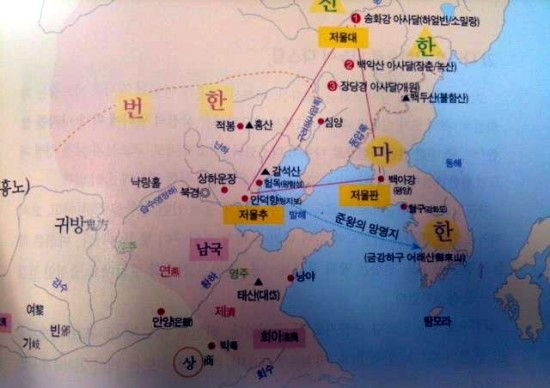
거불단환웅이 세상을 떠나고, 단군왕검이 38세에 천제의 아들로 추대되어 제위에 올랐으니 때는 신시개천 1,565년(BCE2333)이었습니다. 14세 때부터 24년간 웅씨족 나라의 비왕으로 있으면서 이미 제왕 수업을 받은 초대 단군은 배달 말기의 혼란을 잠재우고 구환족 전체를 하나로 통일하여 조선을 열었습니다. 단군왕검은 조선의 개국 시조로서 삼신상제님께 천제를 올리고, 송화강 유역(지금의 흑룡강성 하얼빈)의 ‘아침 태양이 빛을 비추는 땅’인 ‘아사달’에 도읍을 정하였습니다.
그 후 22세 색불루단군은 이 송화강 아사달에서 남서쪽의 백악산 아사달(지금의 길림성 장춘)로 천도하였고, 44세 구물단군은 남쪽으로 더 내려와 장당경 아사달(지금의 요령성 개원시)로 천도 하였습니다. 도읍지의 이동에 따라 세 왕조의 변천을 거친 고조선은 마흔 일곱 분 단군이 2,096년 동안 다스렸습니다.
환단고기와 함께 고조선사를 밝히는 핵심 고유 사서인 단기고사, 규원사화도 47세 단군의 호칭을 동일하게 기록하였습니다. 그러나 고조선의 역년에 대해서는 단기고사는 2,096년, 규원사화는 1,205년으로 차이가 있습니다. 이 세 권과 달리 고조선사를 한 분의 단군사로 잘못 기록한 삼국유사에서 ‘단군이 1,908세를 살았다’라고 한 것은 송화강 아사달(1,048년)과 백악산 아사달(860년)시대를 합친 것입니다. [응제시주], [연대세년가], [동사강목] 등에서 단군왕검의 수를 1,048년이라 한 것은 송화강 아사달 시대의 역년을 가리킨 것입니다.
단군왕검은 삼신(조화신.교화신.치화신)의 원리에 따라 나라를 삼한, 즉 진한.번한.마한으로 나누어 다스렸습니다. 이것이 바로 고조선의 국가 경영 제도인 삼한관경제(三韓管境制)입니다.
단군왕검은 대단군으로서 요동과 만주 지역에 걸쳐 있던 진한을 통치하고, 요서 지역에 있던 번한과 한반도에 있던 마한은 각각 부단군이 통치하였습니다. 마한은 하늘의 정신[天一]을, 번한은 땅의 정신[地一]을, 진한은 천지의 주인이요 중심인 인간[太一]을 상징하였습니다. 삼한으로 나뉘었으니 도읍지도 세 곳이었습니다. 진한의 수도는 아사달(지금의 하얼빈), 번한의 수도는 안덕향(지금의 하북성 당산시), 마한의 수도는 백아강(지금의 평양)이었습니다.
일찍이 한말의 애국지사요 민족사학자인 단재 신채호는 삼한관경제가 고조선의 국가 경영 원리임을 밝혀냈습니다. 단재는 맨몸으로 북만주를 누비며 한반도의 남쪽 삼한시대 이전에 만주, 요서, 한반도에 걸쳐 광대하게 뻗어 있었던 단군조선의 삼한시대가 실재했음을 입증하였습니다.
이처럼 고조선은 광대한 제국이었습니다. 고조선 영토는 동쪽으로 한반도의 동해에 미치고, 북쪽으로 흑룡강을 지나 시베리아까지 이르고, 남쪽으로 큐슈와 일본 본토까지, 서쪽으로 몽골에 이르렀습니다. 이러한 고조선을 고려, 조선의 중화 사대주의자들과 일제의 식민사학자들이 한반도 북부에 국한된 소국으로 줄여 놓았습니다.
단군왕검께서 재위 67년(단기 67,BCE2267)에 태자 부루를 보내어, 9년 대홍수를 겪으며 국가 존망의 위기에 처한 중국에게 ‘오행의 원리로 물을 다스리는 법’을 전하여 요순 정권을 구해 주었습니다. 부루 태자가 중국의 순임금이 보낸 사공을 도산에서 만나 오행치수법을 전한 이 사건은 동방회맹의 시초라 할 수 있습니다.
이후 고조선은 중국과의 국경을 살펴, 오늘날의 하북성과 산동성 일대인 유주와 영주를 강역으로 편입하였습니다. 유주와 영주는 순임금 때 새로 세워진 주입니다. 요임금 때 기주, 연주, 청주, 서주, 형주, 양(梁)주, 예주, 양(揚)주, 옹주 등 9주가 신설되었고, 순임금 때 다시 유주, 영주, 병주등 3주가 신설되었습니다. 이 12주 가운데 고조선과 국경을 맞댄 곳에 위치하였던 유주와 영주가 단군왕검에 의해 고조선으로 편입된 것입니다.
그리고 13세 흘달단군은 하나라의 마지막 왕 걸을 정벌할 때 빈과 기를 공격하여 강역을 더욱 넓혔습니다. 빈과 기는 현재의 섬서성에 위치한 지역으로, 섬서성은 하북성에서 대륙 서쪽으로 더 들어간 곳입니다. 이런데 이 빈, 기 땅을 공격할 때, 고조선 군사와 낙랑 군사가 합세하였다고 합니다.
이 낙랑은 과연 무엇일까요? 지금의 하북성, 요령성 일대에 해당하는 낙랑은 배달의 태호복희씨 때부터 있었던 지명으로, 고조선 시대에는 고조선의 제후국 이름이었습니다. 낙랑은 23세 하홀단군 때 낙랑홀이라는 성으로 다시 나타납니다.
영토를 확장하며 중국을 제압하던 고조선은 제3왕조에 이르러 수세적인 입장에 놓이게 되어 전국 칠웅의 하나인 연나라의 침략을 받았습니다. 45세 여루단군 때(BCE365) 연나라가 고조선과의 국경 지대인 운장을 공격한 것입니다 (단군세기). 운장은 지금의 난하 서쪽으로 하북성 북부 지역에 해당합니다. 연나라에게 이 곳을 빼앗겼으나 고조선의 세 조선(진조선, 번조선, 막조선)이 협력하여 곧 회복하였습니다.
그런데 이 운장은 이후 BCE195년에 번조선의 준왕이 망명객 위만을 받아주면서 그곳 국경 수비대장으로 임명한 곳입니다. 이처럼 운장이 번조선 땅이었다는 점으로 미루어 볼 때, 제3왕조 시대 내내 고조선의 서쪽 국경은 난하를 훨씬 넘어서 위치하였다는 것을 알 수 있습니다.
고조선의 강역을 짐작케 하는 국경지대의 또 다른 지명은 만번한입니다. 몇몇 중국 사서가 기록한 ‘진개의 공격’사건에 이 지명이 등장합니다. “연은 장수 진개를 보내어 그 서쪽 지역을 공격하게 하고 땅 2천여 리를 빼앗았다. ‘만번한’에 이르러 경계로 삼으니 조선은 마침내 약화되었다.”(삼국지-위서동이전). [사기]와 [염철론]의 기록은 [삼국지]와 다소 다르지만, 중국이 승리한 이 전쟁을 세 사서가 모두 자세히 서술하고 있습니다. 이 만번한도 운장과 마찬가지로 고조선의 서쪽 국경이었고 지금의 하북성 일대에 속합니다.
고조선의 강역이 대륙 깊숙이 뻗어 있었다는 사실을 고고학 발굴로도 입증됩니다. 20세기 후반에 발굴된 하가점 문화가 바로 그것입니다. 하가점은 내몽골 자치구 적봉시의 한 촌락으로 건조한 기후 때문에 유적과 유물이 빗물에 유실되지 않고 시대별로 층층이 잘 보존된 곳입니다. 하가점의 유적지의 상층에서 유목민 문화가 나타났고, 하층에서 BCE2400~BCE1500년에 걸쳐 농경집단의 청동기 문화가 나타났습니다. 이 하층에서 비파형 청동검이 나왔는데, 그것은 청동기 문화의 대표적 유물로서 만주와 한반도에서 발굴된 청동검과 동일한 것입니다. 따라서 하가점 하층문화는 고조선 문화이고, 하가점 지역은 고조선의 영역인 것입니다.
이처럼 문헌 기록으로 보나 유물로 보나, 고조선은 한반도에서 요서에 이르는 드넓은 땅을 차지한 동북아시아의 대국이었습니다. 고조선은 동북아의 대국으로서 70여 개의 크고 작은 제후국을 거느렸습니다. 단군세기를 비롯하여 제왕운기, 삼국유사, 고려사, 세종실록, 응제시주, 규원사화 같은 국내 문헌뿐 아니라 중국 사서들이 그 사실이 구체적으로 기록되어 있습니다.
이들 역사책에 기록된 제후국만 해도 시라(길림), 고례(고구려) 즉 고리국, 옥저, 부여, 예, 맥, 남국(북경 부근), 숙신, 청구, 낙랑, 여, 임둔, 현도, 고죽, 영지, 수유, 엄, 서, 회, 추, 양이, 양주, 유, 진번, 졸본, 비류, 해두, 개마, 구다, 송양, 조나, 주나, 행인 등으로 30개국이 넘습니다 단군세기에 의하면, 고조선의 단군은 제후국을 순회하였고 제후들은 단군에게 조공을 바쳐 그 속국임을 자인하였습니다. 단군은 제후들을 불러 삼신상제님께 올리는 천제에 참여 시키고 함께 적국을 공격하기도 하였습니다.
하지만 중국과 일제는 고조선의 제후국들을 모두 고조선과 무관한 별개의 나라인 양 서술함으로써 지금의 중국 본토 일부와 만주와 한반도에 이르는 광대한 영토를 다스린 대제국 고조선의 면모를 은폐하려 하였습니다.

————–
The Decline of Baedal and the Establishment of Gojoseon
It was approximately 1,500 years after the first Hwanung founded Baedal that the kingdom came to an end during the reign of the 18th Hwanung. Reflecting the declining fortunes of Baedal, the last three Hwanungs had shorter lifespans than the historical average of 104 years for their predecessors. In particular, the 18th Hwanung, Geobuldan Hwanung, lived the shortest life, passing away at the age of 82. These details suggest significant political instability within Baedal and chaotic circumstances across Northeast Asia at the time.
After Geobuldan Hwanung passed away, Dangun Wanggeom was recognized as the son of the divine and ascended the throne at the age of 38 in BCE 2333 (1,565th year of Shinsi Gaecheon). Having already received 24 years of royal training as a vice king of the Ung clan’s nation since the age of 14, Dangun was well-prepared for leadership. He quelled the turmoil of Baedal’s later years and unified all nine Hwan tribes to establish Joseon. As the founding father of Joseon, Dangun Wanggeom conducted a heavenly ritual to Samsin Sangje and chose Asadal, located in the Songhua River basin (modern-day Harbin in Heilongjiang Province), as the capital, calling it “The Land Where the Morning Sun Shines.”
Later, during the reign of the 22nd Dangun, Saekbullu Dangun, the capital was moved from Songhua River Asadal to Baekaksan Asadal, located southwest (modern-day Changchun, Jilin Province). During the reign of the 44th Dangun, Gumul Dangun, the capital was moved further south to Jangdang-gyeong Asadal (modern-day Kaiyuan, Liaoning Province). These shifts in the capital marked the transitions of three dynasties, and Gojoseon was ruled by 47 Danguns over a span of 2,096 years.
Key indigenous historical records, such as Hwandan Gogi, Dangigosa, and Gyuwonsahwa, consistently record the reigns of all 47 Danguns. However, discrepancies exist regarding the total years of Gojoseon, with Dangigosa recording 2,096 years and Gyuwonsahwa recording only 1,205 years. Unlike these accounts, the Samguk Yusa erroneously condensed the 47 Danguns into a single figure, claiming that Dangun lived for 1,908 years. This figure is the sum of the Songhua River Asadal era (1,048 years) and the Baekaksan Asadal era (860 years). Other works, such as Eungjesiju, Yeondaesenyeonga, and Dongsa Gangmok, record the era of Dangun Wanggeom as 1,048 years, referring only to the Songhua River Asadal period.
The Three Han Governance System of Gojoseon
Dangun Wanggeom divided the nation into three regions, known as Jinhan, Beonhan, and Mahan, according to the principles of Samsin (the gods of creation, teaching, and governance). This system, called the Samhan Gwan-gyeong-je (Three Han Governance System), became the administrative framework for Gojoseon.
As the supreme ruler (Dae-Dangun), Dangun governed Jinhan, which spanned the Liaodong and Manchurian regions. Beonhan, located in the Liaoxi region, and Mahan, in the Korean Peninsula, were each governed by sub-kings. Jinhan symbolized humanity as the master of heaven and earth (Taeil), Mahan represented the spirit of heaven (Cheonil), and Beonhan symbolized the spirit of the earth (Jil). Thus, the three regions also had separate capitals: Jinhan’s capital was Asadal (modern-day Harbin), Beonhan’s capital was Andeokhyang (modern-day Tangshan, Hebei Province), and Mahan’s capital was Baekagang (modern-day Pyongyang).
Shin Chaeho, a nationalist and historian of the late Joseon era, identified the Three Han Governance System as the core administrative principle of Gojoseon. He traveled extensively through northern Manchuria, proving the existence of the Three Han period of Dangun Joseon, which extended over Manchuria, Liaoxi, and the Korean Peninsula, predating the southern Three Kingdoms period.
The Vast Territory of Gojoseon
Gojoseon was a vast empire. Its territory stretched eastward to the East Sea of the Korean Peninsula, northward beyond the Amur River to Siberia, southward to Kyushu and the Japanese mainland, and westward to Mongolia. However, during the later Joseon dynasty and under colonial Japanese historians, Gojoseon was falsely reduced to a small state confined to northern Korea.
In BCE 2267 (Dangun Year 67), Dangun Wanggeom sent his son, Prince Buru, to aid China during a catastrophic nine-year flood that threatened its survival. Prince Buru met China’s Shun Emperor’s minister at Dosan and taught the principle of water management based on the Five Elements, saving the Yao-Shun government. This event is considered the first East Asian alliance.
Territorial Expansion and Conflict with China
Gojoseon expanded its territory to include Youzhou and Yingzhou, modern-day Hebei and Shandong, regions established during Emperor Shun’s reign. During the reign of the 13th Dangun, Heuldal Dangun, Gojoseon attacked the states of Bin and Gi, expanding its territory further into modern Shaanxi Province. These campaigns were conducted jointly by Gojoseon’s and Nakrang’s forces.
Nakrang, located in present-day Hebei and Liaoning, had been a vassal state of Gojoseon since the time of Baedal’s Taiho Fuxi. Later, during the reign of the 23rd Dangun, Hahol Dangun, Nakrang reappeared as the city-state of Nakranghol.
During the third dynasty of Gojoseon, the kingdom faced invasions by Yan, one of the Seven Warring States of China. In BCE 365, during the reign of the 45th Dangun, Yeoru Dangun, Yan invaded the border region of Unjang (modern northern Hebei). Although Yan briefly occupied this region, Gojoseon quickly reclaimed it with the cooperation of its three sub-regions (Jin Joseon, Beon Joseon, and Mak Joseon).
Unjang later became the territory where King Jun of Beon Joseon appointed Wiman as a border commander in BCE 195. This demonstrates that Gojoseon’s western border remained far west of the Luan River throughout the third dynasty.
Another significant border name, Manbeonhan, appears in several Chinese historical records about Yan’s campaigns. For example, the Records of the Three Kingdoms states, “Yan sent General Qin Kai to attack the western regions of Gojoseon, seizing over 2,000 li and marking Manbeonhan as the new boundary.” This reinforces that Gojoseon’s western border extended deeply into modern-day Hebei Province.
Archaeological Evidence
Archaeological discoveries also confirm the vast expanse of Gojoseon. The Xiajiadian culture, uncovered in modern-day Chifeng, Inner Mongolia, revealed a rich layer of Bronze Age artifacts, including dagger-shaped bronze swords identical to those found in Manchuria and the Korean Peninsula. These findings confirm that the Xiajiadian lower layer culture belonged to Gojoseon.
Both historical records and archaeological evidence affirm that Gojoseon was a powerful state stretching from the Korean Peninsula to Liaoxi. The kingdom ruled over more than 70 vassal states, as recorded in Korean texts (Dangunsegi, Jewang Ungi, Samguk Yusa, Goryeo-sa, and Gyuwonsahwa) and Chinese histories. Despite this, Chinese and Japanese scholars later misrepresented Gojoseon’s vassal states as independent entities to downplay the kingdom’s influence and obscure its status as a great empire.