북흉노가 1세기말 멀리 중앙아시아 초원으로 떠나 버리자 흉노의 본거지이던 몽골 고원은 일시적으로 공백지대가 되었습니다. 그리하여 흉노의 지배를 받았던 여러 유목 집단이 초원을 차지하기 위해 각축전을 벌였고, 결국 선비족이 패권을 잡고 북방 지역을 통일하였습니다.
선비에 관한 기록은 춘추 시대의 기록인 [국어]에 처음 나타납니다. “주나라 초기에 남쪽 오랑캐인 초나라가 또 다른 오랑캐인 선비와 함께 회맹에 참여하지 않았다”라고 기록한 부분입니다. 후한서에는 선비와 오환을 모두 동호(번조선)의 후예라 했습니다. 이를 볼 때 선비는 고조선에 속한 족속 가운데 하나였습니다.
선비족의 발상지를 [위서]에서 대선비산으로 꼽았는데, 이 대선비산이라는 산 이름에서 선비족이라는 족명이 생겨난 것으로 보입니다. 대흥안령 일대가 대선비산이라는 사실은, 1980년에 중국학자가 대흥안령 북단 알선동 동굴 벽에서 북위 시대의 석각 축문을 발견함으로써 입증되었습니다. 선비족의 기원은 고조선에 속한 동북 지방이었던 것입니다.
선비족은 2세기 중반에 단석괴라는 영웅 밑에서 여러 부족이 하나의 국가로 통합되었습니다. 선비 제국은 흉노가 약화된 틈을 타서 북으로 바이칼 호, 서로 신장의 일리 강, 동으로 만주 일대에 걸친 옛 흉노 지역을 차지하였습니다. 그러나 단석괴가 사망하자 선비 제국은 순식간에 여러 집단으로 분할되었습니다.
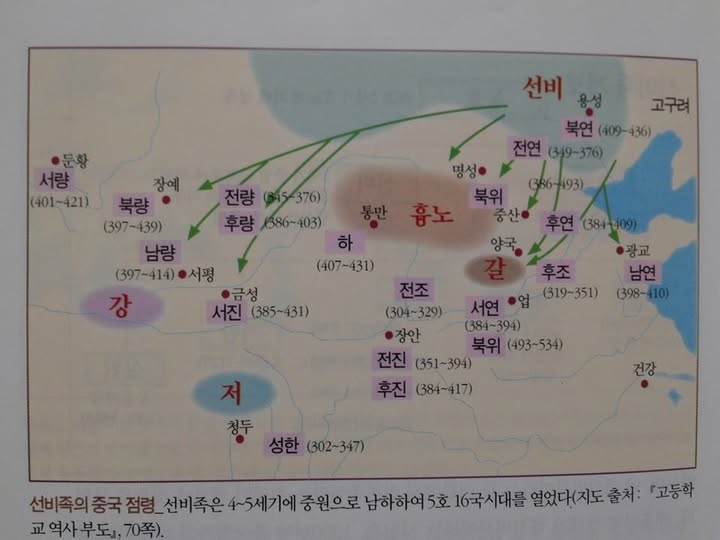
그런데 당시 한나라가 망하고 나서 동탁, 원소, 조조, 유비 등 군웅이 패권을 놓고 다투던 삼국시대와 그 뒤를 이은 위국제국(220~317)이 붕괴하여 중원이 혼란에 빠지자 선비족은 그 틈을 이용하여 대거 북중국으로 밀고 들어갔습니다.
탁발, 모용, 우문, 단, 걸복 등 선비족의 여러 부가 이때 거의 모두 남하였다고 합니다. 중국사에서 말하는 소위 5호 16국 시대가 시작된 것입니다. 탁발부는 대국을 세웠고 모용부는 전연. 후연. 서연. 남연 등을 세웠습니다. 또 산서 지역의 흉노는 한.전조.후조 등을 세웠습니다. 이 가운데서 탁발부의 대국代國(315~376)이 다른 국가들을 모두 정복하고 북중국을 통일하였습니다. 이 나라가 북위입니다.
북위는 후에 동위와 서위로 분열되었는데 그 이름이 다시 북제와 북주로 바뀝니다. 이 북주의 귀족이었던 양견이 패권을 잡고 나라 이름을 바꾸어 수나라가 탄생하였습니다. 수나라의 뿌리는 북주이고 북주의 뿌리는 선비족이므로, 중원을 통일한 대제국 수나라도 결국 북방 유목민족이 세운 나라입니다.
수를 이어 당나라를 개국한 이연도 혈통이 선비족에 가깝습니다. 이연의 조부 이호는 서위를 주도한 20가문중의 하나가 선비족 출신입니다. 이연 자신은 북주와 수나라에서 대장군을 지냈습니다. 그의 왕비 두태후도 선비족 출신입니다. 수와 당은 모두 그 기원이 선비족에 있습니다.
5호 16국 시대에 북방 유목민족들은 중국 본토로만 진출한 것이 아니라 한반도로도 적지 않은 수가 내려왔습니다. 서울대 김호동 교수는 북방 유목민의 일부가 신라에 정착하였다고 합니다. 그러한 사실은 4~5세기경에 조성된 신라의 대형 적석목관분 무덤에서 중앙아시아의 문화적 기류를 느끼게 하는 유물이 대거 발견된 것으로 미루어 알 수 있습니다.
훈족의 출현으로 유라시아 대륙의 서부에서 민족 대이동이 일어난 것과 거의 같은 시기에 대륙의 동부에서는 또 다른 북방 민족에 의해 그에 못지않게 커다란 민족 이동이 발생하였던 것입니다. 정리하면 흉노와 선비족이 일으킨 이동의 파도는 유럽에 서로마 제국의 멸망을 가져오고, 중국에 북방 민족이 중원을 장악한 5호 16국 시대를 열었습니다. 또 한반도 남부와 일본에 기마민족의 정권을 성립시켰습니다.
한마디로 말해 동북아의 중심이었던 고조선의 문화적 자양분을 흡수하며 동북아의 북방에서 뻗어 나간 유목민의 대이동이 유라시아 대륙의 역사를 크게 바꾸어 놓았던 것입니다.
———————
When the Northern Xiongnu migrated to the Central Asian steppes in the late 1st century, the Mongolian plateau, their homeland, became a temporary power vacuum. This led various nomadic groups, previously under Xiongnu rule, to compete for dominance over the steppes. Ultimately, the Xianbei emerged as the dominant power, unifying the northern region.
Records about the Xianbei first appear in Guoyu (Discourses of the States) from the Spring and Autumn period. It notes that during the early Zhou dynasty, the southern barbarians of Chu and another barbarian group, the Xianbei, did not participate in an alliance meeting. The Book of the Later Han describes both the Xianbei and Wuhuan as descendants of the Donghu (Eastern Hu) people, suggesting that the Xianbei were a group within the larger framework of Gojoseon.
The Book of Wei identifies the Xianbei’s origin in the Daxianbei Mountains, from which their name is derived. In 1980, a Chinese scholar confirmed that the Daxianbei Mountains were in the Daxing’anling region, supported by the discovery of a carved inscription in a cave in northern Daxing’anling. The inscription dates back to the Northern Wei dynasty, establishing that the Xianbei originated from the northeastern region once part of Gojoseon.
In the mid-2nd century, under the leadership of the hero Tanshihuai, various Xianbei tribes united into a single state. The Xianbei Empire took advantage of the Xiongnu’s decline, seizing their former territories, stretching from Lake Baikal in the north, the Ili River in Xinjiang to the west, and the Manchurian region in the east. However, the Xianbei Empire quickly fragmented into smaller groups after Tanshihuai’s death.
When the Han dynasty collapsed, and figures like Dong Zhuo, Yuan Shao, Cao Cao, and Liu Bei vied for power during the Three Kingdoms period, followed by the disintegration of the Wei Empire (220–317), chaos engulfed China. The Xianbei took advantage of this turmoil, pushing en masse into northern China.
Xianbei groups such as the Tuoba, Murong, Yuwen, Duan, and Helu moved south during this time, marking the start of what Chinese historians refer to as the Sixteen Kingdoms of the Five Barbarians era. The Tuoba established the state of Dai (315–376), while the Murong founded states such as Former Yan, Later Yan, Western Yan, and Southern Yan. Meanwhile, Xiongnu remnants in Shanxi established Han, Former Zhao, and Later Zhao. Eventually, the Tuoba’s Dai state unified northern China, creating the Northern Wei dynasty.
The Northern Wei later split into the Eastern Wei and Western Wei, which evolved into the Northern Qi and Northern Zhou, respectively. Yang Jian, an aristocrat from the Northern Zhou, seized power and founded the Sui dynasty. Since the Sui’s roots lay in the Northern Zhou, which, in turn, traced its lineage to the Xianbei, the Sui dynasty was fundamentally established by northern nomads.
Similarly, the Tang dynasty, founded by Li Yuan, also had close ties to the Xianbei. Li Yuan’s grandfather, Li Hu, was from one of the 20 noble families of Western Wei, which had Xianbei origins. Li Yuan himself served as a general under the Northern Zhou and Sui dynasties, and his wife, Empress Dou, was also of Xianbei descent. Thus, both the Sui and Tang dynasties trace their origins to the Xianbei.
During the Sixteen Kingdoms era, northern nomads migrated not only to China proper but also to the Korean Peninsula. Seoul National University professor Kim Ho-dong notes that some northern nomads settled in Silla. This is supported by the discovery of numerous artifacts reflecting Central Asian cultural influences in Silla’s large stone mound tombs, dating back to the 4th–5th centuries.
The wave of migrations triggered by the Huns in the west and the Xianbei in the east caused massive movements of peoples across the Eurasian continent. While the Huns’ migration led to the fall of the Western Roman Empire, the Xianbei’s actions ushered in the Sixteen Kingdoms era in China. They also established equestrian-based regimes in southern Korea and Japan. In short, the migrations of northern nomads from Northeast Asia, who carried the cultural legacy of Gojoseon, profoundly reshaped the history of Eurasia.