발해인은 자신들을 스스로 고구려의 후예라 생각하였습니다. 대진 무황제는 일본에 보낸 국서에서 대진을 ‘고구려 땅을 차지하고 부여 전통을 계승한 나라’(속일본기)라고 하였습니다. 또 일본인들도 발해에 관한 기록이 처음 등장하는 곳에 ‘발해는 옛 고구려국’이라고 기록하였습니다. 후대의 기록에서도 일본인들은 한민족의 국통이 고구려-대진(발해)-고려로 이어진다는 것을 분명히 하였습니다. 또 중국의 옛 사료들이 한결같이 발해 건국을 고구려의 멸망과 연계시킨 것도 발해가 고구려의 계승국임을 말해 주는 것입니다.
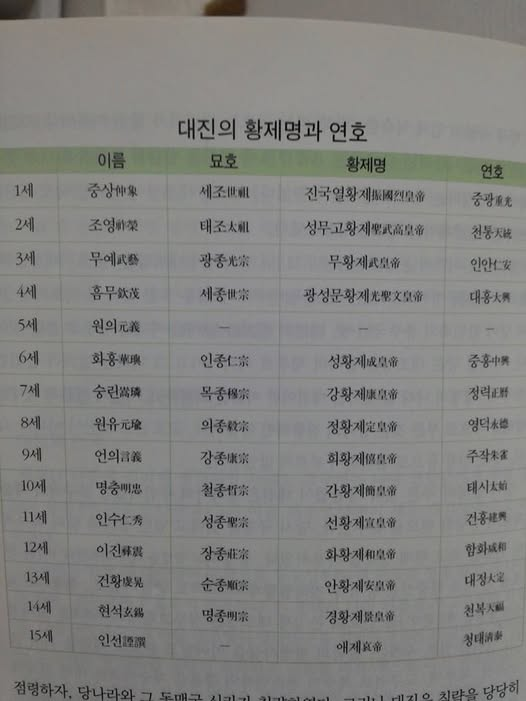
대진은 또 황제국이었습니다. 최근에 발굴된 상경성의 제2 궁전지는 전면이 19칸이나 됩니다. 당나라 장안성의 최대 건물인 함원전이 11칸에 불과함을 고려할 때 대진은 결코 당나라의 예속국이 될 수 없습니다. 그러므로 대진 왕들이 황제를 칭한 것은 결코 역사적 과장이 아닙니다. 1980년에 발견된 정효공주 묘지명에서 그 아버지인 문왕을 황상이라 부른 것, 왕비의 묘비명에서 황후라는 표현을 쓴 것 등은 대진의 칭제 사실을 명백히 나타냅니다.
그런데 동북아의 강대국 대진의 멸망의 하나의 역사적 미스터리로 남아 있습니다. 현재 여러 가지 설이 분분하나 일단 표면적으로는 거란족의 공격으로 망한 것이 분명합니다. 기록에 의하면 거란은 926년 대진을 공격하여 거의 싸우지도 않고 이겼다고 합니다.
“거란 태조가 그 갈린 마음을 틈타 움직이니 싸우지 않고 이겼다”라는 기록으로 보아 거란은 아마 대진의 내부 분란을 이용하여 무너뜨린 것으로 보입니다.
거란은 어떤 족속일까요?
거란은 선비족의 한 갈래로서 북위 시대부터 거란이라는 명칭으로 불리기 시작했습니다. 일정한 정착지를 갖지 않고 유목과 수렵생활을 영위한 거란은 고구려, 돌궐 같은 주변 강국의 지배를 받았습니다. 그러다가 10세기 초 당이 혼란에 빠지고 돌궐도 쇠약해지자, 거란 부족들은 일세의 영웅 야율아보기 밑에서 강력한 국가로 통합되었습니다(907).
아보기는 부족장을 모두 처단하고 자신을 황제라 선포한 후, 먼저 먼 곳에 위치한 돌궐, 토혼 당항 등을 쳐서 배후를 안전하게 한 다음 대진을 공격하였습니다. 주목할 점은 한 달 만에 대진의 수도 상경용천부(홀한성이라고도 함)까지 함락된 것입니다.
주변 나라들이 하나같이 두려워하던 강국이 외적의 침입에 어찌 그리 쉽게 무너졌을까?
대진의 멸망에는 자연재앙이 작용한 것으로 알려지고 있습니다. 일부 학자들은 약 천 년 전 상경용천부에서 멀지 않은 백두산에서 대폭발이라는 재난으로 국가 기능이 마비된 상황에 거란이 침입하자 국가가 통째로 속수무책으로 무너진 것으로 보입니다. 패망 이후 대진 사람들은 수백 년 동안 거란에게 저항하였고, 왕족을 비롯한 지도층은 여러 차례에 걸쳐 고려에 합류하였습니다. 대진의 멸망으로 한민족의 5천 년 대륙사는 막을 내리게 되었습니다.
—————
The people of Balhae considered themselves descendants of Goguryeo. In a diplomatic letter sent to Japan, Emperor Mu of Daejin stated that Daejin was a country that occupied the former territory of Goguryeo and inherited the traditions of Buyeo (as recorded in Shoku Nihongi). Additionally, the earliest Japanese records mentioning Balhae describe it as the “former state of Goguryeo.” Later Japanese records also clearly recognized the historical continuity of the Korean nation, tracing it from Goguryeo to Daejin (Balhae) and then to Goryeo. Furthermore, ancient Chinese historical sources consistently link the founding of Balhae to the fall of Goguryeo, reinforcing the idea that Balhae was its legitimate successor.
Daejin was also an imperial state. The recently excavated ruins of the second palace in Shangjing (Sanggyeong) measure 19 bays in width. Considering that the largest building in the Tang capital of Chang’an, the Hanyuan Hall, was only 11 bays wide, it is evident that Daejin was by no means a vassal state of Tang China. Therefore, the fact that Daejin’s rulers proclaimed themselves emperors is not an exaggeration. The epitaph of Princess Jeonghyo, discovered in 1980, refers to her father, King Mun, as Hwangsang (Emperor), and her mother’s tombstone inscription uses the title Hwanghu (Empress), providing clear evidence of Daejin’s imperial status.
However, the fall of Daejin, a major power in Northeast Asia, remains a historical mystery. While various theories exist, it is clear from historical records that Balhae was ultimately destroyed by an invasion from the Khitans. According to historical accounts, the Khitan forces attacked Daejin in 926 and won with little resistance.
A record states, “The Khitan Taizu took advantage of their internal discord and won without a fight,” suggesting that the Khitans capitalized on internal strife within Daejin to bring about its downfall.
Who were the Khitans?
The Khitans were a branch of the Xianbei people and were first referred to as such during the Northern Wei period. As a nomadic and hunting society without a fixed settlement, the Khitans were subject to the rule of powerful neighboring states such as Goguryeo and the Turkic Khaganate. However, in the early 10th century, as the Tang Dynasty fell into chaos and the Turks weakened, the Khitan tribes united under the leadership of the legendary warrior Yelü Abaoji (907), forming a powerful state.
Abaoji executed tribal leaders and declared himself emperor. He then secured his rear by subduing distant rivals such as the Turks and the Tuyuhun before launching an attack on Daejin. Notably, Daejin’s capital, Shangjing Longquanfu (also known as Holhan Fortress), fell within just one month.
How could such a powerful state, feared by its neighbors, collapse so easily in the face of foreign invasion?
It is believed that natural disasters played a role in Daejin’s downfall. Some scholars suggest that a massive volcanic eruption at Mount Baekdu, located not far from Shangjing Longquanfu, roughly a thousand years ago paralyzed the nation’s administrative functions. This catastrophic event, combined with the Khitan invasion, left the state utterly defenseless.
Even after Daejin’s fall, its people continued to resist the Khitans for centuries, and members of the royal family and ruling elite sought refuge in Goryeo on multiple occasions. With the demise of Daejin, the five-thousand-year history of Korean civilization on the continent came to an end.