창세 역사와 문화를 잃은 한국인은, 고대 동북아 문명의 주인공이었던 본연의 모습을 전혀 기억하지도, 알지도 못하는 정신적 불구자가 되어 버렸습니다. 한국인의 원형질을 형성하는 시원 문화와 역사를 잃어버린 것은 곧 모든 한국인이 자기 정체성을 상실한 것이며, 또한 온 인류가 그 시원 역사를 잃어버린 것이기도 합니다.
한민족은 현 인류의 뿌리 문명을 개척한 주체입니다. 따라서 한국인의 상고 역사 소실은 동북아 일개 국가의 상고사가 사라진 것이 아니라 70억 인류의 시원역사가 사라진 것입니다.
그럼 오늘의 세계인들은 한국사를 어떻게 인식하고 있을까요? 먼저 일본과 중국 교과서의 내용을 통해 알아보기로 하겠습니다.
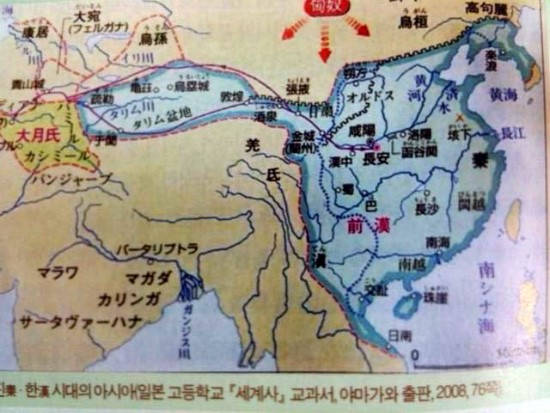
일본 고등학교에서 가장 많이 채택하는 일본사 교과서에 소개된 한국 관련 첫 역사는 바로 한사군입니다. “낙랑군에 당시 왜인 사회가 정기적으로 사신을 보냈다”라는 본문 서술에 붙인 주석에서 “전한 무제가 BCE108년에 조선 반도에 설치한 한사군 중의 하나”로 낙랑군을 소개하면서 그 위치를 “평양 부근으로 추정 한다”라고 하였습니다.
게다가 “낙랑군은 중국풍의 높은 문화를 자랑하였다”라고 하여 한국을 중국의 정치적 속국일 뿐 아니라 문화적 속국으로 그려 놓았습니다. 그리고 “4세기에 남북분열 시대를 맞은 중국이 주변 민족에 대한 지배력을 잃자 동아시아의 제 민족은 국가 형성 단계로 들어섰다”라고 합니다.
이처럼 중국이 혼란해진 그때 한반도에 비로소 고구려 백제 신라가 세워진 것으로 서술하고, 삼국의 성립 시기를 겨우 4세기로 설정하였습니다. 이때는 삼국이 세워진 지 4백 년도 더 지난 때입니다. 이런 내용에 덧붙여 “조선반도 일부에는 소국 연합에 머물러 있던 가야가 있었으며, 일본서기는 그 가야를 임나라 부른다”라는 주석을 달아 놓았습니다. 일본이 한반도 남쪽 당에 임나일본부를 세웠다는 주장을 우회적으로 표현한 것입니다.
일본의 또 다른 인문계 고등하교 역사 교과서도 이와 대동소이한 내용을 싣고 있습니다. 중학교 교과서는 한사군과 임나일본부라는 용어를 직접 언급하진 않지만 표현을 좀 더 쉽게 하여 같은 내용을 기술합니다.
한사군 체제에 대해 漢은 기원전 2세기에 조선반도 북부를 비롯하여 중앙아시아도 지배하에 두었다“라고 하고, 임나일본부에 대해서는 ”야마토 조정은 반도 남부의 임나(가라)라고 하는 땅에 거점을 두었다고 생각 된다“라고 합니다. 심지어 한반도에서 건너 간 도래인도 그들에게 유리하게 해석하여 귀화인이라고 말을 바꾸는 등 한국과 관련된 거의 모든 역사를 왜곡 기술하고 있습니다.
뿐만 아니라 일본 교과서는 독도에 대해서도 “한국과는 다케시마(독도)의 귀속을 둘러싼 대립이 있다. 이것은 일본고유의 영토이다”라고 하여 현대사도 왜곡하고 있습니다.
중국의 교과서는 어떨까요?
구석기와 신석기의 원시생활을 간략히 소개한 후 화하족의 시조로 4,700여 년 전의 황제헌원을 내세우는 것으로 시작되는 중국의 국정 역사 교과서는 5,300년 전의 우리 조상인 염제신농씨를 자신들의 조상이라 말합니다. 염제는 황제와 함께 “황하 유역의 저명한 부락 수령”이었다고 합니다. 하지만 염제는 앞서 살펴보았듯이, 배달의 문명을 크게 일으킨 3대 성황중의 한 분으로 황제보다 5백 년 앞서 살았던 인물입니다.
그리고 “동방에는 강대한 치우 부락이 있었다. 황제 부락은 염제 부락과 연합하여 탁록 전쟁에서 치우를 크게 이겼다”라는 서술과 함께 “치우는 풍백, 우사를 데리고 법술을 부렸는데 갑자기 비바람이 크게 몰아치면서, 황제, 염제의 부락 사람들로 하여금 방향을 잃게 하였다. 이에 황제는 부하를 명하여 지남거를 만들어 방향을 분별하게 하였으므로 치우를 이길 수 있었다”라고 말합니다.
배달의 한웅천황인 치우를 동방의 부락장 정도로 밝히면서, 숭자와 패자를 바꾸어 황제가 치우천황을 이긴 것으로 중국 학생들에게 가르치는 것입니다. 더구나 황제는 훌륭한 병기를 개발한 영웅으로 표현한 반면에 치우천황은 요술이나 부리는 도사로 묘사하고 있습니다.
황제헌원 이후의 역사 서술에서는, 4세기 위진남북조까지 다루는 7학년 교과서가 끝나도록 동방 한민족과 관련된 내용은 아예 찾아볼 수 없습니다.
북방 민족에 대해서 ‘북방민족대통합’이라는 별개의 장을 설정하고, 진.한 무렵 흉노의 걸출한 수령 묵특은 최초로 몽골 초원을 통일하여 강대한 국가를 건립하였다“, ”동한 말년부터 흉노, 선비, 갈, 저, 강 등 북방과 서방의 소수 민족들이 잇달아 내륙으로 이주하였다“ 등의 내용을 여기저기에 서술한 것과 대조적입니다. 고조선 시대에는 한국이 중국의 왕조 성립 과정에서 깊이 관여하였고, 열국 시대에는 중국 땅과 한반도 사이에 정치경제적 교류가 많이 있었건만, 그 어떤 내용도 일체 언급하지 않았습니다.
중국 교과서는 고대 한국의 존재 자체를 부정하고 있는 것입니다.
——————
Koreans, having lost their foundational history and culture, have become mentally handicapped, unable to recall or recognize their original identity as protagonists of ancient Northeast Asian civilization. The loss of the primordial culture and history that formed the archetype of the Korean people signifies a complete loss of self-identity, not only for all Koreans but for all humanity that has lost its origin history.
The Korean people were the agents who pioneered the root civilization of modern humanity. Therefore, the erasure of Korea’s ancient history is not simply the loss of one country’s prehistory in Northeast Asia, but the disappearance of the origin history of seven billion people around the world.
So, how does the world today perceive Korean history? Let’s first examine the content found in Japanese and Chinese textbooks.
In the most widely adopted Japanese high school history textbook, the first mention of Korean-related history is the Han Commanderies. A footnote accompanying the main text—”The Wa society of the time regularly sent envoys to Lelang Commandery”—describes Lelang as “one of the Han commanderies established by Emperor Wu of the Former Han in 108 BCE on the Korean Peninsula” and locates it “near Pyongyang.”
Moreover, the textbook states, “Lelang Commandery boasted a highly developed Chinese-style culture,” portraying Korea not only as a political vassal of China but also as a cultural subordinate. It further asserts that “when China entered the era of Northern and Southern Dynasties in the 4th century and lost its grip over neighboring peoples, various ethnic groups in East Asia entered the state formation phase.”
This implies that Goguryeo, Baekje, and Silla were only established on the Korean Peninsula after China fell into disarray, arbitrarily placing the formation of the Three Kingdoms in the 4th century—a period more than 400 years after their actual founding. In addition, a footnote states, “In part of the Korean Peninsula, there was Gaya, a confederation of small states, which Nihon Shoki refers to as Imna,” indirectly promoting the theory that Japan established the Mimana Nihonfu in the southern part of the Korean Peninsula.
Another Japanese high school liberal arts textbook presents almost identical content. Although middle school textbooks do not directly mention terms like Han Commanderies or Mimana Nihonfu, they convey the same content in simpler expressions.
Regarding the Han Commanderies, they write, “The Han dynasty brought the northern part of the Korean Peninsula and Central Asia under its control in the 2nd century BCE.” For Mimana Nihonfu, they write, “It is believed that the Yamato court had a base in a region called Imna (Kara) in the southern part of the Peninsula.” Even migrants from the Peninsula are reinterpreted in Japan’s favor, being referred to as naturalized citizens. Nearly all of Korea-related history is distorted in such ways.
Furthermore, Japanese textbooks distort modern history by stating, “There is a dispute with Korea over the territorial sovereignty of Takeshima (Dokdo). This is originally Japanese territory.”
What about Chinese textbooks?
After a brief introduction to Paleolithic and Neolithic lifestyles, China’s national history textbook begins by presenting the legendary Emperor Xuanyuan (Huangdi), who lived around 4,700 years ago, as the ancestor of the Huaxia people. They claim that Shennong, our ancestor from 5,300 years ago, was also their ancestor. Shennong, along with Huangdi, is described as a “renowned tribal leader of the Yellow River basin.” However, Shennong, as earlier examined, was one of the three great sacred monarchs who developed the civilization of Baedal, and lived 500 years prior to Huangdi.
The textbook also includes a narrative stating, “To the east, there was a powerful tribal leader named Chiyou. The Huangdi tribe allied with the Shennong tribe and decisively defeated Chiyou in the Battle of Zhuolu,” adding, “Chiyou summoned wind and rain by employing sorcery with Fengbo and Yushi, which confused the forces of Huangdi and Shennong. Then Huangdi ordered his men to create a south-pointing chariot to discern direction, thereby defeating Chiyou.”
This description reduces Chiwoo, the heavenly emperor of Baedal, to merely a tribal chief of the East, reversing the victor and the vanquished, and teaching Chinese students that Huangdi defeated Emperor Chiwoo. Moreover, Huangdi is portrayed as a heroic developer of powerful weapons, while Chiwoo is depicted as a mere sorcerer.
From the historical account following Emperor Xuanyuan, the 7th-grade textbook, which covers up to the 4th century Wei, Jin, and Southern and Northern Dynasties period, contains no content related to the Korean people of the East whatsoever.
In stark contrast, the textbook includes a separate chapter titled “Great Integration of Northern Peoples” and presents content such as: “During the Qin and Han dynasties, the outstanding leader of the Xiongnu, Modu Chanyu, first unified the Mongolian steppe and established a powerful nation,” and “From the late Eastern Han period, northern and western ethnic minorities such as Xiongnu, Xianbei, Qiang, Di, and Jie successively migrated inland.”
Despite the deep involvement of ancient Korea in the state-formation process of Chinese dynasties during the Gojoseon period, and the abundant political and economic exchange between Chinese lands and the Korean Peninsula during the Warring States period, there is no mention of any of this.
Chinese textbooks effectively deny the very existence of ancient Korea.