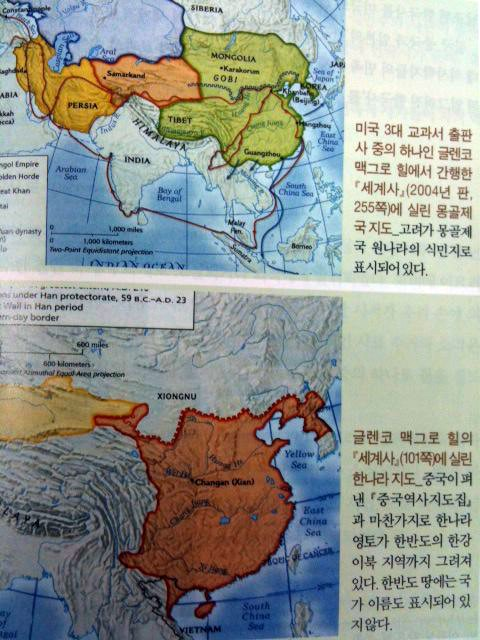
세계 강대국 중의 하나인 미국의 교과서들을 보면, 앞에서 살펴본 중국과 일본의 역사 왜곡을 수용하여 ‘4세기 초까지 한반도의 전부 혹은 절반이 중국의 영토였다’고 말합니다. 예를 들면, 미국 3대 교과서 출판사 중의 하나인 글렌코 맥그로 힐에서 간행한 세계사(2004)에는, “BCE109년경 한국은 중국의 지배하에 있었습니다. 한 왕조가 몰락한 후 반도의 지배권을 되찾았고, 313년까지 신라, 백제, 고구려 세 왕국이 건국 되었다“라고 적혀 있습니다.
BCE109년 이전의 역사에 대해서는 아무런 언급이 없고 다만, ”한국 역사는 중국의 식민지로 출발하였고 4세기가 되어서야 처음으로 나라를 세웠다“라고 말합니다. 이것이 바로 미국인이 배우는 한국 고대사의 실상입니다. 다행히 최근 미국 교과서에서는 한국 고대사 부분에 변화의 조짐이 조금씩 보이기 시작하였습니다. 한국사의 시작을 고조선으로 보는 서술이 등장한 것입니다.
맥두걸리텔에서 출판한 세계사에서는 “BCE 2000년경 조선이라는 이름을 지닌 첫 국가가 한국에서 일어났다”라고 하였고, 하코드에서 출판한 세계사에서는 BCE300년경 한국에서 가장 강력한 국가는 고조선이었다“라고 하였습니다. 하지만 이러한 내용도 여전히 진실과는 다른, 잘못된 한국 고대사입니다. 미국 교과서 속의 동북아 고대사는 중국 일색으로 서술되어 있습니다. 중세사와 근대사는 중국 중심의 이야기에 일본이 더해져 있을 뿐입니다. 미국으로 이민 간 한국인들은 미국 교과서에 적힌 왜곡된 한국사의 기막힌 현실에 경악을 금치 못하고 있습니다.
그렇다면 한국사를 직접 연구하는 서양 학자들은 한국을 어떻게 인식할까요? 캐나다 브리티쉬 콜롬비아 대학 한국학과의 베이커 교수는 “고조선과 단군은 뚜렷한 증거가 없으므로 신화로 단정 지을 수밖에 없는, 믿을 수 없는 역사”라고 말합니다. 또한 “진정한 한국사는 고려부터이다. 그 이전은 하나의 통합된 나라가 아니었다. 단지 고구려인, 신라인, 백제인이 있었을 뿐이다”라고 하여 한국사의 출발을 왕건이 세운 고려시대(918~1392)로 잡고 있습니다. 결론적으로 한국사는 천 년 역사에 불과하다는 것입니다.
하와이 미노아 대학의 슐츠 교수는 ‘한사군(한나라가 고조선 땅에 설치한 군현)이 한국 고대사에 끼친 영향이 클 뿐 아니라 고구려, 백제, 신라가 조직적인 국가로 성장하는 데 촉진제가 되었다’고 말합니다. 이처럼 서양 학자들도 교과서를 통해 한국을 배운 서양의 일반인과 마찬가지고 한국사에 대해 잘못 인식하고 있습니다. 아시아와 북미 지역 이외의 세계사 교과서에서는 한국 고대사에 대한 내용 자체가 거의 없습니다.
멕시코 교과서를 보면, “한국은 중국의 옛 영토였다가 1910년 일본에 합병되었다”라고 기술되어 있습니다. 중국의 옛 영토, 즉 중국의 속국, 이 한마디가 한국 고대사의 전부입니다. 고대와 중세의 한국에 대한 서술이 거의 없는 이 책이 유독 자세히 전하는 한국의 근대사는 일제 식민 사관을 그대로 답습한 것입니다. 중국과 일본의 식민지였다가 현재는 남북으로 갈라진 나라, 이것이 멕시코인의 머릿 속에 심어진 한국의 모습입니다.
그리고 유럽 교과서도 대부분 6.25 사변과 경제 성장에 대해 몇 마디를 서술할 뿐입니다. 그렇다면 동서양의 교과서들이 왜 이렇게 하나같이 한국사를 축소, 왜곡할까요? 그 근본 원인은 중국과 일본에 의한 한국사 왜곡에 있습니다. 두 나라는 자신들 국익에 유리하도록 한국사를 날조하였을 뿐 아니라, 그 날조된 내용을 다양한 외국어로 번역하여 여러 나라에 알리는 일도 게을리하지 않았습니다.
일본은 지난 강점기 때 ‘한국인들은 스스로 역사를 움직일 능력이 없어서 고대부터 줄곧 이웃 민족의 지배를 받아왔다’는 논리를 만들어 세계에 유포시켰고, 중국은 최근 한국의 고조선과 고구려 역사까지 강탈해 간 동북공정을 널리 알리고 있습니다. 세계 교과서가 한국사를 잘못 서술하게 된 또 다른 원인은 광복 후 한국의 역사 학계를 주름잡은 이 땅의 강단사학자들에게 있습니다.
40여 나라가 사용하는 교과서 5백 종을 분석하여 한국사 왜곡의 실태를 밝힌 이길상 교수가 지적하였듯이, 일본으로 유학을 가서 일본 학자들에게 배운 한국의 식민주의 역사학자들은 그들의 주장을 그대로 받아들였고, 광복이 된 뒤에는 한국의 1세대 역사학자가 되어 왜곡 날조된 한국사를 미국의 학계에 그대로 전하였습니다.
결국 중국과 일본의 한국사 왜곡, 왜곡된 역사의 세계적 유포, 그리고 한국의 1세대 역사학자들의 민족 주체성을 상실한 태도가 세계 교과서 속에 ‘상고역사가 실종된 일그러진 한국사’를 실리게 만든 것입니다.
——————
American textbooks, representative of one of the world’s superpowers, accept the historical distortions of China and Japan and assert that “until the early 4th century, all or half of the Korean Peninsula belonged to China.” For instance, in the 2004 edition of World History published by Glencoe/McGraw-Hill, one of the three major American textbook publishers, it is written, “Around 109 BCE, Korea was under Chinese control. After the fall of the Han Dynasty, control of the peninsula was regained, and by 313, the kingdoms of Silla, Baekje, and Goguryeo had been founded.”
There is no mention of any history before 109 BCE. It simply states that “Korean history began as a Chinese colony and only formed its own states in the 4th century.” This is the reality of ancient Korean history as taught to Americans. Fortunately, there have been signs of change in recent American textbooks. Descriptions now occasionally identify Gojoseon as the beginning of Korean history.
The World History textbook published by McDougal Littell states, “Around 2000 BCE, the first state called Joseon arose in Korea.” Likewise, Houghton Mifflin Harcourt’s textbook claims, “Around 300 BCE, the strongest state in Korea was Gojoseon.” However, even these depictions remain historically inaccurate and continue to misrepresent Korea’s ancient past. Ancient East Asian history in American textbooks is overwhelmingly Sinocentric. The medieval and modern history sections are essentially Chinese-centered, with Japan included to a lesser extent. Korean immigrants in the U.S. are often shocked by the distorted portrayal of Korean history found in these textbooks.
How do Western scholars who directly research Korean history perceive Korea? Professor Bruce Cumings of the University of Chicago has argued for broader recognition of Korean history, but scholars such as Professor Baker of the University of British Columbia dismiss Dangun and Gojoseon as myths, stating that there is “no clear evidence, thus it must be considered mythology and cannot be trusted.” He further claims, “Authentic Korean history begins with Goryeo. Before that, there was no unified state—only Goguryeoans, Sillans, and Baekjeans.” This reduces Korean history to merely a millennium, starting from the founding of Goryeo by Wang Geon (918–1392).
Professor Keith Schultz of the University of Hawaii at Manoa states that “the Han Commanderies had significant influence on Korean ancient history and acted as a catalyst for the development of Goguryeo, Baekje, and Silla into organized states.” In this way, many Western scholars, like ordinary Westerners educated through textbooks, have a misinformed perception of Korean history. In world history textbooks outside of Asia and North America, there is almost no mention of ancient Korean history.
For instance, Mexican textbooks state, “Korea was formerly Chinese territory and was annexed by Japan in 1910.” The phrase “former Chinese territory”—implying that Korea was a Chinese vassal—is the entirety of Korean ancient history. The book contains virtually no content on Korea’s ancient or medieval periods, and the modern history section simply echoes the Japanese colonialist perspective. In the minds of Mexicans, Korea is understood as a country that was once colonized by China and Japan and is now divided into North and South.
Most European textbooks mention little more than the Korean War and South Korea’s economic development. So why is Korean history so uniformly minimized and distorted in both Eastern and Western textbooks? The fundamental cause lies in historical distortion by China and Japan. These two countries not only fabricated Korean history to serve their national interests but also translated and disseminated these distortions worldwide.
During the Japanese colonial era, Japan spread the narrative that “Koreans have never had the capacity to shape history on their own and have always been ruled by neighboring peoples,” and China has recently been widely promoting the Northeast Project, which aims to appropriate the histories of Gojoseon and Goguryeo. Another cause of distorted Korean history in global textbooks lies with South Korea’s post-liberation academic establishment.
As Professor Lee Gil-sang, who analyzed 500 textbooks used in over 40 countries, pointed out, Korean historians who studied in Japan accepted the colonialist historical theories of Japanese scholars. After Korea’s liberation, these scholars became the first generation of Korean historians and conveyed the distorted and fabricated version of Korean history to American academia.
Ultimately, the global misrepresentation of Korean history in school textbooks is the result of Chinese and Japanese distortions, their widespread international dissemination, and the loss of national identity among Korea’s first generation of academic historians. This has led to the portrayal of a “distorted Korean history with its ancient past erased” across the world’s educational materials.