[치우천황을 삼조당에 모신 중국의 숨은 의도]
2002년 겨울, 필자는 북경에 도착하여 짐도 풀지 않고 곧바로 탁록을 찾아 간 적이 있습니다. 중국 북경에서 만리장성의 팔달령을 넘어 몇 시간을 달리면, 치우천황과 헌원의 격전지였던 탁록이 나옵니다. 남채, 중채, 북채의 삼채로 된 치우채라는 성터가 있고, 그 맞은편에 황제헌원이 살았던 곳이라 하여 울타리를 두른 황제성이 있었습니다.
그 궁전 한쪽 구석에 면류관을 쓴 황제의 동상이 세워져 있는데, 저녁 해질 무렵 그 동상을 바라보면서 ‘당시 동북아 역사의 주도권자가 과연 중국 사서에서 주장하는 것처럼 헌원이었는지, 실제로 역사 현장을 밟아 보지 않고 어떻게 그것을 믿을 수 있겠는가’라는 의문이 스쳐갔습니다.
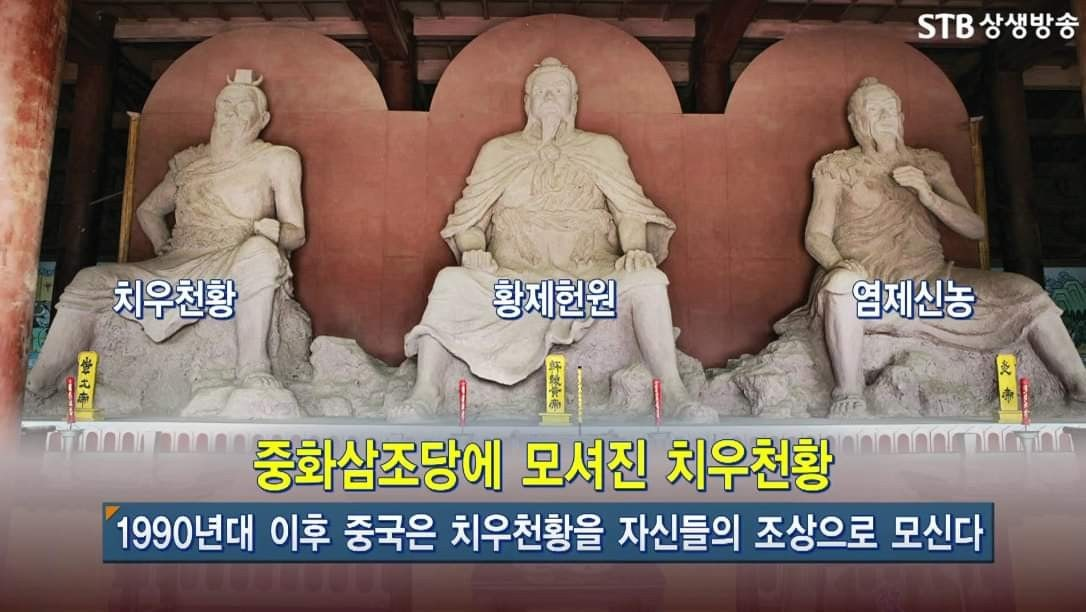
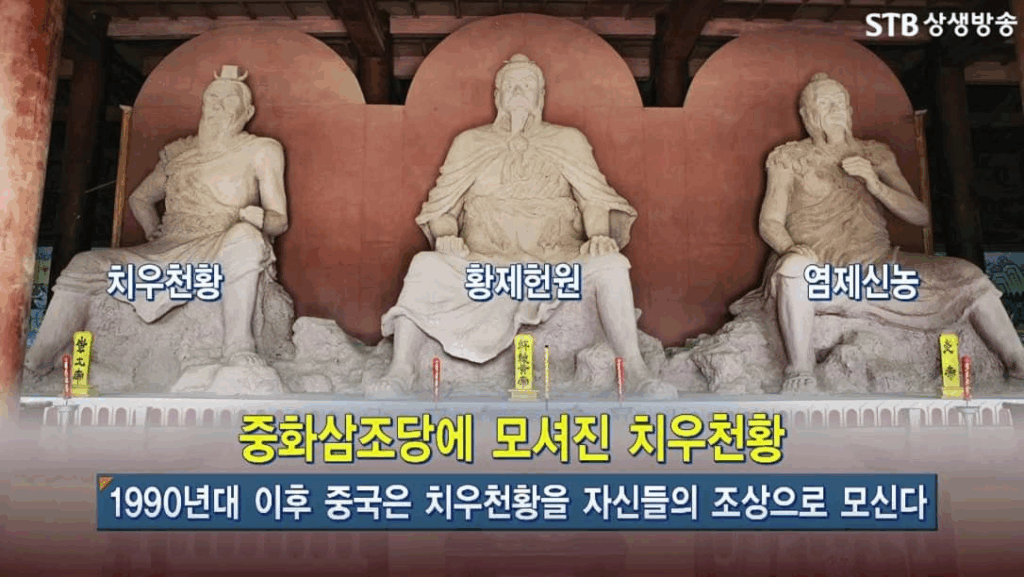
탁록에는 중국의 위대한 세 조상을 모신 삼조당이 있습니다. 한민족의 조상인 염제신농씨와 치우천황이, 중국 역사의 시조로 일컬어지는 황제헌원과 함께 모셔져 있습니다. 각기 높이가 무려 5.5미터나 되는 거대한 상인데 황제헌원이 중앙에 앉아있고, 그 좌우에 두 분이 배치되어 있습니다.
중국인들은 오래 전부터 우리 배달겨레의 조상인 태호복희씨와 염제신농씨를 자기네 조상으로 모셨습니다. 그런데 삼조당을 지으면서 마침내 치우천황까지 자기네 조상으로 모신 것입니다. 그러나 그곳 내부 벽화에는 치우천황과 헌원이 맞서 싸우는 모습을 묘사하였습니다.
이것은 정치적 의도에서 억지로 치우천황을 중국인의 조상으로 만들어 삼조당에 앉혔지만, 결코 중국인들은 마음속으로 치우천황을 자신들의 조상으로 인정하지 않음을 보여줍니다. 중국은 원래 치우천황을 남방 묘족의 지도자로 간주하였습니다.
그런데 왜 치우천황을 자기네 조상으로 끌고 간 것일까요? 여기에는 무서운 음모가 숨어 있습니다. 치우 천황을 중국의 조상으로 만들어야 그 옛날 치우천황이 다스린 강역을 중국 땅으로 만들 수 있기 때문입니다. 중국이 말하는 치우천황의 강역에는 오늘날 중국의 영토가 되어 버린 산동반도, 요동반도, 만주는 물론이고 한반도까지 포함됩니다.
삼조당을 지어 황제, 염제, 치우를 중국 민족의 근본을 다진 인물로 설정한 중국은 치우천황 후반기의 주 활동 무대였던 탁록을 중국 5천 년 문명사의 요람이자 중화민족의 주요 발상지 중의 하나로 내세우고 있습니다. 중국은 한민족의 조상을 삼조당에 모셔 자신들의 조상으로 만들더니, 이제 한민족의 고토인 탁록까지 중국의 시원 역사 무대로 만들었습니다.
중국 학자 쑤빙치는 백 년 전 중국의 모습을 보려면 상해로 가라. 그리고 천 년 전 중국 모습을 보려면 북경으로, 2천 년 전 중국 모습을 보려면 서안(장안)을 가 보라. 그러나 그대가 5천 년 전 중국 모습을 보고자 한다면 탁록으로 갈지어다“라고 주장합니다.
[조작된 기자조선]
중국 역사서에서는 조선이라는 국호를 좀처럼 찾아볼 수 없습니다. 대신 예, 맥, 발, 숙식, 우이, 내이, 견이, 서이, 고죽, 고이 등과 같은 고조선의 제후국 이름이 등장합니다. 다른 호칭을 써서 조선이라는 국가 이름 자체를 철저하게 제거한 것입니다.
사마천도 사기-본기에서 조선이라는 호칭을 전혀 쓰지 않았습니다. 그런 제후국의 역사를 다룬 세가에서 “봉기자어조선奉箕子於朝鮮”이라 하여 갑자기 조선이란 이름을 썼습니다. “기자를 조선에 봉하였다”는 것입니다. 이것을 근거로 중국 사가들은 조선 역사가 약 3,100년 전에 중국의 제후국인 기자조선에서 시작된 것으로 단정합니다.
[상서대저], [사기] 등에서 전하는 기자조선의 내력은 이러합니다. 주나라의 건국자 무왕이 상나라를 멸망시키고, 감옥에 감금되어 있던 기자를 풀어주었습니다. 이때 기자는 주나라에 의해 풀려난 부끄러움을 참을 수 없어 조선으로 떠나 버렸다. 이 소식을 들은 무왕이 기자를 조선의 왕으로 봉하였다.
그런데 제후로 봉해진 이후의 이야기는 서로 다릅니다. 상서대전은 기자가 책봉을 받은 후 신하의 예를 행하기 위해 주나라를 찾아가 무왕에게 홍범구주에 대해 설명하였다고 합니다. 반면 사기는 기자가 책봉은 받았지만 주나라의 신하로 삼지는 않았다[而不臣也]고 기록하였습니다. 기자를 제후로 임명했다는 말 바로 다음에 신하로 삼지는 못했다는 모순된 말을 하고 있는 것입니다. 제후가 되면 당연히 신하가 되는 것인데도 그와 상반되는 말을 하는 것입니다.
그것은 기자가 무왕의 신하였던 적이 결코 없었기 때문에 사마천 자신도 모르게 역사의 진실을 고백한 것입니다. 요컨대 기자라는 인물이 조선 왕으로 봉해진 일은 결코 없었습니다. 여기서 한 가지 주목할 것은 기자가 조선으로 떠나버렸다는 구절입니다. 이것은 동방 땅에 그전부터 조선이 자리 잡고 있었음을 천명한 내용입니다. 기자가 망해 버린 고국을 떠나 이웃나라 조선으로 망명할 수 있었던 것은 이미 오래 전부터 단군조선이 존재하였기 때문입니다.
중국이 기자조선을 내세워 단군조선을 숨기려 하였으나, 오히려 더 드러내는 결과가 되었습니다. 결론적으로 말해서 기자조선은 한민족사를 그 출발부터 중국사에 예속된 것으로 만들기 위해 중국이 날조한 것에 지나지 않습니다.
—————
[The Hidden Intention Behind Enshrining Chiwoo Cheonhwang in the Three Ancestors Hall in China]
In the winter of 2002, I arrived in Beijing and headed straight to Takrok without even unpacking. A few hours past Badaling on the Great Wall from Beijing lies Takrok, the battlefield of Chiwoo Cheonhwang and the Yellow Emperor (Huangdi). There remains a fortress site known as Chiwoo Fortress, composed of three fortresses: Namchae, Jungchae, and Bukchae. Opposite the site is a fenced area said to be where the Yellow Emperor resided, called the Yellow Emperor Castle. In one corner of the palace, there is a statue of the Yellow Emperor wearing a ceremonial crown. As I looked at the statue during the evening sunset, the question crossed my mind—was the true leader of Northeast Asian history at that time really the Yellow Emperor, as claimed in Chinese historical records? How can one believe that without visiting the actual historical sites?
In Takrok, there is a shrine known as the Three Ancestors Hall, which honors three great ancestors of Chinese civilization. Enshrined here are Yandi Shennong, an ancestor of the Korean people, Chiwoo Cheonhwang, and the Yellow Emperor, regarded as the progenitor of Chinese history. These are colossal statues, each measuring an imposing 5.5 meters in height, with the Yellow Emperor seated in the center and the other two flanking him. The Chinese have long revered Taihao Fuxi and Yandi Shennong, ancestors of the Korean people, as their own. And now, with the construction of the Three Ancestors Hall, they have even enshrined Chiwoo Cheonhwang as one of their ancestors. However, murals inside the hall depict Chiwoo Cheonhwang in battle against the Yellow Emperor.
This reveals the contradiction: while China politically forces Chiwoo Cheonhwang into the role of an ancestral figure by placing him in the Three Ancestors Hall, they do not truly accept him as one in their hearts. Originally, China considered Chiwoo Cheonhwang to be a leader of the southern Miao people.
So why has China claimed Chiwoo Cheonhwang as their ancestor? There is a chilling conspiracy behind this. By making Chiwoo Cheonhwang a Chinese ancestor, they can then claim his historical territories as Chinese land. The territories allegedly ruled by Chiwoo Cheonhwang, as defined by China, include Shandong Peninsula, Liaodong Peninsula, Manchuria, and even the Korean Peninsula—all now considered part of China’s territory.
By building the Three Ancestors Hall and establishing Huangdi, Yandi, and Chiwoo as the foundational figures of the Chinese nation, China is promoting Takrok, the main stage of Chiwoo’s later activities, as the cradle of its 5,000-year-old civilization and one of the major birthplaces of Chinese civilization. In doing so, China not only claimed the ancestors of the Korean people as their own, but also turned Takrok—historically a part of Korean heritage—into a foundational stage of Chinese history.
Chinese scholar Su Bingqi once asserted: “If you want to see China from 100 years ago, go to Shanghai. If you want to see it from 1,000 years ago, go to Beijing. If you want to see it from 2,000 years ago, go to Xi’an (Chang’an). But if you want to see China from 5,000 years ago, then go to Takrok.”
[The Fabricated Gija Joseon]
In Chinese historical records, the term “Joseon” is rarely found. Instead, names of vassal states from ancient Gojoseon appear, such as Ye, Maek, Bal, Suksik, Uyi, Naeyi, Gyeon’i, Seoyi, Gojuk, and Goyi. By using alternative names, they thoroughly erased the name “Joseon” itself.
Even Sima Qian in the Records of the Grand Historian (Shiji) does not use the term “Joseon” in the main annals. The only place where the name suddenly appears is in the hereditary houses section (Shijia), which states, “Feng Gija yu Joseon (봉기자어조선),” meaning “Gija was enfeoffed in Joseon.” Based on this single statement, Chinese historians claim that Joseon’s history began about 3,100 years ago as a vassal state of China under Gija Joseon.
According to sources like Shangshu Dazhuan and Shiji, the story of Gija Joseon goes as follows: King Wu of Zhou, founder of the Zhou dynasty, overthrew the Shang dynasty and released Gija from prison. Unable to bear the shame of being freed by Zhou, Gija left for Joseon. Hearing this, King Wu appointed him as the king of Joseon.
However, subsequent accounts about his enfeoffment differ. According to Shangshu Dazhuan, after being enfeoffed, Gija visited the Zhou court and explained the “Nine Categories of Governance” (Hongfan Jiuzhou) to King Wu. On the other hand, Shiji states that although Gija was enfeoffed, “he did not become a subject [of Zhou]” (而不臣也). This contradicts the logic that an enfeoffed vassal should naturally be a subject. It is an inconsistency.
This contradiction implies that Gija was never truly a subject of King Wu, and that Sima Qian inadvertently revealed the truth of history. In short, the enfeoffment of Gija as King of Joseon never happened. One notable phrase is that “Gija left for Joseon.” This statement affirms that a state called Joseon already existed in the East. Gija’s act of leaving his ruined homeland to seek refuge in a neighboring country implies the prior existence of Dangun Joseon.
China attempted to conceal Dangun Joseon by promoting the narrative of Gija Joseon. But in doing so, they ironically exposed the existence of Dangun Joseon even more clearly. Ultimately, Gija Joseon is nothing more than a fabricated narrative devised by China to make Korean history subordinate to Chinese history from its very origin.