

고려사 열전에 오를 정도로 유명한 인물인 행촌 이암은 원나라의 간섭을 받기 시작한 고려의 25세 충렬왕 때(1297) 경상도 고성에서 고성 이씨 이우의 장남으로 태어났습니다. 이암은 뛰어난 학자와 관리를 배출한 고성 이씨 집안의 9세 손이고, 행촌이란 호는 자신이 유배되었던 강화도의 마을 이름을 따서 지은 것입니다.
증조부 이진은 고종 때 문과에 합격하여 승문원 학사를 역임하였고, 조부 이존비 역시 과거에 급제하여 문한학사, 진현관 대제학 등을 역임하였습니다. 부친 이우는 과거에 응시하지 않았으나 문음제를 통해 경상도 김해와 강원도 회양 부사를 지냈습니다.
태백일사 고려국본기에 의하면, 이존비는 환국과 배달의 역사에 대해 근본을 통하고 환단사상에 대한 깊은 안목을 가진 대학자였습니다. 이러한 정신을 그대로 전수받은 이가 바로 손자 이암입니다.
이암은 10세 때 아버지의 명을 따라 강화도 마리산 보제사에 들어가 학동초당을 짓고 3년 동안 유가 경전과 우리 고대사 기록을 탐독하였습니다. 어린 나이에 부모님과 고향 생각이 날 때마다 고조선 초대 단군 때 쌓은 참성단에 올라 단군왕검의 역사의식을 가슴에 새겼다고 합니다.
그때 이미 이암은 외래풍이 뒤덮고 있던 고려를 그 옛날처럼 동방의 맑고 깨끗한 나라로 일신하려는 큰 뜻을 품어 “어두운 우리 동방의 거리에 누가 밝은 등불을 비출 것인가? 우리 동방 세계의 평안을 위해 지금 내가 나서리!” 라는 시를 지었습니다.
이암은 17세에 문과에 급제하고, 이듬해에 경전을 비롯한 여러 문헌을 관리하는 비서성의 교감에 임명되었습니다. 그때 원나라가 원래 송나라에서 비장하던 4천 권을 책을 보내왔고, 이암은 비서성의 남과 주무로 승진하면서 그 모든 서적을 탐독하였습니다.
그렇게 책에 묻혀 10년을 보내던 중, 조정을 이간하고 무시하던 간신배가 고려를 없애고 원나라에 귀속하기를 청하는 사건이 발생합니다. 충숙왕에 류청신과 오잠 등이 국호, 고려를 폐지하고 원나라의 일개 성이 되고자 하는 청원을 조정에 제출하였고, 원으로부터 원나라의 삼한성으로 한다는 칙령이 내려온 것입니다.
이에 이암은 “우리나라는 환단시대 이래로 모두 천상 상제님의 아들이라 칭했고 하늘에 제사를 지냈습니다. 그러니 애당초 분봉을 받은 제후와는 근본이 같을 수 없습니다.” 라는 통분의 상소문을 올렸습니다 (태백일사, 고려국본기).
비록 하급 관리의 신분이지만, 이암은 고려가 바로 천자의 나라이므로 결코 중국의 여느 제후국과 같은 대접을 받을 수 없음을 고하며 고려의 위호를 낮추자는 간악한 무리의 죄를 엄히 다스릴 것을 주청한 것입니다.
이무렵 고려의 왕권과 국권은 밖으로는 원의 내정 간섭으로, 안으로는 원과 결탁한 간신배의 횡포로 그 위세가 바닥에 떨어져 있었습니다. 그 후 충혜왕이 등극하고 다시 충숙왕이 복위하는 난세 속에 이암은 강화도에 귀양을 갔습니다. 어린 시절에 수학했던 강화도에 죄인의 신분으로 다시 왔을 때 이암의 나이는 36세였습니다.
이암은 그곳에서 주역을 연구하고, 우주의 이치와 천문, 풍수, 지리에 관한 책을 섭렵하였습니다. 3년 후 유배에서 방면되면서 천보산 태소암에서 1년간 머무르게 되는데, 이 때 이암에게 일생일대의 중요한 사건이 일어납니다. 그것은 이명과 범장을 만나 한민족사의 회복을 위한 사서 집필을 결의한 것입니다.
이 세 사람이 어떻게 만났는지 아직 밝혀지지 않았지만, 이들은 그곳에서 소전거사라는 인물로부터 석굴 속에 감춰져 있던 고서적들을 나누어 받았습니다. 그것은 인류 문명의 황금시절이었던 환단(환국-배달-조선)시대를 기록한 것이었습니다.
소전거사의 실체 역시 아직 밝혀지지 않았지만, 삼신과 하나되어 온전한 사람이 된다는 의미의 전(佺)자를 이름에 쓴 것으로 보아 신교문화의 전도에 화통한 인물로 짐작됩니다. 이명, 범장, 이암에게 비기를 전한 그는 한민족의 창세 역사를 되찾게 한 배후의 손길입니다.
이암은 소전거사에게 들은 이야기와 전수 받은 책을 바탕으로 환단 시대의 도학을 논한 태백진훈과 단군세기를, 복애거사 범장은 북부여기를, 청평거사 이명은 진역유기를 지었습니다.
충숙왕이 죽고 충혜왕이 복위된 다음 해(1340), 이암은 복직하여 44세의 나이에 도승지와 성균관 등에서 일을 하며, 왕명의 츨납을 맡은 추밀원의 중책을 맡으면서 단숨에 재상의 반열에 올랐습니다. 하지만 이암은 왕의 총애를 바라지 않고 왕의 정치적 파행을 바로잡는 데 힘을 쏟았습니다.
그 후 또 한 차례의 유배와 복직을 겪은 후, 공민왕 때에는 철원군에 봉해지고 서연에서 경서와 예법에 관한 시독을 맡게 되었습니다. 이암은 다음 해에 임금에게 사직을 청하여 강원도 청평산으로 들어갔습니다.
이암은 왜 돌연 관직에서 물러나 청평산으로 들어갔을까요? 공민왕을 옹립한 공신들의 방자한 언행 때문이라는 해석도 있지만, 그것이 과연 전부일까요?
청평산에는 소전거사로부터 비서를 같이 전수받은 이명이 살고 있었습니다. 당시의 평균 수명으로 보아 노년에 접어든 57세의 이암은 평생 준비해 온 환단 시대의 역사서 집필이라는 과업을 완수하기 위해 처사의 삶을 살기로 하고, 그 은거지로 이명이 살던 곳을 택하였을 것입니다.
그러나 이암은 이때 자신의 꿈을 이루지 못하였습니다. 은거한 지 5년이 되던 해에, 개혁정치를 이끌어 나갈 경륜 있는 원로가 절실하게 필요했던 공민왕이 이암을 다시 조정으로 불러들였기 때문입니다. 공민왕은 이암을 오늘날의 국무총리 격인 수무하시중에 임명하였습니다.
이암이 일인지하 만인지상의 자리에서 공민왕을 보필하기 시작한 그 다음 해, 원에 반발하여 일어난 한족 반란군인 홍건적이 침략하였습니다. 이때 고려 조정이 최고 사령관으로 명하여 급파한 인물이 바로 행촌 이암입니다. 이암은 서북면 병마도원수가 되어 4만 명의 적을 물리쳤습니다.
홍건적의 침입은 여기서 그치지 않았고, 1361년에는 10만 대군으로 다시 쳐들어와 지금의 황해도 지역까지 밀고 내려왔습니다. 공민왕은 남쪽으로 피난길에 올라 복주(현 경북 안동)에 이르렀는데, 이때도 이암은 공민왕의 곁을 지켰습니다.
수도 개경이 함락된 지 54일만에 탈환되고, 공민왕이 흥왕사의 변으로 암살될 뻔한 위기를 넘기고 무사히 환도한 후, 이암은 마침내 관직에서 완전히 물러났습니다. 그때 이암의 나이 67세 였습니다.
17세에 급제하여 무려 50년 동안 여섯 임금을 모시며 격동의 삶을 살았던 이암은 드디어 관복을 벗고 야인이 되었습니다. 그 해 2월에 강화도로 들어가 홍행촌에 해운당이라는 집을 짓고 스스로 홍행촌수(홍행촌의 늙은이)라 불렀습니다. 그리고 이암은 여생을 단군세기 완성에 모두 바쳤습니다.
언제부터 집필하였는지 확실하지는 않지만, 단군세기 서문에 의하면 홍행촌수로 살기 시작한 그 해 10월에 단군세기를 완결하였습니다. 망해 가는 국운에 비분강개하며 동북아의 종주였던 옛 조선의 영화로운 역사를 만천하에 드러내고자 저술한 역작을 비로소 완성한 것입니다.
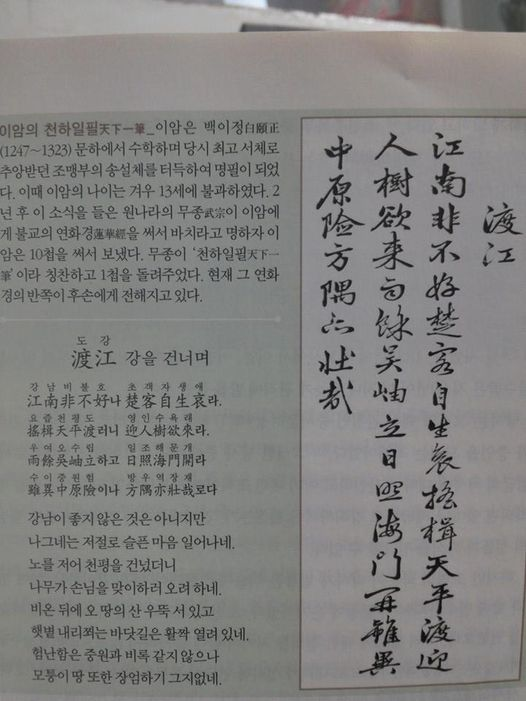
서문으로 글을 마감한 후 겨우 일곱 달이 지난 이듬해 5월 이암은 병으로 세상을 떠났습니다. 편치 않은 몸으로 생애 마지막 정력을 다 쏟아 단군세기를 마무리한 것입니다. 이암은 당대 최고의 지성과 학식을 갖춘 대학자요 정치가였습니다. 그의 글씨는 여말선초의 국서체가 될 정도로 최고의 명필이었습니다.
그러면서도 그는 나라의 안위를 뒷전으로 미루고 사리사욕에 급급하던 권문세가들과 달리, 재물과 권세를 탐하지 않고 임금과 나라에 대한 충심을 지켰습니다. 이암은 단군세기를 지어 고조선 2,096년 역사를 정리하였을 뿐 아니라, 그 서문에서 역사를 똑바로 아는 것이 왜 중요한지 피력하였고 국통을 바로 세우는 것이 구국의 길임을 토로하였습니다.
나아가 인간은 어떻게, 왜, 무엇을 위해 태어났으며 인간으로서 살아가야 할 참된 삶은 무엇인가 하는 인간론의 명제를 명쾌한 필치로 풀어냈습니다. 첫 행부터 마지막 행까지 논리정연한 구조로 정리된 단군세기 서문은 대학자의 지성을 유감없이 발휘한 만고의 명문입니다.

————-
Hangchon Yi Am, a figure famous enough to be included in the Biographies section of Goryeosa (History of Goryeo), was born in 1297, during the reign of King Chungnyeol of Goryeo, in Goseong, Gyeongsang Province. He was the eldest son of Yi U, of the Goseong Yi clan. Yi Am came from a distinguished scholarly family that had produced many scholars and officials. The pen name Hangchon comes from a village in Ganghwa Island, where he was exiled.
Yi Am’s great-grandfather, Yi Jin, passed the state examination during the reign of King Gojong and served as an official in the Seungmunwon (the Royal Secretariat). His grandfather, Yi Jonbi, also passed the examination and held positions such as Munhan Scholar and head of the Jinhyeongwan. Yi Am’s father, Yi U, did not sit for the examination but held regional posts in Gyeongsang and Gangwon Provinces through the recommendation system.
According to the TaeBaekIlSa (History of the Greater Baek), Yi Jonbi had a profound understanding of the history of Hwan-guk and Bae-dal, and was deeply versed in the concept of Hwan-dan. Yi Am inherited this spirit and knowledge from his grandfather.
At the age of 10, under his father’s direction, Yi Am entered Boje Temple on Mount Mari in Ganghwa Island, where he studied Confucian classics and the ancient history of Korea for three years. Whenever he missed his parents and hometown, he would climb the Chamseongdan, an altar built during the time of Dangun Wanggeom, the first ruler of Gojoseon, and reflect on the historical consciousness of Dangun.
Even at that early age, Yi Am had great ambitions to restore Goryeo to its former glory as a clean and pure nation in the East, free from foreign influence. He composed a poem that expressed his desire: “Who will light the bright torch on the dark streets of our Eastern land? I will rise now for the peace of our Eastern world!”
At the age of 17, Yi Am passed the civil service examination, and the following year, he was appointed to a position managing various documents and books at the Royal Library. Around this time, the Yuan dynasty sent 4,000 volumes of books that had originally belonged to the Song dynasty, and Yi Am, as an official in charge, eagerly studied them.
During the 10 years he spent immersed in books, a major incident occurred. Certain corrupt officials in the court sought to dissolve Goryeo and petition the Yuan dynasty to make it part of Yuan territory. These officials, including Ryu Cheongsin and Oh Jam, submitted a petition to the Yuan, requesting that Goryeo be renamed as Samhan Province, and a decree from Yuan approved this request.
Yi Am submitted a passionate memorial to the king, stating, “Our nation has, since the age of Hwandan, referred to its people as the sons of the Heavenly God and offered sacrifices to Heaven. Therefore, we cannot be equated with the feudal lords who were merely granted their lands.” Despite being a lower-ranking official, Yi Am insisted that Goryeo, as the land of the Son of Heaven, should not be treated as any ordinary vassal state of China, and called for severe punishment of those who sought to degrade Goryeo’s national prestige.
At the time, Goryeo’s sovereignty was severely weakened due to both external interference from the Yuan and the tyranny of traitorous officials aligned with the Yuan. After King Chungmok’s death, during the chaotic periods of King Chungjeong and King Gongmin’s reigns, Yi Am was exiled to Ganghwa Island. He returned to the island where he had studied as a child, now as an exile at the age of 36.
During his exile, Yi Am studied the I Ching (Book of Changes) and various books on the principles of the universe, astronomy, geomancy, and geography. Three years later, after being pardoned, he stayed at Taesam Hermitage on Mount Cheonbo for a year, where a pivotal event in his life occurred: he met Yi Myeong and Beomjang, and together, they vowed to restore Korean history by writing historical texts.
The details of how these three met are still unclear, but they received ancient manuscripts hidden in a cave from a mysterious figure known as Sojeon Geosa. These manuscripts contained records of the Hwandan era (the period of Hwan-guk, Bae-dal, and Joseon), considered the golden age of human civilization.
The true identity of Sojeon Geosa remains unknown, but his name suggests that he was deeply connected to the propagation of the ancient Sin-gyo culture. It was he who handed down these secret books to Yi Myeong, Beomjang, and Yi Am, enabling them to restore the ancient history of the Korean people.
Yi Am wrote Taebaekjinhun and Dangunsegi, which discussed the Daoist principles of the Hwandan era. Beomjang wrote Bukbuyeogi, and Yi Myeong wrote Jinyeokyugi.
After King Chungjeong’s death and King Gongmin’s restoration, Yi Am returned to government service at the age of 44, serving as a high-ranking official in the Seonggyun-gwan and as an advisor to the king. However, Yi Am focused not on currying royal favor but on correcting the king’s political missteps.
Following another period of exile and reinstatement, during King Gongmin’s reign, Yi Am was appointed to the title of Marquis of Cheorwon and took charge of teaching the classics and Confucian rites at the Royal Academy. The following year, Yi Am requested to retire and withdrew to Mount Cheongpyeong.
Why did Yi Am suddenly retire to Mount Cheongpyeong? Some speculate that it was due to the behavior of the meritorious retainers who had helped enthrone King Gongmin, but that may not have been the only reason. Yi Myeong, who had received the secret books alongside Yi Am, lived in Cheongpyeong. Yi Am, now 57 years old and nearing the end of his life by the standards of the time, likely chose this place to devote himself to completing the historical texts on the Hwandan era that he had prepared for throughout his life.
However, Yi Am’s plans were interrupted. After five years of retirement, King Gongmin called him back to court to serve as Prime Minister, as the king urgently needed an experienced statesman to lead the kingdom’s reforms.
The year after Yi Am returned to court, a Chinese rebel group called the Red Turbans, rebelling against the Yuan, invaded Goryeo. Yi Am was appointed as the supreme commander and dispatched to the northwest to repel the invaders. He successfully defeated an enemy force of 40,000 soldiers.
In 1361, the Red Turbans invaded again, this time with an army of 100,000, pushing as far as Hwanghae Province. King Gongmin fled south to Gyeongbuk Andong, and Yi Am accompanied him. After 54 days of occupation, Goryeo regained control of its capital, Gaegyeong, and King Gongmin narrowly escaped an assassination attempt. Following this, Yi Am finally retired from government service at the age of 67.
Having served six kings over the course of 50 tumultuous years, Yi Am finally removed his official robes and retired to a private life. That same year, he moved to Ganghwa Island, built a house called Haeundang in Honghaengchon, and began calling himself “The Old Man of Honghaengchon.” He devoted the remainder of his life to completing Dangunsegi.
Although it is unclear when Yi Am began writing Dangunsegi, according to the preface, he completed the work in October of the year he settled in Honghaengchon. This monumental work, written with deep resentment for the declining fortunes of the kingdom, aimed to reveal the glorious history of ancient Joseon to the world.
Seven months after finishing the preface, Yi Am passed away in May of the following year, exhausted from his final efforts to complete Dangunsegi. Yi Am was a great scholar and statesman with unmatched intellect and knowledge. His calligraphy was so renowned that it became the standard national style in the late Goryeo and early Joseon periods.
Despite his high position, Yi Am was different from the greedy and self-serving aristocrats of his time, remaining loyal to the king and the country without seeking wealth or power. Not only did Yi Am organize 2,096 years of Gojoseon history through his work on Dangunsegi, but in the preface, he also emphasized the importance of correctly understanding history and proclaimed that restoring the national lineage was the path to saving the nation.
Moreover, he clearly articulated key questions about human existence: how, why, and for what purpose were humans born, and what constitutes a true life as a human being. The preface to Dangunsegi, with its clear and logical structure, is a masterpiece that showcases the intellect of a great scholar.