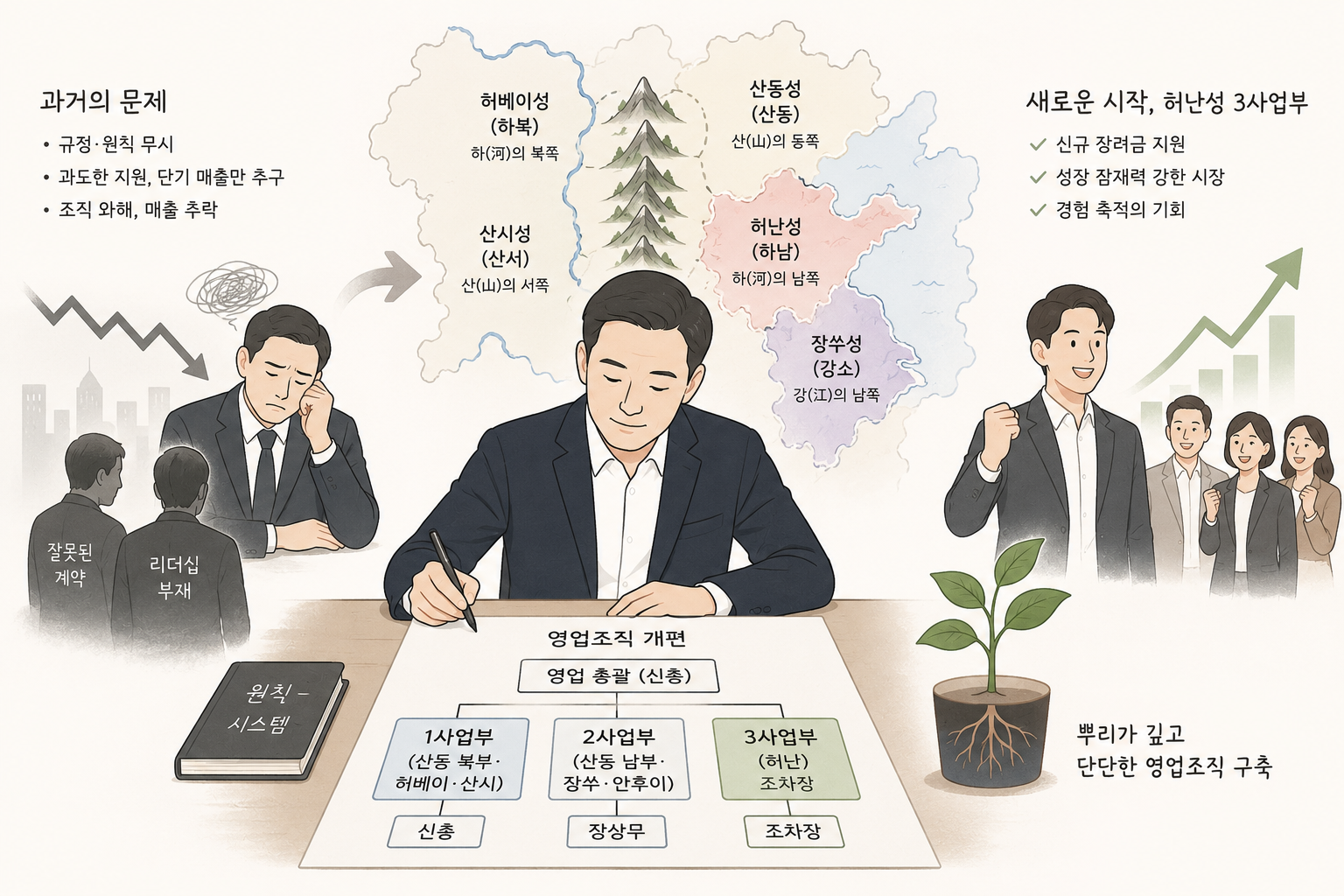
허난성의 경우는 새로 막 시작한 사업부로써 신규 장려금 지원을 받으며 매출이 계속 신장할 여력이 강한 곳이었기에, 경험이 부족한 조 차장이라 해도 비교적 쉽게 영업을 하며 경험을 쌓을 수가 있을 것이다.
허난성으로 시장을 개척한 것은 장 상무의 공도 없지 않아 있었다. 지난번 동북에서 쉬 이사 일행이 찾아왔을 때, 슬쩍 도망간 장 상무는 실제로 허난성으로 출장을 갔었다. 단지 일부러 그날 일정을 잡아서 내게 골탕을 먹이려 한 것이 잘못이었던 것이다.
장 상무는 이부총의 소개로 왕 부총을 만나 허난 성을 담당할 리더급 대리상으로 왕 부총 조직과 대리상 계약을 체결했다. 문제는 왕 부총의 역량이 부총감의 수준이 되지 않는데도 불구하고, 당장의 매출을 위해 또 한 번 그녀가 원하는 조건대로 비교적 좋게 계약을 체결해 주었던 것이다.
후에 겪으며 알게 되었지만, 그녀는 개인적인 욕심이 과하여 하부 구성원들에게 잘 베풀지를 않아서 그들에게 존경을 받지 못하는 사람이었다. 한마디로 부하들을 부려먹을 줄만 알고 제 실속만 차리기에 급급한 인물이라, 나중엔 조직이 와해되는 아픔을 겪게도 된다. 리더십이란 내가 아닌 타인에 대한 배려로부터 시작된다는 것을 어리석은 그녀나 장 상무는 서로 모르고 있었다.
그러나 다행인 것은 왕 부총의 밑에 있던 이 부장의 발견이었다. 그녀는 잘못된 상사와의 만남에서 홀로 꿋꿋하게 살아남게 된다. 이 부장은 왕 부총이 자신에게 큰 도움이 되지 않는 사람임을 알았으나, 허난성에 터전을 두고 있는 상황에서 그녀의 밑에서 쉽게 벗어날 수가 없었다. 회사가 왕 부총에게 허난성에 대한 독점권을 주었기 때문이다.
그러나 그녀는 쉽게 포기하지 않고 자신의 밑에 있는 직원들과 한가족처럼 합심하여, 밤낮으로 휴일도 없이 헌신적으로 영업을 했다. 그 결과 전국 최고의 실적을 내는 부장이 되고, 단기간에 이사로 진급을 하자마자 또 다시 1등 이사가 되어, 이 년 만에 부총이 되면서 허난 성을 반으로 나눠 왕 부총 밑에서 독립을 하게 된다. 그런 이 부장이 있었기에 나는 신입이나 다름없는 조 차장을 3사업부 팀장으로 맡길 수가 있었던 것이다.
나에겐 큰 목표가 있다. 지금까지 반복되어 왔던 한순간의 반짝 매출이 아니라, 지속적으로 성장 가능한 뿌리가 깊고 단단한 영업 조직을 구축하는 것이다. 그리하여 나는 추락하는 매출을 다시 끌어올리기 위해 잘못 된 점을 바로잡으려고 전국을 순회하며 대리상들을 만났다.
그동안 장 상무가 저지른 일을 수습하기 위해 조직 시스템을 재정비하고, 중국 전역을 누비며 대리상들의 교육에 온 노력을 기울였다. 무엇보다도 구체적이지 못하고 머릿속에만 가둬 놓고 있는 대리상들의 영업 목표와 계획을 숫자로 끄집어내는 영업의 프로세스를 개선함으로써, 그들을 목표지향적인 체질로 바꾸기 위해 애썼다.
또한 나는 뚜렷한 원칙을 세우려 했다. 내가 장 상무에게 매우 답답했던 것은 그가 자신이 만든 영업의 규정과 원칙을 본인이 스스로 깬다는 것이었다.
나는 과거 나의 통제권 밖에 있었던 장 상무가 출장을 한 번 가기만 하면 또 무슨 사고를 칠지 걱정해야만 했다. 나는 그에게 대리상을 만나도 절대로 규정의 한도 내에서만 약속을 하라고 신신당부를 했지만, 그는 매번 사업자들이 요구하는 것들을 허락하고 돌아왔다.
언제나 그의 사고방식은 영업을 하다 보면 이럴 수도 있고 저럴 수도 있듯이, 상황이 모두 다른데 어떻게 하나의 규정으로 모두 똑 같이 적용할 수 있느냐는 식이었다. 물론 나도 이 말에는 동의하나, 만약 해줄 수 있는 일이 있고 해줄 수 없는 일이 있다면, 진정으로 하면 안 되는 일은 회사의 규정을 깨는 일이라고 생각했다. 사무실 지원 규정, 판촉 지원 규정 등의 원칙을 특정한 사람에게 깨는 순간, 회사의 법은 바로 무너지기 때문이다. (계속)
Henan Province was a newly established division with tremendous growth potential. As a new market, it qualified for various incentive programs designed to encourage expansion, and sales were expected to continue growing rapidly. For that reason, even Deputy Manager Cho, who had relatively little management experience, would be able to build his skills while operating in a market that offered favorable conditions.
To be fair, Executive Director Zhang also deserved some credit for opening the Henan market.
When Director Xu and her team from the Northeast had unexpectedly visited our company, Zhang had quietly slipped away. What I later learned was that he had actually left on a business trip to Henan. His mistake was not the trip itself, but that he had deliberately scheduled it on that particular day, leaving me to deal with the difficult situation alone.
Through the introduction of Deputy General Manager Lee, Zhang met Deputy General Manager Wang and signed a distributor agreement with her organization, appointing her as the regional leader for Henan Province.
The problem was that Wang lacked the leadership and capability expected of someone at the deputy general manager level. Nevertheless, in his eagerness to generate immediate sales, Zhang once again granted her a highly favorable contract almost entirely on her own terms.
As I came to discover later, Wang was an excessively self-centered person. She rarely shared opportunities or rewards with the people under her leadership, earning little respect from her team. Simply put, she knew only how to make others work for her while looking after her own interests. Eventually, her organization would suffer the painful experience of falling apart.
Neither the foolish Wang nor Executive Director Zhang seemed to understand that true leadership begins not with oneself, but with consideration for others.
Fortunately, however, there was one remarkable discovery within Wang’s organization—Manager Lee.
Despite serving under the wrong leader, she persevered and survived through her own determination.
Manager Lee understood perfectly well that Wang contributed very little to her own professional growth. Yet because the company had granted Wang exclusive distribution rights for Henan Province, she had no realistic way of breaking away from her organization while remaining in the market.
Instead of giving up, Lee united her employees like members of one family. Together they devoted themselves to sales day and night, working tirelessly without regard for weekends or holidays.
Their efforts paid off.
She achieved the highest sales performance of any regional manager in the entire country, earned a rapid promotion to Director, and soon afterward became the nation’s top-performing Director as well. Within just two years, she was promoted to Deputy General Manager. By then, Henan Province had grown enough to be divided into two territories, allowing her to become independent from Wang’s organization.
It was precisely because someone like Deputy General Manager Lee existed that I felt confident entrusting the newly created Third Division to Deputy Manager Cho, despite his limited experience.
I had a much larger goal in mind.
Rather than chasing the brief flashes of spectacular sales that had repeatedly occurred in the past, I wanted to build a sales organization with deep, solid roots—one capable of sustaining long-term growth.
To reverse our declining sales, I traveled throughout China meeting distributors in person, determined to correct the mistakes that had accumulated over the years.
I reorganized the entire sales system to repair the damage caused by Executive Director Zhang’s management, while devoting myself to educating distributors across the country.
Above all, I focused on improving the sales process itself.
Most distributors had sales goals and business plans that existed only as vague ideas in their minds. I worked to transform those abstract intentions into measurable numerical targets and concrete action plans, helping them develop a disciplined, goal-oriented mindset.
At the same time, I was determined to establish clear principles.
One of my greatest frustrations with Executive Director Zhang had always been that he routinely violated the very rules and policies he himself had created.
Whenever Zhang traveled on business while he was still outside my authority, I found myself worrying about what new problem he might create.
I repeatedly reminded him that no matter what promises he made to distributors, they must always remain within the limits of company policy.
Yet every time he returned from a trip, he had agreed to nearly every request his distributors had made.
His philosophy was always the same.
“In sales, every situation is different. Since every customer and every circumstance is unique, how can a single rule possibly apply equally to everyone?”
To a certain extent, I agreed with his reasoning.
However, I also believed that if there are things a company can do and things it cannot do, then one thing should never be compromised: the company’s own rules.
The moment exceptions are made for a particular individual—whether regarding office subsidies, promotional support, or any other company policy—the authority of those rules begins to collapse.
And once the company’s rules collapse, the organization itself inevitably begins to fall apart.
(To be continued)