


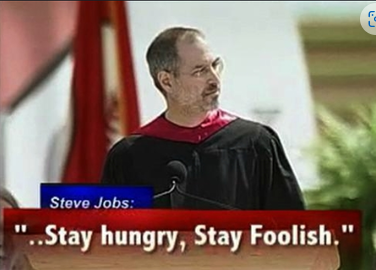
스티브잡스가 스탠포드대학 졸업식 연설에서 자신의 인생을 간략히 얘기하며 말한 명언이 있다.
“무덤 안에서 가장 부자가 되는 것보다, 매일 밤 잠자리에 들 때, 우리가 놀라운 일을 했다고 말하는 것이 더 중요하다.”
세상을 놀라게 하는 변화를 만들어 매일 밤 벅찬 가슴으로 잠자리에 들 수 있다면, 이 얼마나 기쁜 일이 아니겠는가? 그가 애플에서 쫓겨난 후, 단 돈 1달러를 받고 다 쓰러져가는 애플에 다시 돌아왔을 때, 그는 잃어버린 돈과 명예를 되찾기 위한 것이 아니라, 그냥 가슴이 시키는 대로 하였다고 했다. 가슴은 이미 이성적인 머리보다 먼저 알고 있었다. 그것이 매우 기쁘고 즐거운 일이라는 것을…
그리고 그는 연설의 마지막에 시대를 넘어 길이 남을 명언을 하나 남겼다.
“Stay Hungry, Stay Foolish!”
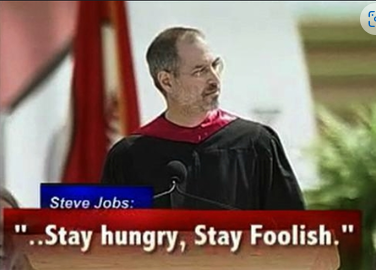
“Stay Hungry”란 말은 말 그대로 직역하면 배고품을 유지하라는 말이다. 2002년 월드컵 당시 한국 국가대표를 4강의 신화로 끌어올린 명감독 히딩크도 우리가 세계 강호들을 물리치고 떠들썩 소란을 피웠을 때 “나는 아직도 배가 고프다.”라는 명언을 남겼었다. 히딩크 감독이 그 때 그 수준에서 “이만하면 만족한다. 난 할만큼 다했다.”라고 말했다면, 어찌 우리나라의 4강신화가 이루어졌겠는가.
스티브 잡스의 “Stay Hungry”란 말은 결국 어느 정도 성공을 한 사람들에게 하고 싶은 말이었을 것이다. 스탠포드라는 명문 대학교를 졸업하는 학생들은 아직 사회에 발을 내딛지도 않았지만, 어느 정도 성취감에 빠져 있었을 것이다. 스티브 잡스는 졸업생들에게 자신의 인생을 얘기하면서 스스로 만족하지 않고 계속 새로운 사업을 성공할 수 있었던 것도 바로 초심을 잊지 않고 자신을 절박하게 몰아 부치며 끊임없이 변화를 시도하였기 때문임을 일깨워주고 싶었을 것이다.
‘Stay Foolish’도 또한 바보가 아니라면 이 말이 진짜 바보가 되라는 말이 아님을 누구나 알 것이다. 이는 스스로를 낮추어 좀 모자라 듯 항상 배워야 함을 의미하는 것이다. ‘위대함’의 가장 큰 적은 ‘좋음’이고, 내가 맞서야 할 가장 큰 적은 바로 스스로 만족하는 나 자신이기 때문이다. 그러므로 “Stay Hungry, Stay Foolish”해져서 과거의 나를 부수는 것이 새로운 나를 만드는 것이라고 그는 주장한 것이다.
앞서 얘기했지만 변화는 두려운 일이다. 하지만 변화를 통해 계속 새로움을 접한다는 것은 가슴을 방망이 치듯 뛰게 하는 놀라운 기쁨이다. 나는 애경산업에서 어렵게 마리끌레르와 에이솔루션을 출시했던 때도, LG생명과학에서 필러를 출시하고 생소한 의사들을 만나러 다녔던 때도, 나중에 40대 후반의 나이에 중국어도 못하면서 중국으로 넘어가서 세라젬 화장품 중국법인을 세우고 맨땅에 헤딩하듯 방방곡곡을 누비며 영업을 했던 때도, 모두 힘든 과정이었지만 인생의 한 줄기 행복감으로 느껴졌다. 아마도 스티브 잡스 또한 그런 즐거움으로 지속적인 변화의 원동력을 창출하였을 것이다.
마지막으로 변화에 대한 멋진 명대사가 있는 영화 베스트 엑조틱 매리골드 호텔(The Best Exotic Marigold Hotel)을 소개한다. 각자의 사연을 담은 채 어느 날 갑자기 운명처럼 인도의 자이푸르에 있는 베스트 엑조틱 매리골드 호텔에 모인 인생의 황혼기에 놓인 7명의 영국인 노인들의 삶에 대한 다양한 모습을 유쾌하고 아름답게 볼 수 있는 재미있는 영화였다. 영화의 마지막에 나오는 대사가 내 마음 속에 깊이 자리 잡혀 떠나지를 않았었다.


“진정한 실패는 시도도하지 않는 것이다. 성공의 방법이란 어떻게 실망을 극복하는가” 이다. 늘 그랬듯이 우리는 이곳에 와서 다른 방식으로 살아보려고 노력을 했다. 변화하기엔 너무 늙었다고 해서 과연 비난 받을 수 있을까?
다시 시작해야 하는 것이 너무 겁이 나서, 우린 아침에 일어나서부터 최선을 다한다. 다른 건 상관없다. 위험을 무릅쓰지 않는 사람이 오히려 자유로울 수 있는 것도 사실이다. 우리가 미래에 대해 아는 것이라곤 지금과는 다르다는 것일 뿐…
하지만 우리가 두려운 건 변하지 않고 똑같을까 이다. 그러니 변화를 축하해야 한다. 모든 건 결국에는 다 괜찮아질 것이라고 누군가 말했다. 그래도 만약 괜찮아지지 않았다면, 아직 끝난 것이 아니다. (Everything will be alright in the end. So if it is not alright, it is not yet the end.)”
‘피할 수 없으면 즐겨라’는 말이 있다. 이제 변화는 피할 수 없는 필수조건이다. 변화를 즐겨라. 즐거운 일을 하는데 어떤 고통과 두려움이 문제겠는가? 공자께서도 말씀하였다.
“아는 자가 되어야 한다. 그러나, 아는 자는 좋아서 하는 자를 못 당하고, 좋아서 하는 자는 즐기는 자를 못 당한다(子曰 知者, 知者不如好者, 好者不如樂者).”
변화를 아는 자,
변화를 좋아하는 자,
변화를 즐기는 자만이 두려움을 극복하고 변화에 성공할 수 있을 것이다.
Change, 변화를 즐겨라.
———————
Steve Jobs, in his commencement speech at Stanford University, shared a brief story about his life and left us with a famous quote:
“Being the richest man in the cemetery doesn’t matter to me. Going to bed at night saying we’ve done something wonderful, that’s what matters to me.”
How wonderful would it be if we could go to bed every night with a full heart, knowing we had made a remarkable impact on the world? When he returned to a failing Apple for a salary of just $1, he wasn’t trying to regain lost wealth or reputation. He simply followed his heart. His heart already knew what his logical mind hadn’t yet fully realized—that this was something incredibly exciting and fulfilling.
At the end of his speech, he left us with a timeless piece of advice:
“Stay Hungry, Stay Foolish!”
The phrase “Stay Hungry” can be taken literally to mean “stay hungry,” but its deeper meaning lies in the message it conveys. In the 2002 World Cup, when South Korea’s national football team, led by the great coach Guus Hiddink, made it to the semi-finals, Hiddink famously said, “I am still hungry,” despite the historic achievement. If, at that moment, Hiddink had declared himself satisfied, saying, “I’ve done enough,” how could the legendary journey to the semi-finals have been realized?
Similarly, Steve Jobs’ message of “Stay Hungry” was likely directed toward those who have already achieved some level of success. Although the Stanford graduates had yet to step into the real world, they might have already been basking in a sense of accomplishment. By sharing his life story, Jobs aimed to remind them that his continued success came from never settling and from constantly pushing himself, staying desperate, and embracing change.
As for “Stay Foolish,” it’s clear that this doesn’t mean being foolish in a literal sense. It’s about staying humble, being willing to learn as if you know nothing. The greatest enemy of “great” is “good,” and the biggest opponent we face is often our own complacency. Thus, Jobs urged everyone to “Stay Hungry, Stay Foolish” to break past their old selves and create something new.
As I mentioned earlier, change can be daunting. But the joy of continually experiencing new things through change is what makes our hearts beat with excitement. Personally, I felt a sense of happiness when I launched Marie Claire and A-Solution at Aekyung Industrial, when I released filler products at LG Life Sciences and met unfamiliar doctors, and later, in my late 40s, when I went to China without knowing a word of Chinese to establish Ceragem Cosmetics’ China branch, traveling to every corner of the country like hitting my head against a wall.
All of these were tough, but they also gave me a profound sense of joy. I imagine that Steve Jobs found similar joy in embracing constant change and using it as the driving force behind his achievements.
Lastly, I’d like to introduce a film with a fantastic quote about change: The Best Exotic Marigold Hotel. It’s an entertaining movie that showcases the different lives of seven British seniors who, by fate, end up at the Best Exotic Marigold Hotel in Jaipur, India, during the twilight of their lives. One line from the movie stuck with me long after watching it:
“The only real failure is the failure to try, and the measure of success is how we cope with disappointment. As always, we’ve tried to live differently here. Can we be blamed for it, even though we’re too old to change?
Starting over can be terrifying, but every morning, we wake up and give our best. Nothing else matters. It’s true that the person who avoids risk may feel freer. The only thing we know about the future is that it will be different from the present. Yet, what truly scares us is not changing and staying the same. So, we must celebrate change. Someone once said that everything will be alright in the end.
If it’s not alright, then it’s not yet the end.“
There’s a saying, “If you can’t avoid it, enjoy it.” Change is now an unavoidable condition. Embrace it. What pain or fear could stand in the way when you’re doing something enjoyable? Confucius also said:
“To know something is important. But someone who enjoys doing it surpasses someone who merely knows it, and someone who finds joy in it surpasses even the one who enjoys it.”
Only those who understand change, those who love change, and those who enjoy change will overcome their fears and succeed in adapting to change.
Change – embrace it and enjoy it!