끊임없이 아내를 의심하는 남편이 있다고 하자. 아내는 어려운 살림을 위해 밤늦게도 일을 하는데, 남편은 제대로 일도 하지 않으며 아내가 밤늦도록 진짜 일하는 건지, 아니면 딴짓 하다가 일부러 밤늦게 일하는 척하는 건지 의심스러워 했다.
그러나 남편은 차마 일하는 아내에게 물어보고 확인하진 못하고 의심의 불씨만 키워가며, 이 사람 저 사람에게 아내의 흉을 보고 다니게 되었다. 그러던 어느 날, 그 말이 돌아 아내에게 전달되어, 아내는 너무도 큰 충격을 받게 되었다. 이제 아내는 어찌 해야만 할까? 집안 살림이 어찌 되든 남편에 맞춰 일도 그만 두고 남편 시중만 들어야 할까, 아니면 남편을 떠나 자기 살 길을 찾아가야 할까?
직장에서도 마찬가지다. 부하직원에 대한 아주 작은 의심의 씨앗 하나를 가슴에 품게 된 리더는 처음엔 그것이 별것 아닌 사소한 일이라고 웃어 넘겨도, 어느 새 그 씨앗이 싹을 틔어 뿌리를 내리고 결국은 곧은 줄기로 자라 꽃을 피운다는 사실을 잘 모르고 있다. 그러기 때문에 의심이란 씨앗조차도 뿌려서는 안 된다. 의심의 근원이 사라질 수 있도록 사소한 것이라도 매사에 명확하게 밝히고 넘어가야 한다. 리더에게 부하는 의심하고 감시해야 할 대상이 아니라, 물을 뿌리고 영양제도 공급해줘서 스스로 굳게 자랄 수 있도록 믿고 키워야 할 대상이기 때문이다.
신뢰는 쌍방향이다. 서로 간의 상호작용이다. 신뢰는 한 사람의 노력만으로 이루어질 수 없는 일이지만, 나의 노력으로 상대방에게 강한 영향력을 줄 수 있는 인간관계의 근간이다. 세상의 모든 일이 남에게 받기 전에 나부터 주어야 하는 ‘Give & Take’인 것처럼, 내가 믿음을 먼저 주어야 상대방에게도 신뢰가 형성되는 것이다.
그런 의미에서 남은 나의 거울인 것이다. 내가 의심받을 짓을 하면 남도 그럴 것 같아 믿을 수 없게 되고, 내가 태만하고 게으르면 남도 일 안하고 게을러만 보이며, 내가 책임감이 없으면 사소한 일에서도 끊임없이 남의 탓을 한다. 진정한 리더는 남을 통해 자신의 허울을 발견하고 스스로 겸손할 줄 아는 사람이어야 하며, 이를 통해 직원들과 서로 굳건한 믿음으로 연결되어야 할 것이다.
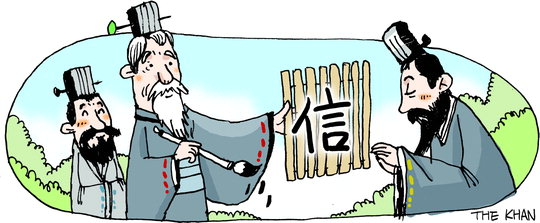
논어(論語)의 ‘안연편(顔淵篇)’에는 ‘무신불립(無信不立)이라 하여, 공자와 그의 제자 자공(子貢)의 대화에서 신뢰의 중요성에 대한 얘기가 나온다. 자공이 정치에서 중요한 것이 무엇이냐고 묻자, 공자는 “첫째 먹는 것이 풍족하여야 하고(足食), 둘째는 군사력이 충분해야 하며(足兵), 마지막으로 백성의 믿음을 얻는 일(民信)이 중요하다”고 대답하였다.
그러자 자공이 “어쩔 수 없이 하나를 포기해야 한다면 무엇을 빼야 합니까?”라고 묻자 공자는 군대를 포기해야 한다고 대답했다. 자공이 다시 나머지 두 가지 가운데 또 하나를 포기해야 한다면 무엇이냐고 묻자, 공자는 식량을 포기해야 한다며 말했다.
“옛날부터 사람들은 죽을 수밖에 없다(자고개유사 自古皆有死), 그러나 백성의 믿음이 없으면 국가도 바로 서지 못한다(민무신불립 民無信不立).”
아무리 먹을 것이 풍족하고 군사력이 강해도 백성의 신뢰가 없는 국가는 존립할 수 없다는 것처럼, 기업도 아무리 많은 인력을 보유하고 많은 월급을 준다고 하여도, 직원들과 신뢰로 맺어진 강한 유대관계가 없거나, 품질과 서비스를 통한 고객과의 신뢰가 형성되지 못한다면 오래 존속될 수가 없을 것이다. 그리고 개인도 마찬가지다. 사람들 간에 믿음이 없는 사람은 더불어 살아갈 수가 없다. 인간관계에서 가장 중요한 미덕은 역시 신뢰이다.
———–
Imagine a husband who constantly doubts his wife. The wife works late at night to help support their difficult household, but the husband, who doesn’t work properly, begins to suspect that she may not actually be working and is just pretending to be busy. He grows suspicious, but instead of asking her directly, he chooses to talk behind her back to others, spreading rumors. Eventually, these rumors reach the wife, and she is deeply shocked. Now, what should the wife do? Should she give up her job, focus entirely on serving her husband, and ignore the household’s needs, or should she leave him and seek her own path?
This situation is similar in the workplace. When a leader harbors even a small seed of doubt about a subordinate, at first, they may dismiss it as something insignificant. However, over time, that small seed grows, takes root, and eventually blossoms into a serious issue. Leaders often fail to realize this, which is why even the slightest doubt should never be allowed to sprout. The source of the doubt should be cleared up immediately, and even the smallest details should be made clear to avoid any misunderstanding. A leader’s role is not to doubt and monitor subordinates, but to nurture and support them so that they can grow strong on their own.
Trust is reciprocal. It is an interaction between two parties. Trust cannot be built by just one person’s effort, but through one’s efforts, they can strongly influence the relationship. Just as all matters in life involve a ‘Give & Take,’ where you first give before expecting to receive, I must give trust first in order to build mutual trust with others.
In this sense, others are a reflection of myself. If I act in a way that makes me untrustworthy, others will likely be untrustworthy too. If I am lazy or irresponsible, others will seem lazy and irresponsible to me. If I am negligent, I will constantly blame others for even the smallest problems. A true leader is someone who discovers their own flaws through others and is humble enough to learn from them, ultimately forming strong trust with their team.
In the Analects of Confucius, in the chapter on Yan Yuan (顔淵篇), there is a conversation between Confucius and his disciple, Zigong (子貢), about the importance of trust. Zigong asks Confucius what is most important in politics. Confucius responds, “First, there must be sufficient food (足食), second, there must be sufficient military power (足兵), and third, the trust of the people (民信) is essential.”
Zigong then asks, “If one must give up one of these things, what should be sacrificed?” Confucius replies that the military should be given up. Zigong asks again, “If one must give up one of the remaining two, what should be sacrificed?” Confucius responds that food should be given up.
“Since ancient times, all people are destined to die (自古皆有死), but a country without the trust of its people cannot stand (民無信不立).”
Just as a country cannot survive without the trust of its people, even if it has abundant food and military power, a company cannot last if it lacks strong bonds of trust with its employees or if it fails to build trust with its customers through quality and service. Similarly, individuals cannot thrive without trust in their relationships. In human interactions, trust is the most important virtue.