

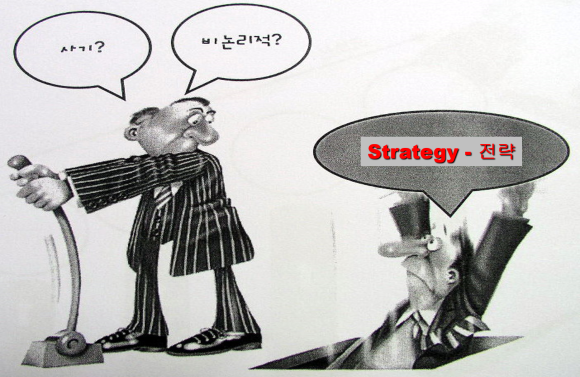
근거가 없는 기획이나 전략은 모두 사 와 다름없다. 사실 사기를 친다는 것도 미래에 대한 기대심리를 이용하여 선 투자를 받는 사업이나 다름없다. 단지 법적인 것과 불법적인 것의 경계선 상에서 그 계획이 근거가 있는 것인가 아닌가의 차이다.
물론 사기꾼들도 피해자를 속이기 위해 거짓 정보로 포장된 그럴싸한 근거들을 보여준다. 그러한 근거 때문에 많은 사람들이 맹목적인 믿음으로 피해를 겪는 것이다.
하지만 좀 더 분석적이고 논리적 마인드를 가지고 있는 사람이라면 그 근거들에게서 많은 헛점들을 발견할 수 있을 것이다. 그래서 사기꾼들도 그렇지 못한 사람들을 선택해서 집중적으로 노리는 것일지도 모른다.
기업의 신규사업이나 신제품 개발 투자를 주장하는 상사, 동료, 부하에게서도, 우리 주변에 동업이나 어떤 투자를 권유하는 가족이나 친구에게서도, 통닭집이나 편의점 같은 프랜차이즈 사업의 성공적인 환상을 제시하는 기업의 영업사원에게서도, 아니면 새로운 제품을 추천하려고 방문한 이웃집 아줌마에게서도 우리는 선의적이거나 합법적인 사기의 기운을 느낄 수가 있다.


그들이 일부러 돈을 뜯어내려는 전문 사기꾼이 아니고 불법적인 일이 아니더라도, 명백하고 논리적인 판단을 위한 근거를 제시하지 않고 무조건 좋으니 잘 될 것이라는 식으로 일단 한번 해보라는 말에서, 사기의 낌새를 발견할 수 있어야 한다.
미래를 예견하는 일에는 무당이 신을 빌려 점을 보는 것이 아니라면, 항상 원인과 과정, 그리고 예상되는 결과가 명백하게 드러나 보여줘야 한다. 그렇지 않고 눈에 보이지 않는 멋진 결과만 상상하며 판단하는 것은 사기꾼에 쌈지돈을 털어 내어주는 꼴이나 다름없는 일이다.
그러면 사기를 치거나 당하지 않기 위해, 어떻게 불확실한 미래를 예측할 수 있을까? 어떻게 올바른 선택을 할 수 있을까? 아니면 지금 우리가 처한 상황, 현실이라도 어떻게 제대로 파악해 볼 수가 있을까?
지금까지 어렵고도 지루한 전략에 대해 긴 이야기를 한 이유도 바로 이 문제에 대한 답을 찾기 위한 것이었다. 정답은 없다. 대신 우리는 정답을 찾기 위해 올바른 전략이 필요하고, 올바른 전략을 위해서는 올바른 정보가 필요하며, 올바른 정보를 수집하고 평가하기 위해서는 반드시 논리적 사고능력이 필요하다는 것은 틀림없는 사실이다.
논리적 마인드는 바로 전략 수립의 근간이 되는 조사, 분석, 예측에 대한 힘의 바탕이다. 이는 단순히 기업의 마케팅 조사업무에 필요한 것만 의미하지 않는다. 논리적 마인드는 사람의 창의력을 뒷받침해주고 통찰력을 키워주는 역할을 하는 좋은 습관이 되어준다.
흔히들 경험 많은 사람들이 말하는 동물적인 감각이란 것이 잘 들어맞는 이유는 그것이 단순히 본능에만 의존하는 것이 아니라, 수 년간 훈련된 논리적 사고력의 기본 하에서 생긴 진정한 인사이트(Insight)이기 때문이다.

과거 아무리 수많은 고생을 극복하였다 하더라도, 고성장시대 시류에 편승해서 성공한 사업가들이, 현재 더욱 복잡하고 치열한 경쟁과 저성장 시대에 와서 힘들어 하는 이유도 그들이 헤쳐온 배경이 이런 논리적 배경이 부족하여 올바른 선택을 하지 못하기 때문이라고 나는 감히 얘기하고 싶다.
앞서 소개한 마리끌레르, 에이솔루션 등 성공사례들의 공통점은 시장조사와 환경분석에 있다. 세상은 계속 변하고 있다. 그 변화를 알기 위해서 우리는 당연히 환경분석을 하지 않을 수가 없으며, 환경을 바라보는 관점도 어느 한 시점이 아니라 계속적이고 역동적인 흐름이어야 한다.
그래서 나는 어느 한 번의 조사에서 멈추지 않고 브랜드의 시장성 및 가능성을 알아보기 위해 소비자의 제품 사용실태 및 태도 조사(A&U-Attitude & Usage Test)를 하였고, 소비자의 깊은 속마음을 파악하기 위해 포커스 그룹 인터뷰(FGI-Focus Group Interview)도 하였으며, 바로 제품이 출시되기 직전에는 시제품을 소비자가 직접 집에서 사용해보게 하고 의견을 받는 조사(HUT-Home Using Test)도 하였다.
LG생명과학에 다닐 때는 고객이 의사였기 때문에 나는 반드시 팀원들로 하여금 주요 의사들에게 1:1 심층면접(In-depth Interview) 조사를 하게 하여, 검토 중인 의약품을 고객이자 전문가에게 직접 평가를 받게 한 후 다양한 분석기법을 통해 출시시점부터 5년간의 수요예측을 도출하여였고, 이를 바탕으로 현재 투자할 경우 미래에 기대되는 경제성을 평가한 바도 있다.
이런 조사, 분석, 예측기법에 대한 내용은 이 책의 주제가 아니며, 현재 시중에 많은 서적이 나와 있으므로 전문적으로 이 일에 관심 있는 사람이라면 반드시 읽어 보길 바란다. 지금 말하고자 하는 요점은 이처럼 논리적인 분석을 통한 합리적인 의사결정이 이루어져야 한다는 것이다.
그러나 아무리 체계적이고 논리적 분석을 통해 미래에 대한 객관적인 예측 근거를 제시하고 올바른 판단을 했다고 해도 뚜껑을 열어보면 그 예측이 틀린 경우도 많다. 그러나 이런 의사결정 과정을 수행했다면 후회는 없을 것이다. 현재로서는 할 수 있는 일은 다 해봤기 때문이다.
만약 그러지 못하고 잘못된 판단으로 실패를 경험하게 된다면 깊은 상심과 함께 후회가 남을 것이다. 그때 좀더 조사 분석을 더 했더라면, 그때 내가 그 놈에게 속아 넘어가지만 않았다면…

—————
A plan or strategy without a basis is no different from fraud. In fact, committing fraud is essentially no different from a business that receives early investments by exploiting expectations for the future. The distinction lies in whether the plan has a legitimate foundation or not, positioned at the boundary between legal and illegal actions.
Of course, fraudsters also present seemingly plausible evidence wrapped in false information to deceive victims. Many people suffer because of their blind faith in such fabricated evidence.
However, a person with a more analytical and logical mindset would be able to identify many flaws within those claims. It is for this reason that fraudsters may deliberately target those who lack such critical thinking abilities.
One can sense the atmosphere of well-intentioned or lawful fraud not only in bosses, colleagues, and subordinates advocating for new business ventures or product development investments, but also in family members or friends proposing joint ventures or investments, salespeople pitching the dream of success through fried chicken franchises or convenience stores, and even in a neighbor recommending a new product.
Even if these individuals are not professional con artists or involved in illegal activities, one must recognize the signs of fraud when they fail to present clear and logical evidence, instead merely insisting that it will work out well and urging to “just try it.”
In matters of predicting the future, unless one is a shaman borrowing divine powers for fortune-telling, the causes, processes, and expected results must be clearly laid out. Otherwise, making decisions based solely on imagined brilliant outcomes is no different from handing over hard-earned money to a fraudster.
Then how can we predict an uncertain future to avoid committing or falling victim to fraud? How can we make correct choices? Or at the very least, how can we properly understand our current situation and reality?
The reason for the lengthy and tedious discussion about strategy until now was precisely to seek an answer to this issue. There is no absolute answer. However, it is an undeniable fact that to find the right answer, a proper strategy is necessary; for a proper strategy, correct information is needed; and to collect and evaluate correct information, logical thinking skills are absolutely required.
Logical thinking forms the foundation of research, analysis, and forecasting, which are the pillars of strategy development. This is not limited to corporate marketing research tasks. Logical thinking becomes a valuable habit that supports human creativity and nurtures insight.
The reason why the so-called animal instincts of experienced individuals often hit the mark is because they are not merely based on instinct, but are true insights developed through years of trained logical thinking skills.
Even those who overcame countless hardships in the past, and rode the wave of rapid economic growth to succeed, are now struggling in the era of fierce competition and low growth. I dare say that the reason is their background lacked logical foundations necessary for making proper decisions.
The commonality among the success stories of brands like Marie Claire and A-Solution introduced earlier lies in market research and environmental analysis. The world is continuously changing. To understand these changes, environmental analysis is indispensable, and the perspective must capture not a static moment, but a continuous and dynamic flow.
Thus, I did not stop at a single investigation. To verify the marketability and potential of a brand, I conducted A&U (Attitude & Usage) tests to assess consumer product usage patterns and attitudes. To grasp consumers’ deeper emotions, I carried out Focus Group Interviews (FGIs), and right before product launches, I conducted Home Usage Tests (HUTs) where consumers directly used prototypes at home and provided feedback.
While working at LG Life Sciences, because our customers were doctors, I made sure team members conducted 1:1 In-depth Interviews with key physicians, obtained direct evaluations of the pharmaceuticals under review, and used various analysis techniques to forecast five years of demand from the launch point, thereby evaluating the future profitability of current investments.
The detailed content of these research, analysis, and forecasting techniques is not the main subject of this book. Numerous specialized books are available on the market for those who are professionally interested.
What I intend to emphasize here is that rational decision-making based on logical analysis must be performed.
Nevertheless, even if systematic and logical analysis provides objective grounds for forecasting the future and a correct decision is made, it is often found, upon actual execution, that the predictions were wrong. However, if such decision-making processes were faithfully carried out, there would be no regrets because all possible efforts were made at the time.
If one fails to do so and experiences failure due to a poor decision, deep regret and heartbreak will follow. One would inevitably lament, “If only I had conducted more research and analysis back then,” or, “If only I hadn’t been deceived by that person…”