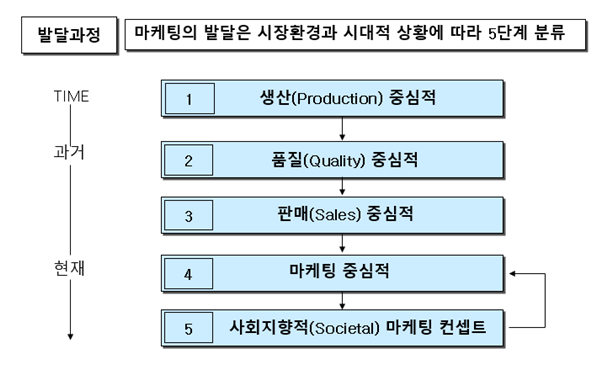
앞서 우리나라 LG의 사례처럼, 과거 산업혁명과 근대화를 통한 경제의 발전에 따라 새로운 신문물이 쏟아져 나왔던 시대는 어느 나라나 있다. 그때는 생산만 하면 팔리던 시기이므로 마케팅이란게 필요도 없었다. 아니 마케팅이란 말도 없었다.
상품의 수요가 공급을 초과하니 공급이 곧 수요이기 때문에, 그때 기업의 경영활동의 중심은 생산 지향적으로써, 대량생산을 통해 생산성을 향상시키고 원가를 절감하여 생산효율성을 높이는 한편, 더욱 소비자를 많이 만나기 위해 유통범위를 넓히는데 있었다.
그러다 보니 경쟁자들도 생기고 품질문제가 대두되기 시작했다. 기업은 소비자들이 품질이 더 좋은 제품을 살 것이란 생각에, 경쟁자보다 더 나은 품질의 제품을 제공하기 위해 품질 지향적 경영을 하기 시작했다.
그러나 여기서 그들이 간과한 것은 생산자가 생각하는 품질은 고객이 생각하는 것과 다를 수 있다는 사실이다. 자칫하면, 소비자의 본원적인 니즈를 만족시켜야 한다는 것보다는 제품의 품질만 좋으면 무조건 남들보다 잘 팔릴 것이란 착각을 하고 품질개선과 생산에만 집중하게 된다.
그러자 1930년대, 미국에서는 제품 공급과잉 사태가 벌어졌다. 품질 좋게 만들었는데도 안 팔리니 어쩌란 말인가? 이제부터는 소비자들의 관심을 자극하고 강력한 판매노력을 기울이지 않으면, 소비자들은 자발적으로 제품을 구매하지 않는다고 생각하게 되었다.
따라서 경영자의 주된 관심은 유통의 확대로써, 강력한 영업활동과 광고를 통해 구매를 자극하는 판매 지향적 경영을 하게 되었다. 즉, 소비자들이 원하는 잘 팔릴 수 있는 것을 만드는 것이 아니라, 이미 만들어진 제품들을 무슨 수를 써서라도 무조건 파는 것이 최고였기 때문에 “제품은 구매되는 것이 아니라 판매되는 것이다(Goods are sold, not bought)!” 라는 말도 나올 정도였다.
여기까지가 산업혁명 이후 1930년대까지 미국에서 일어난 일이다. 그러나 아시다시피 1930년대는 2차세계대전이 한창이었던 때이다. 독일의 침공으로 유럽은 쑥대밭이 되었다. 공장들은 파괴되었고 기업은 붕괴되었으며, 피난민들은 직장과 집을 잃고 먹고 살기도 힘든 시대였다. 그렇다면 그들은 도대체 어디서 필요한 제품을 구했을까? 바로 미국이다.
미국제품들은 그들에게 없어선 안 될 필수품이었다. 1941년 일본이 진주만을 습격하면서 미국 또한 전쟁에 참여하게 되었다. 그리고 미군들의 통조림이나 옷가지들은 유럽에서 날개 돋친 듯 팔리기 시작했다.
붕괴된 유럽 덕분에 미국의 기업들은 큰돈을 벌었다. 우리나라 한국전쟁 때 일본이 엄청 돈을 벌고, 베트남전쟁 때 우리나라가 돈을 벌었던 것처럼, 안타깝게도 전쟁의 참사는 이웃국가에겐 큰 시장이 될 수도 있다.
그러나 전쟁이 끝나고 1950년대 들어 양상은 급변하기 시작했다. 이젠 팔 곳이 없는 것이다. 소비자들의 교육수준 및 소득수준의 증대로 욕구(니즈)는 다양화되어 서로 다른 개성에 맞게 이질화 된 반면, 공급은 과잉되고 경쟁은 더 치열해 졌으며, 천편일률적으로 똑같은 대량생산 제품에 대한 구매저항이 일어나기 시작했다.
이제는 고객이 원하는 제품을 생산, 판매해야만 한다는 고객 중심적 개념과, 어느 기업도 전체시장의 모든 고객을 만족시킬 수 없으므로, 잘하는 것을 선택과 집중해야 이익을 낼 수 있다는 시장 중심적 개념이 생기기 시작했다.
기업들은 소비자들이 제품 자체가 아니라, 자신의 문제해결에 관심을 갖고 있으며, 그러한 문제를 보다 효과적으로 해결해 주는 수단을 선호한다는 사실을 알게 되었다. 그리하여 고객의 충족되지 않은 니즈를 발견하고, 그것을 효과적으로 해결할 새로운 수단을 개발 및 제공함으로써 고객만족을 창출하고, 그 댓가로 매출성과와 이윤을 증가시킬 수 있다는 마케팅 지향적 컨셉이 나오게 된 것이다.
그 후 1970년대까지만 해도 미국의 기업은 마케팅을 잘해서 이익을 내고 고용을 창출하며 국가에 세금만 잘 내면 좋은 기업이었다. 그러나 기업의 활동들이 자원을 고갈하고 환경을 오염시키며, 빈부격차를 크게 하고 저소득층을 착취하는 등, 사회적 문제를 초래하게 되었다.
그래서 기업의 이익을 사회와 소비자의 복리에 연결시켜 기업이 장기적으로 소비자와 사회와 더불어 공생하고 번영하도록 마케팅을 해야 한다는 기업의 사회적 책임(CSR)을 강조하는 사회 지향적 마케팅이 대두되었다.
As seen in the case of South Korea’s LG mentioned earlier, every country has experienced an era when new modern conveniences poured out following economic development driven by the Industrial Revolution and modernization. During that period, products sold simply by being produced, so marketing was not necessary. In fact, even the word “marketing” did not exist.
Because product demand exceeded supply, supply itself equaled demand. Consequently, corporate management was production-oriented, focusing on enhancing productivity and reducing costs through mass production to improve manufacturing efficiency, while expanding distribution channels to reach more consumers.
As a result, competitors began to emerge, and quality issues started to surface. Believing that consumers would purchase higher-quality products, companies shifted toward quality-oriented management to offer better products than their rivals.
What they overlooked, however, was that quality as perceived by manufacturers could differ from quality as perceived by customers. This often led to the illusion that superior product quality alone would guarantee higher sales regardless of satisfying core consumer needs, causing companies to focus strictly on quality improvement and production.
By the 1930s, a product oversupply occurred in the United States. What were companies to do when products failed to sell despite being well-made? They began to believe that consumers would not voluntarily purchase products unless their interest was stimulated and strong sales efforts were exerted.
Thus, executive focus shifted to sales-oriented management, aiming to stimulate purchases through aggressive sales activities and advertising alongside distribution expansion. Rather than creating what consumers actually wanted and what would sell easily, the priority became selling already-manufactured products by any means necessary—giving rise to the phrase, “Goods are sold, not bought!”
This describes what transpired in the United States from the Industrial Revolution up to the 1930s. However, as is well known, the 1930s and 1940s were dominated by World War II. Germany’s invasion devastated Europe—factories were destroyed, businesses collapsed, and refugees who lost their homes and jobs struggled merely to survive. Where, then, did they obtain necessary goods? The answer was the United States.
American products became indispensable lifesavers for them. When Japan attacked Pearl Harbor in 1941, the United States entered the war. Subsequently, canned food, clothing, and supplies for American troops sold like wildfire in Europe. Thanks to the ruined state of Europe, American corporations amassed tremendous wealth. Tragically, just as Japan profited immensely during the Korean War and South Korea did during the Vietnam War, the disaster of war can become a massive market for neighboring nations.
When the war ended and the 1950s arrived, the landscape shifted dramatically. Suddenly, there was nowhere left to sell. With rising education and income levels, consumer needs diversified and fragmented according to individual personalities.
Meanwhile, supply remained in excess, competition intensified, and consumer resistance against uniform, mass-produced items began to mount. This gave birth to a customer-centric concept—that companies must produce and sell what customers actually want—and a market-centric concept acknowledging that no single firm can satisfy every customer across the entire market, meaning profitability requires selectiveness and focus on key strengths.
Companies realized that consumers were not interested in products themselves, but rather in solving their own problems, preferring means that resolved those issues more effectively. Consequently, the marketing-oriented concept emerged: discovering consumers’ unmet needs and developing new means to solve them effectively, thereby generating customer satisfaction and increasing revenue and profit in return.
Up through the 1970s, an American company was considered a good business as long as it practiced sound marketing to generate profits, create employment, and pay taxes faithfully to the state. Over time, however, corporate activities began causing societal issues—depleting resources, polluting the environment, widening the wealth gap, and exploiting low-income groups.
This led to the rise of societal marketing, which emphasizes Corporate Social Responsibility (CSR). It asserts that corporate profits must align with the welfare of consumers and society, ensuring that businesses coexist and thrive alongside consumers and society in the long run.