마케팅 전략에서 포지셔닝은 상품에 대해 어떤 행동을 취하는것이 아니라, 잠재고객의 마인드에 어떤 행동을 가하는 것이다. 즉, 잠재고객의 마인드 속에 브랜드의 가치를 심어주는 것으로써, 반드시 뭔가 다르고 새로운 것을 만드는 것만이 아니라, 이미 마인드에 들어있는 내용을 조작하고, 기존의 연결고리를 다시 엮어주는 행위이기도 하다.
“그렇다면 우리는 왜 이렇게 포지셔닝을 통해 고객의 마인드를 재구성하는 일을 해야 하는 것일까?”
과거와 달리 우리가 속한 환경은 점점 더 복잡해지고 경쟁이 치열해지면서 수 많은 기업이 수 많은 제품을 쏟아내고 있으며, 제 각각 자신의 상품을 알리기 위해 엄청난 광고를 내보내고 있다. 그리하여 우리가 사는 일상은 이제 더 이상 나만의 공간이 아니라, 수 많은 브랜드의 노출 속에 파묻혀 있다고 해도 과언이 아니다.
아침에 일어나 신문을 보고나 TV를 틀면 광고가 쏟아지고, 출근 길 대중교통을 이용한다면 버스나 지하철을 기다리는 곳에서부터 차 안까지 천정과 벽면의 수 많은 광고가 기다리고 있다.
차에서 내려 사무실까지 걸어가는 거리 가로수와 고층 빌딩의 광고판을 지나, 사무실에 도착하여 PC를 켜고 인터넷에 접속하거나, 스마트폰의 무료 어플을 이용하면 여지없이 광고가 먼저 우리를 맞이한다.
점심시간 음식점에 널려 있는 잡지와 벽면의 달력 속에서, 길거리 버려진 무가지 신문이나 쓰레기 더미 속에서도 우리는 많은 브랜드에 노출된다.
간신히 퇴근하여 집에 돌아오면 문간에 꽂인 전단지가 먼저 우리를 반기고, 식사후 TV를 보고나 인터넷을 하거나 또는 잠자리에서 SNS를 하더라도 기업의 수 많은 브랜드는 밤낮으로 끊임없이 소비자들을 찾아온다.
이렇게 되면 소비자의 마인드는 막대한 물량의 광고공격을 받는 것이다. 그래서 소비자는 혼란스럽다. 수많은 브랜드들이 저마다 잘났다고 떠들어 대는 소란 통에서, 과연 어떤 브랜드를 기억하고, 좋아하고, 구매해야 할지 결정하기가 쉽지 않다.
그래서 혼란스러운 소비자는 모든 것을 기억하고자 하지 않고, 스스로를 극도로 단순화 시키게 되었다. 그러다 보니 소비자의 마인드 속 기억의 사다리 속에는 모든 브랜드가 자리를 차지하지 못하게 되고 만 것이다.
그럼 이렇게 철옹성처럼 견고하게 단순화된 소비자의 마인드 속으로 어떻게 들어갈 수 있을까? 고객의 마인드 속의 고지를 어떻게 점령하여, 마인드 사다리에 나의 브랜드를 올려 놓을 수 있을까?
그러려면 먼저 고객이 원하는 것이 과연 무엇이고, 어떻게 원하는 것을 만족시켜 줄 수 있는가를 생각해야 한다. 그렇기 때문에 제품이라는 실체에 집중해서는 안 되고, 상대방의 인식에 집중하는 관점의 전환이 되어야 한다.
이미 앞서 컨셉과 차별화를 위해서 회사가 아닌 소비자 관점 (The view from the outside)과 인식이 중요하다고 했던 것처럼, 브랜드 컨셉을 포지셔닝 하는 일은 소비자의 마인드, 즉 인식의 사다리에 높은 자리를 차지하는 인식의 싸움이라고 할 수 있다.
잭 트라우트와 알 리스는 <마케팅 불변의 법칙>에서, 기억의 법칙과 인식의 법칙을 통해, 시장에 먼저 들어가는 것보다 기억 속에 먼저 들어가는 게 더 중요하며, 마케팅은 제품의 싸움이 아니라 인식의 싸움이라고 했다.
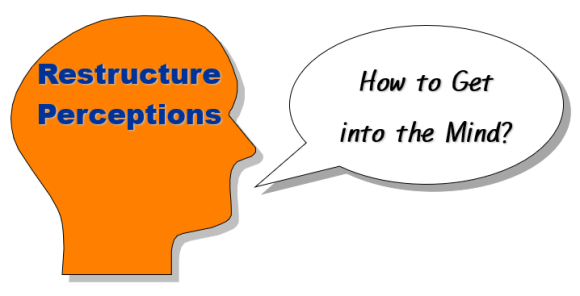
따라서 진실은 무의미하다. 고객의 인식을 리스트럭쳐(Restructure)하여 인식을 현실로 수용해서 마인드 속에 자리잡도록 해아야만 한다. 그 방법으로 단순한 한마디(One Word)를 지속적으로 커뮤니케이션하여, 소비자의 마인드 속에 깊이 심어 놓는 일을 하눈건데, 이는 알게 모르게 일종의 세뇌를 시키는 작업과도 같다.
극도로 단순화된 소비자의 마인드 속에는 주절주절 많은 내용을 담을 수가 없게 되었기 때문에, “Volvo=Safety”, “네이버=지식검색”과 같은 극도로 단순화한 메시지 하나를 만들어, 지속적으로 반복해야만이 고객의 마인드 속에 자리를 잡을 수 있는 것이다.
이렇게 소비자의 마인드를 바로 잡아, 브랜드를 콕 집어 기억하여 구매하도록 만드는 일이 바로 포지셔닝인 것이다.
In marketing strategy, positioning is not taking an action toward a product; rather, it is taking an action toward the prospect’s mind. That is, it is the act of instilling brand value into the prospect’s mind—which does not necessarily mean creating something entirely different and new, but rather manipulating content that is already in the mind and reconnecting existing links.
“Why then must we undertake this task of restructuring customer minds through positioning?”
Unlike in the past, the environment we inhabit has grown increasingly complex and fiercely competitive, with countless companies pouring out innumerable products and broadcasting massive amounts of advertising to promote their respective goods. Thus, it is no exaggeration to say that our daily lives are no longer our own private spaces, but are buried beneath exposure to countless brands.
When we wake up in the morning and read the newspaper or turn on the TV, ads pour out; if we take public transit to work, numerous ads await us on the ceilings and walls from the bus stops and subway stations all the way into the vehicles.
Passing advertising billboards on street trees and high-rise buildings on the walk from the vehicle to the office, turning on the PC upon arriving at work to access the internet, or using free smartphone apps, advertisements unfailingly greet us first.
During lunchtime, amid magazines scattered in restaurants and calendars on the walls, and even within discarded free papers on the streets or piles of trash, we are exposed to countless brands.
Barely making it home after work, flyers stuck in the doorway welcome us first, and even if we watch TV after dinner, surf the internet, or use social media in bed, a multitude of corporate brands relentlessly seek out consumers day and night.
When this happens, consumer minds undergo a massive advertising attack. Consequently, consumers feel confused. Amid the clamor of countless brands boasting about themselves, it is far from easy to decide which brand to remember, like, and purchase.
Therefore, confused consumers do not try to remember everything, but instead choose to extremely simplify themselves. As a result, not all brands can secure a spot on the ladder of memory inside the consumer’s mind.
Then, how can we enter inside the consumer’s mind that has been simplified like an impenetrable fortress? How can we occupy the high ground in the customer’s mind and place our brand on their mind ladder?
To do so, we must first think about what customers truly want and how we can satisfy those desires. For this reason, we must not focus on the physical reality of the product, but instead make a shift in perspective to focus on the other party’s perception.
Just as mentioned earlier regarding concepts and differentiation, where “the view from the outside” (the consumer’s perspective) and perception are vital, positioning a brand concept can be described as a battle of perception to capture a high position on the consumer’s mind—that is, their ladder of perception.
Jack Trout and Al Ries stated in The 22 Immutable Laws of Marketing, through the Law of the Mind and the Law of Perception, that it is more important to be first in the mind than first in the marketplace, and that marketing is not a battle of products, but a battle of perception.
Therefore, truth is irrelevant. We must restructure customer perceptions so that they accept perception as reality and allow it to take root in their minds. The way to achieve this is by continuously communicating a simple single word (“One Word”) to plant it deeply within the consumer’s mind, which operates much like an unconscious brainwashing process.
Because consumers’ extremely simplified minds can no longer hold rambling details, one must create a single, extremely simplified message such as “Volvo = Safety” or “Naver = Knowledge Search” and repeat it continuously to secure a position in the customer’s mind.
Straightening out consumer perceptions like this—so that they pinpoint, remember, and purchase a brand—is precisely what positioning is all about.