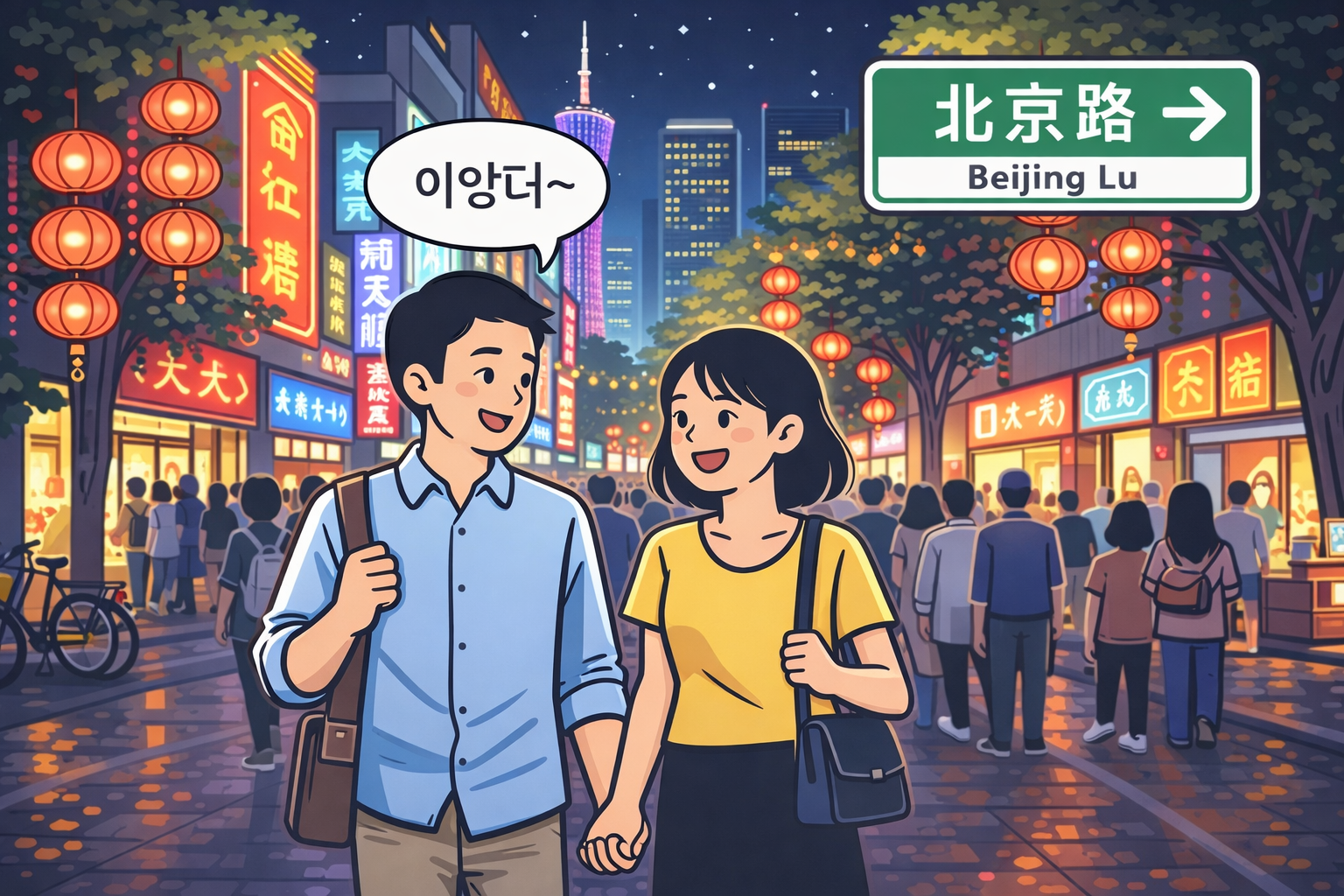
베이징루는 광저우가 1선 도시임을 보여주는 곳이었다. 대도시임에도 불구하고 허름한 건물과 지저분해 보이는 거리, 그리고 아무 곳에서나 웃통을 벗어 젖힌 거리의 인부들과 수많은 자전거와 스쿠터의 무질서한 행렬 속에서, 베이징에서 살았던 김현웅에게 있어서 처음 접한 광저우는 중국에서 내로라하는 대도시 중의 하나라고는 상상이 가지 않는 곳이었다.
그러나 그는 베이징루에 들어오는 순간, 지금까지 자신이 접한 광저우가 도심 외곽의 한 거리임을 실감하게 되었다. 특히 울긋불긋 조명으로 한껏 치장을 한 베이징루의 밤 거리는 불빛에 이끌린 불나비처럼 많은 사람들을 끌어 모아 더욱 거리를 생기있게 재탄생시키고 있었다.
하지만… 그 무엇보다도 그들은 배가 고팠다. 더욱이 이곳은 음식의 천국, 중국 4대요리에 들어가는 광동요리의 성지 광저우가 아닌가? 불빛에 반짝이는 온갖 요리로 치장된 거리를 외면한 채 지나 간다는 것이 고문이나 다름없을 김현웅이었지만, 그는 마음을 굳게 먹고 마카이가 인도하는 태국음식점으로 서둘러 발길을 재촉했다. 그러나 허무하게도 그곳엔 태국음식점이 아니라 덕하니 중국식 국수집이 있었다. 마카이는 당혹하였다.
“분명 이곳에 있었는데….”
이리저리 두리번거리며 갈피를 잡지 못하는 마카이를 보고 참다 못한 김현웅이 다분히 짜증 섞인 목소리로 나섰다.
“마카이, 이곳이 확실해?”
“응. 분명 확실한데…. 이상하네~?”
“그럼 없어졌나 보지. 거~ 왜~ 장사 잘되면 집주인이 내쫓아 버리고 자기가 들어와 버리잖아. 그런 거 보면 중국인들 참 욕심이 많아~”
순간 그는 ‘아차~’ 하며 마카이의 눈치를 보았다. 이런 점이 중국인 친구에겐 항상 조심스러운 부분이었으나, 허물없이 부쩍 가까워진 마카이였기에 그는 거리낌 없이 한국인 친구 대하듯이 속마음을 그대로 들어내고 만 것이다.
그러나 마카이는 살짝 눈을 흘겨보기만 하였을 뿐, 별 다른 소리를 하진 않았다. 지금 그녀는 아침부터 제대로 식사를 하지 못한 김현웅에게 잘못 안내한 것이 무척 미안하기만 할 뿐이었다. 그런 낌새를 눈치 챈 그가 얼른 말을 돌리며 그녀에게 말하였다.
“우리 여기까지 왔으니…. 그냥 다른데 가지 말고 그냥 여기서 맛있는 면으로 때우자고. 이 집도 사람들로 가득 찬 것 보니 꽤 인기 있는 집 같은데….”
말이 끝나기도 전에 그는 음식점 앞 메뉴 안내판 쪽으로 걸어가 메뉴를 보며 말을 이었다.
“어디 보자~ 난 우육탕면이 먹고 싶네. 배가 너무 고파 소고기가 듬뿍 들어간 걸로 먹어야겠어~ 마카이는 뭐 먹을래?”
김현웅의 배려에 마카이는 한편으론 미안함과 한편으론 고마움을 느끼며 그의 등 뒤를 따르며 짧게 말했다.
“이양더(一样的, 같은 걸로)~”
소박하지만 두 사람의 마음이 하나가 되는 포근한 저녁이었다.
식사를 마친 두 사람은 광저우의 무더위도 아랑곳없이 어느새 두 손을 꼭 잡고 즐거운 연인처럼 온 거리를 누비며 걸었다. 거리 한 곳 나무에는 고풍스런 홍등이 가득 장식되기도 하였는데, 이상하게도 흥등에 불이 들어오지 않아 거리를 지나는 수많은 사람들과는 전혀 어울리지 않게, 마치 중국영화의 귀신들이 사는 곳처럼 을씨년스럽기도 하였다.
그러다 대로 한 가운데를 가로지르며 송나라시절 길 바닥 그대로를 잘 보존하여 유리창을 통해 볼 수 있게 만든 곳이 나왔다. 전통과 현대가 공존하는 모습을 연출한 곳이었다. 마카이는 중국의 이런 점이 좋다고 하였다. 특히 그녀가 대학을 나온 수저우의 옛 건물과 아름다운 호수와 수로들을 생각하면 지금도 그곳에서 살고 싶다는 생각이 들 정도로 그립다고 했다.
그러나 김현웅은 그녀와 이런 점에서 많이 다르구나 싶었다. 그는 서울 출신답게 문명의 이기(利器)가 가득 넘치는 대도시가 좋았기 때문이다. 그러나 한편으론 우리나라 명동에 조선시대의 거리를 볼 수 없듯이 전통을 잘 보존하고 살리는 중국의 이런 점이 부럽기도 하여, 뭔지 모를 어떤 반발감에 한국에도 이런 곳이 많다며 말하였다.
“마카이~ 한국도 그래~. 서울의 북촌에 가면 마을 전체가 조선시대 전통 한옥으로 되어 있어. 언제 서울에 함께 가게 되면 그땐 내가 꼭 안내할게~!”
“그래? 난 서울에 한번도 못 가봤는데, 너랑 꼭 가보고 싶다.”
마카이의 꿈은 서울을 그리며 점점 더 부풀어 가고 있었다.
——————————–
Beijing Road was a place that clearly demonstrated that Guangzhou was a first-tier city. Despite being a major metropolis, my first impression of Guangzhou, filled with shabby buildings, seemingly dirty streets, construction workers casually walking around shirtless, and countless bicycles and scooters moving in chaotic disorder, made it hard for Kim Hyun-woong, who had lived in Beijing, to imagine that this was one of China’s most prominent large cities.
However, the moment he stepped into Beijing Road, he realized that the Guangzhou he had encountered so far had merely been an outlying street of the city center. In particular, the night street of Beijing Road, lavishly adorned with colorful lights, attracted crowds like moths drawn to flames, revitalizing the entire area with vibrant energy. (To be continued)
But above all else, they were hungry. Moreover, this was Guangzhou, the sacred ground of Cantonese cuisine, one of the Four Great Cuisines of China, often called a paradise of food. For Kim Hyun-woong, passing by streets glittering with all kinds of dazzling dishes without stopping would have been nothing short of torture, yet he resolutely steeled himself and hurried after Makai toward the Thai restaurant she was leading him to. However, to their dismay, the Thai restaurant was gone, replaced instead by a Chinese noodle shop. Makai was flustered.
“It was definitely here…”
Seeing Makai looking around in confusion, unable to get her bearings, Kim Hyun-woong finally stepped in with a voice tinged with irritation.
“Makai, are you sure this is the place?”
“Yes, I’m sure… That’s strange.”
“Then it must have closed. You know how it is—if a business does well, the landlord kicks them out and takes over the place. When you see things like that, you realize how greedy people can be.”
At that moment, he caught himself and cautiously glanced at Makai. This was always a delicate matter with a Chinese friend, yet because he had grown so much closer to her, he had spoken candidly, just as he would with a Korean friend. Makai merely cast him a brief sideways glance and said nothing. She simply felt deeply sorry for having misled Kim Hyun-woong, who had not eaten properly since morning. Noticing her mood, he quickly changed the subject and said to her,
“Since we’re already here, let’s not go somewhere else. Let’s just have some delicious noodles here. Judging by how crowded it is, it must be a pretty popular place.”
Before he even finished speaking, he walked over to the menu board in front of the restaurant and continued,
“Let’s see… I feel like having beef noodle soup. I’m so hungry I need something loaded with beef. What about you, Makai?”
Feeling both apologetic and grateful for his consideration, Makai followed behind him and replied briefly,
“Yiyang de (一样的, the same).”
It was a simple yet warm evening when their hearts felt united.
After finishing their meal, the two of them, heedless of Guangzhou’s sweltering heat, found themselves strolling hand in hand through the streets like a joyful couple. In one corner of the street, trees were decorated with antique red lanterns.
Strangely, however, the lanterns were not lit, making the area appear eerily out of place amid the bustling crowd, almost like a scene inhabited by ghosts from a Chinese film. At the same time, a section of the main road preserved the original pavement from the Song Dynasty, displayed beneath glass panels, presenting a striking coexistence of tradition and modernity.
Makai said she liked this aspect of China. Thinking of the old buildings, beautiful lakes, and canals of Suzhou, where she had attended university, she confessed that she still longed to live there again. Kim Hyun-woong, however, felt how different they were in this regard. As someone from Seoul, he preferred large cities overflowing with the conveniences of modern civilization.
Yet at the same time, he envied China’s effort to preserve and sustain its traditions—something akin to how one cannot see Joseon-era streets in Myeongdong—and, perhaps out of a subtle sense of pride, he insisted that Korea also had such places.
“Makai, Korea has that too. If you go to Bukchon in Seoul, the entire village is made up of traditional hanok houses from the Joseon Dynasty. If we ever go to Seoul together, I’ll definitely show you around.”
“Really? I’ve never been to Seoul. I really want to go with you.”
Makai’s dream of visiting Seoul continued to grow as she imagined it vividly in her mind.