

“우선 나는 장 상무가 한 일 때문에 문 이사에게 화를 내는 것이 절대 아닙니다. 이미 장 상무에겐 내가 몇 번을 얘기했지만 그는 내 말을 듣지를 않아요. 그래서 이를 사장님께 건의도 했지만, 사장님은 영업하는 사람, 너무 기 죽이지 말라며 나보고 좋게 해결하라고 하시는 거 알고있죠?”
나는 문 이사가 동의의 뜻으로 고개를 끄덕이는 것을 확인한 후에 계속 말을 이었다.
“그럼 어떻게 해야겠습니까? 사무실 임대료 지급 규정을 만들어야죠. 그 규정 안에 천방지축으로 날뛰는 망아지를 가둬야 하지 않습니까? 그 규정을 만들라고 제가 문 이사에게 몇 번을 얘기했습니까?
그런데 문 이사는 매번 규정을 아직 못 만들었다며 이번만 결재해달라며 오지 않습니까? 그 규정 만드는 데 뭐가 어려워서 두 달 동안 만들지 못하고 매번 이렇게 회사 돈을 대리상들에게 마구 퍼주냔 말이에요. 이게 자기 개인 돈이라면 수백만 원씩 남에게 주겠어요?”
“알겠습니다. 바로 시정하겠습니다.”
마지못해 대답하는 문 이사를 보며 나는 답답한 마음에 마지막으로 충고의 말을 건넸다.
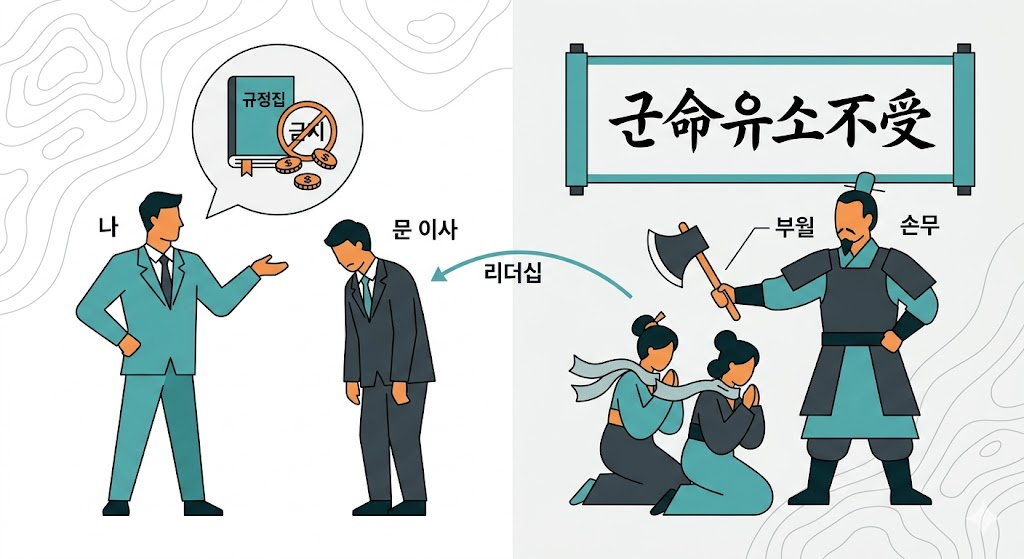
“문 이사, 손자병법에도 군명유소불수(君命有所不受)란 말이 나옵니다. 아무리 지엄한 왕의 명령이라도 받아들일 수 없는 것이 있다는 뜻입니다. 왕이 잘못된 명령을 내려 나라를 위태롭게 한다면, 장수는 그 명령을 받아들이면 안 되는 것입니다.”
“글쎄요. 저는 잘 모르겠습니다. 제가 직장 생활한 십육 년은 항상 상명하복의 군대식이었습니다. 그리고 전 특히 영업 조직에서 그게 맞다고 생각합니다. 그것이 저의 방식이고 저는 그걸 바꾸기가 어렵습니다.”
순간 나는 깜짝 놀랐다. 어찌 이리 앞뒤가 꽉 막힌 사람이 있는지, 나는 그를 이해시키기 위해 손자병법에서 왜 그런 말이 나왔는지를 간단히 설명해주었다.
우리가 잘 아는 손자의 본명은 손무(孫武)로서, 제나라에서 태어나 어린 시절을 좋은 환경에서 보냈으나, 아버지가 정치 투쟁에 휘말려 가족이 모두 제나라를 떠나 오나라로 넘어 와 산간벽지에서 숨어 살게 되었다.
손무는 그 후 이십 년 동안 숨어 살면서 오로지 병법만 깊이 탐구하여 그 유명한 손자병법을 저술하여 이름을 알리게 되었다. 그러자 오나라의 장군이자 뛰어난 전략가인 오자서는 손무를 보고 그가 훌륭한 장군감임을 알아보고 즉시 오왕 합려에게 그를 추천을 하였다.
하지만 오왕 합려는 손무를 쉽게 믿지 못해 시험을 하였는데, 사마천의 사기 ‘손자열전’을 보면, 오왕 합려가 손무에게 백팔 명의 궁녀들을 훈련시켜 훌륭한 병사로 만들라는 너무도 유명한 이야기가 나온다.
손무는 궁녀들을 두 편으로 나누고, 오나라 왕이 총애하는 후궁 두 명을 각 편의 대장으로 삼았다. 그러고는 모두에게 창을 들게 하고 여러 명령을 내렸지만, 궁녀들은 서로 키득거리며 딴전을 피우고 도통 구령에 맞춰 움직이질 않았다. 오합지졸들의 난장판 그 자체였다. 그러자 손무는 군법으로 사람을 죽일 때 쓰는 도끼 부월(斧鉞)을 움켜쥐고 군법을 어기면 목을 베겠다고 하였지만 궁녀들은 여전히 듣지 않았다.
결국 손무는 이미 말한 대로 좌우 대장의 목을 베려고 했다. 애첩을 죽이겠다는 말에 깜짝 놀란 오왕이 만류했지만, 손무는 왕명을 거역하고 두 여인의 목을 잘라 버렸다. 그러자 법의 무서움을 안 궁녀들은 손무가 명령하는 대로 일사불란하게 움직여 정예화 된 병사로 거듭났다.
손무는 무엇보다도 자신의 능력을 보여 주고 오왕의 신임을 얻기 위해 어찌 보면 자신의 목숨을 건 무모한 모험을 한 것일지도 모른다. 만약 오왕이 사랑하는 후궁 둘을 죽인 죄를 물어 손무를 죽여 버렸다면 어찌 됐을까? 이것이 바로 난세를 극복하기 위한 손자의 도전 정신이요 모험 정신인 군명유소불수(君命有所不受)가 의미하는 것이다.
“아시겠습니까? 지금 우리 회사는 2,500년 전 춘추시대와 같은 난세 속에 있습니다. 그래서 개인이 아닌 회사를 위해 때론 잘못된 명도 어기고 서로가 노력하여 제대로 된 법을 세우는 과정이 중요해요. 리더십이란 항상 윗사람이 아랫사람에게만 하는 것이 아닙니다. 더욱이 신입 사원도 아닌 이사 직함을 가진 문 이사 정도면 윗사람에게도 리더십을 발휘해야 해요. 그 사람이 진정 바른 길로 갈 수 있도록 아래에서도 길을 만들어 줘야 한단 말입니다.” (계속)

——————
“First of all, I am not angry at you, Director Moon, because of what Executive Director Jang has done. I’ve already spoken to him several times, but he simply doesn’t listen. I even raised this issue with the President, but you know what he said—don’t discourage someone in sales too much, and resolve it amicably.”
After confirming that Director Moon nodded in agreement, I continued.
“Then what should we do? We must establish a regulation for office lease payments. We need to confine that runaway colt within a proper framework, don’t we? How many times have I told you to create that regulation?
Yet every time, you come to me saying it hasn’t been completed and ask for approval just this once. What is so difficult about creating such a rule that it hasn’t been done for two months, while company money is continuously being handed out to distributors like this? If it were your own money, would you be giving away millions of won so easily?”
“I understand. I will correct it immediately.”
Looking at Director Moon, who answered reluctantly, I offered one final piece of advice out of sheer frustration.
“Director Moon, in the The Art of War, there is a phrase: ‘There are commands of the sovereign that need not be obeyed (君命有所不受).’ It means that even the most absolute command of a king may not be followed under certain circumstances. If a king issues a wrong order that endangers the state, a general must not obey it.”
“Well… I’m not sure. For the sixteen years I’ve worked, it has always been a strict top-down, military-style hierarchy. And I believe that especially in a sales organization, that approach is appropriate. That is my way, and it’s difficult for me to change it.”
At that moment, I was taken aback. How could someone be so rigid in their thinking? To help him understand, I briefly explained why such a principle appears in The Art of War.
As we know, Sun Tzu’s real name was Sun Wu. He was born in the State of Qi and spent his early years in a favorable environment. However, when his father became entangled in political struggles, the entire family fled to the State of Wu, where they lived in seclusion in a remote mountainous region.
For the next twenty years, Sun Wu lived in hiding, devoting himself entirely to the study of military strategy. During that time, he wrote the renowned The Art of War, which brought him recognition. Wu Zixu, a general and brilliant strategist of the State of Wu, recognized Sun Wu’s potential and immediately recommended him to King Helü of Wu.
However, King Helü did not trust him easily and decided to test him. According to Sima Qian’s Records of the Grand Historian (“Biography of Sun Tzu”), there is the famous story in which the king ordered Sun Wu to train 180 palace concubines into disciplined soldiers.
Sun Wu divided the concubines into two groups and appointed two of the king’s favorite consorts as their leaders. He armed them with spears and issued commands, but the women merely giggled and failed to follow orders, creating complete chaos. It was utter disorder. In response, Sun Wu seized a battle axe used for executions under military law and declared that anyone disobeying orders would be executed. Yet the concubines still did not take him seriously.
Ultimately, Sun Wu prepared to execute the two leaders as he had warned. Shocked, the king tried to stop him, unwilling to lose his beloved consorts. However, Sun Wu defied the king’s command and executed them. Only then did the concubines grasp the severity of military discipline and began to follow orders flawlessly, transforming into an elite unit.
Above all, Sun Wu may have risked his life in what seemed like a reckless gamble to demonstrate his capability and earn the king’s trust. If the king had chosen to execute him for killing his favored consorts, what would have happened? This is precisely the spirit of challenge and risk-taking embodied in the principle ‘There are commands that need not be obeyed,’ which enabled Sun Tzu to overcome chaotic times.
“Do you understand now? Our company is in a chaotic situation, much like the Spring and Autumn period 2,500 years ago. That is why, for the sake of the company rather than individuals, it is sometimes necessary to defy incorrect orders and work together to establish proper rules. Leadership is not something that only flows from the top down. Especially for someone like you, a director and not a junior employee, you must also exercise leadership upward. You must help guide your superiors toward the right path by creating that path from below.” (To be continued)