그런 일이 있은 후 도저히 안 되겠다 싶었는지, 문 이사는 매출 실적의 1퍼센트를 사무실 지원금으로 지급하는 규정을 만들었다. 일 개월에 오십만 위안, 일 년에 육백만 위안 매출을 기준으로 1퍼센트인 육만 위안을 선지급한 후, 매출 실적이 미달되었을 경우 다음 해에 정산하는 방법이었다.
이로써 중구난방으로 지급되며 낭비되었던 사무실 비용이 체계화되었지만, 이 또한 시간이 지나면서 큰 맹점이 드러났다. 그것은 대부분의 대리상들이 영업부가 예측한 대로 일 년에 육백만 위안의 매출을 하지 못한다는 점이었다. 아직 상품수도 많지 않고 브랜드도 알려지지 않은 상태라서, 대리상들의 평균 매출은 절반인 삼백만 위안을 넘기도 힘들었다.
한두 달만 조금 매출을 올리고 사무실 임대료를 빼먹고 사라지는 먹튀 대리상들도 있었고, 일 년이 지난 후에 정산을 하려고 하면, 우리와 더 이상 거래하지 않겠다며 떠나는 대리상들이 부지기수였기 때문에, 초기 육만 위안의 임대료 지급은 이 년이 지난 후에 수백만 위안의 손해를 끼치고 말았다.
결국 나는 신규 대리상에게 처음에 삼만 위안을 임대료로 지급하고, 육 개월 후에 매출 실적의 1퍼센트에 해당되는 금액을 정산해서 주는 방식으로 바꾸었다.
장 상무는 그리하면 대리상들이 바로 사무실을 구할 수가 없어, 우리 회사와 계약하려고 하지 않을 것이라고 으름장을 놓기도 했지만, 그의 우려와는 달리 아무 문제없이 신규 대리상은 늘어만 갔다. 그리고 현재는 첫 달에 삼만 위안을 주는 것마저도 모두 없애버리고 처음부터 매월 매출 실적의 1퍼센트에 해당하는 금액을 다달이 지급하고 있지만, 그 어떤 문제도 일어나지 않고 있다.
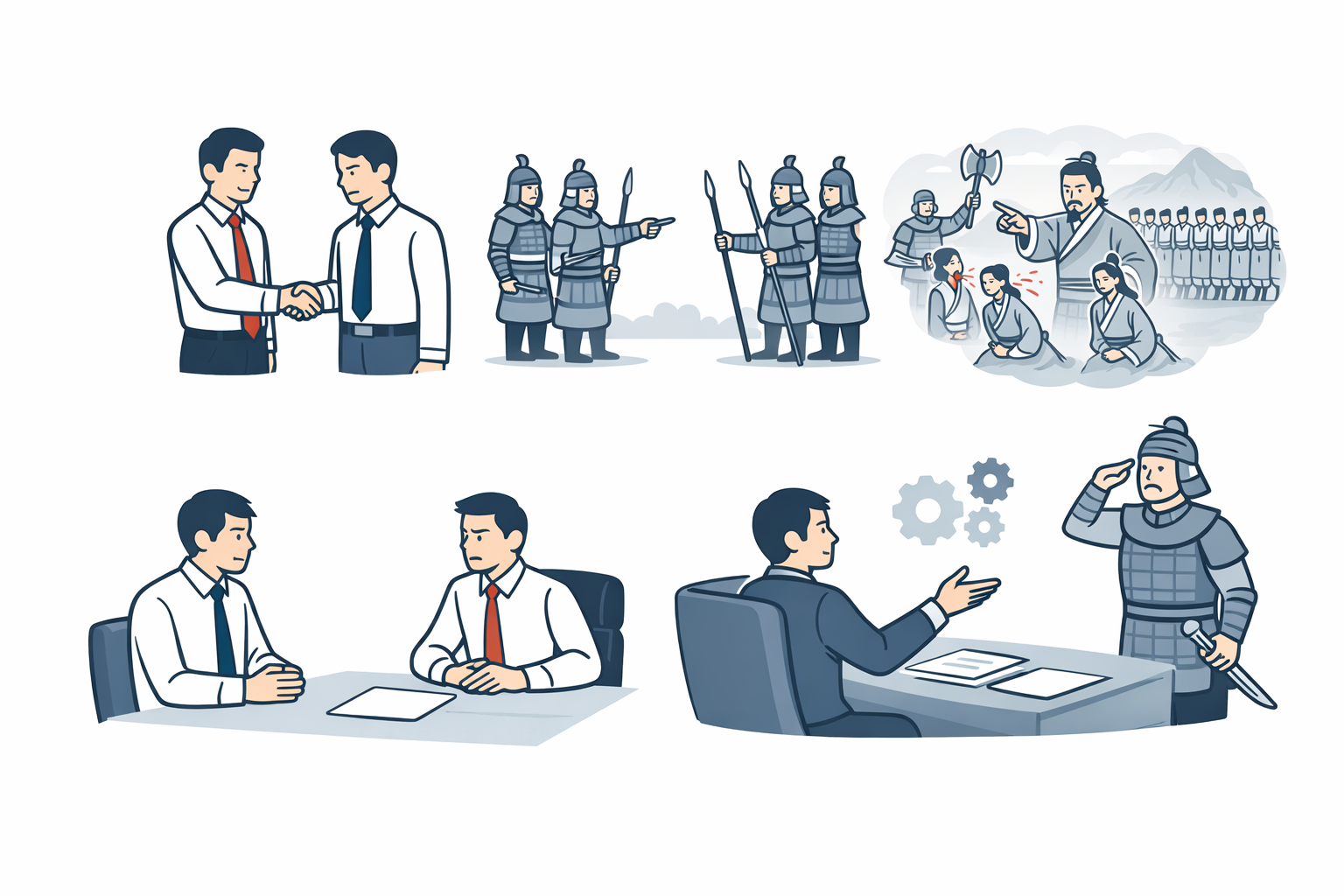
나는 대리상 영업 정책이나 사무실 지원 제도 등 장 상무와 함께 한 일들을 통해 한 가지 큰 교훈을 얻었다. 이를 손자병법의 모공(謨攻)편에 나오는 승리를 알 수 있는 다섯 가지(고지승유오, 故知勝有五) 요인으로 대변해 보겠다.
첫째, 지가이여전 불가이여전자승(知可以與戰, 不可以與戰者勝), 더불어 싸울 수 있는 경우와 싸울 수 없는 경우를 아는 자가 승리한다.
중국 땅, 이 전쟁에서 나는 누구와 더불어 싸우고 싸우지 말아야 할까? 분명한 건 아군이라 생각하던 장 상무와 함께 나는 이 전쟁에서 오래갈 수는 없을 것이다. 진정 회사를 위해 목숨 걸고 함께 싸우며 적을 무찌를 진정한 아군부터 만들어야 할 것이다.
둘째, 식중과지용자승(識衆寡之用者勝), 군사의 수효가 많고 적음에 따라 전략을 운영할 줄 아는 사람이 승리한다
회사의 자원은 한정되어 있다. 한정된 자원을 효율적으로 배분하여 최대의 성과를 끌어내기 위해선, 선택과 집중의 전략이 필요하다. 이 부총을 통해 지역을 무작정 확대하는 걸 경계하고, 선택과 집중을 통해 우선 산둥성 지역에서 안정적인 성공을 하면서 서서히 영역을 확장해 나가야 한다. 과도한 확장과 무분별한 비용의 증가는 회사에 백해무익하다.
셋째, 이우대불우자승(以虞待不虞者勝), 항상 우려하는 마음으로 만반의 준비를 갖추고, 적을 기다리는 자가 승리한다.
무엇보다도 제품을 제대로 갖추어져야 한다. 전국의 각 성마다 다른 나라와도 같이 특색이 다른 중국 소비자들의 취향을 맞추려면, 다양한 제품 전략이 준비되어야 전국으로 뻗어나갈 수 있을 것이다. 내가 가장 역점을 두어야 할 일은 지금은 바로 다양한 제품 포토폴리오를 만드는 것이다.
넷째, 상하동욕자승(上下同欲者勝), 윗사람과 아랫사람의 뜻이 같으면 승리한다.
회사 전반적인 경영을 맡고 있는 나를 중심으로 마케팅 송 부장, 제품개발 나 부장이 회사의 비젼을 위해 한 뜻을 가지게 되었다. 이젠 전 직원들이 함께할 회사의 전체적인 비전과 전략을 완성할 수가 있게 되었다. 회사의 전략이 바로 서면, 장 상무도 혼자서 마음대로 행동하지는 못하게 될 것이다.
다섯째, 장능이군불어자승(將能而君不御者勝), 장수가 능하고 임금이 장군을 간섭하지 않으면 승리한다.
민 대표에게도 회사의 법칙이 우선 될 필요가 있다. 모든 일의 중심이 개인이 아니라 시스템을 통해서 이루어져야 할 것이다. 회사의 CEO도 거부할 수 없는 시스템과 프로세스를 갖추어야, 나도 진정으로 민 대표에게 군명유소불수(君命有所不受)할 수 있을 것이다. (계속)
—————-
After such incidents, perhaps realizing that the situation could no longer continue, Director Moon established a policy to allocate 1% of sales revenue as office support funds. Based on a monthly target of 500,000 yuan and an annual target of 6 million yuan, 60,000 yuan—equivalent to 1%—was paid in advance, with adjustments made the following year if actual sales fell short.
This brought structure to what had previously been chaotic and wasteful office expenditures. However, over time, a significant flaw emerged. Most distributors were unable to achieve the projected annual sales of 6 million yuan. With a limited product lineup and low brand awareness, the average distributor struggled to exceed half that amount—around 3 million yuan.
Some distributors would generate minimal sales for just a month or two, take the office rental support, and disappear. Others, when it came time for settlement after a year, would simply refuse to continue business with us and leave. As a result, the initial payment of 60,000 yuan in rent led to losses amounting to several million yuan over a two-year period.
Ultimately, I revised the system. Instead of paying 60,000 yuan upfront, we provided 30,000 yuan initially to new distributors, and after six months, we settled and paid an amount equivalent to 1% of actual sales performance.
Executive Director Jang warned that such a system would discourage distributors from signing contracts, as they would struggle to secure office space immediately. However, contrary to his concerns, the number of new distributors continued to grow without issue. Eventually, we even eliminated the initial 30,000 yuan payment, shifting entirely to a system where 1% of monthly sales performance is paid each month. Since then, no problems have arisen.
Through the distributor sales policies and office support systems I implemented alongside Executive Director Jang, I gained a significant lesson. I will frame it through the five factors for predicting victory (故知勝有五) from the “Mou Gong” chapter of The Art of War.
First, “He who knows when he can fight and when he cannot fight will be victorious (知可以與戰, 不可以與戰者勝).”
In the vast battlefield of China, who should I fight alongside, and who should I avoid? It is clear that I cannot endure this battle long with Executive Director Jang, whom I once considered an ally. I must first build a truly reliable alliance—those who will genuinely commit to the company and fight together.
Second, “He who understands how to use both large and small forces will be victorious (識衆寡之用者勝).”
The company’s resources are limited. To maximize outcomes, those limited resources must be allocated efficiently through a strategy of selection and concentration. Expansion into new regions must be approached cautiously, focusing first on achieving stable success in Shandong Province before gradually expanding. Excessive expansion and indiscriminate spending bring no benefit.
Third, “He who prepares thoroughly and waits for the unprepared enemy will be victorious (以虞待不虞者勝).”
Above all, the product lineup must be well-prepared. China is like a collection of different countries, each province with its own consumer preferences. To expand nationwide, a diverse product strategy is essential. My top priority now is to build a comprehensive product portfolio.
Fourth, “He whose upper and lower ranks share the same purpose will be victorious (上下同欲者勝).”
Centered around myself as the head of overall management, along with Marketing Manager Song and Product Development Manager Na, we aligned our vision for the company. Now, we are in a position to establish a unified corporate vision and strategy that all employees can share. Once a clear strategy is in place, even Executive Director Jang will no longer be able to act arbitrarily.
Fifth, “He whose general is capable and not interfered with by the ruler will be victorious (將能而君不御者勝).”
Even CEO Min must recognize that the company’s principles come first. All operations must be driven not by individuals, but by systems and processes. Only when we establish a system that even the CEO cannot override will I be able to truly practice the principle of ‘there are commands that need not be obeyed (君命有所不受).’ (To be continued)