그렇게 사업개발팀원들은 일심 단결하여 한 달 동안 노력한 결과 수십 개 브랜드를 3개의 브랜드로 압축할 수 있었다. 공교롭게도 모두 프랑스뿐만 아니라 전세계적으로 유명한 패션 매거진 브랜드였으며, 국내에서도 매거진뿐만 아니라 여성 의류 및 패션 소품 등이 이미 출시되어 있는 브랜드였다. 이제 문제는 셋 중 어느 하나를 선택하느냐였다. 사실 세 브랜드 모두가 비슷비슷한 이미지라서 선뜻 어떤 것을 선택하기가 어려워서, 신대리는 고민 끝에 송팀장을 찾아갔다.
“팀장님, 이 세가지 브랜드까지 일은 제가 할 수 있었지만, 다음부터는 제가 어떻게 해야 할지 모르겠습니다. 최종 브랜드 선택이란 막중한 일을 제 개인적인 의견으로 함부로 할 수는 없을 것 같으니, 아무래도 돈이 좀 들어도 리서치 대행사를 통해 소비자 리서치를 하면 좋겠습니다.”
“소비자 리서치? 그래요…, 근데 그거 하면 시간과 돈이 얼마나 들 것 같나요?”
“글쎄요…. 저도 자세히는 모르니, 마케팅 BM들에게 그 동안 거래해본 괜찮은 대행사를 소개 받아서 얘기를 해보겠습니다. 일단 제가 듣기로 비용은 1인당 3만5천원 정도라니까 100명씩 세 개 그룹 정도 하면 약 천만원 정도 들 것 같습니다.”
송팀장은 잠시 생각에 잠긴 듯 하더니 조윤희를 불렀다.
“조윤희씨! 우리 리서치 예산이 얼마지?”
“네, 팀장님 잠깐만요?” 조윤희가 예산 장부를 찾더니 이내 활기차게 대답하였다.
“여유가 있는데요? 2천만원 입니다.”
“그래? OK~! 그럼 신대리가 리서치 회사를 두 곳 정도 불러서 미팅을 한번 해보세요. 중요한 사안이니까 신중히 결정하기 바랍니다. 그리고 이번 건 외에도 리서치할 일이 계속 있을지 모르니 예산이 여유 있다 생각 말고 아껴서 잘 사용하기 바랍니다”
“네, 알겠습니다.”
신대리는 이미 마케팅부 BM에게 소개 받은 두 곳의 대행사에게 전화를 하여, 다음 날 바로 약속을 정하곤, 박성준과 함께 내일 제안할 설문 내용을 정리하였다. 항상 직접 시장조사를 해왔던 신대리였지만, 이처럼 전문 대행사를 통해 조사를 해보긴 처음이라 그는 누구보다도 이번 조사에 대한 기대가 무척 컸다.
한참 일에 몰두하고 있던 신대리가 한껏 기지개를 피자, 일이 거의 끝났다는 것을 눈치 챈 조윤희가 신대리에게 다가가 말했다.
“그런데 대리님, 이번 시장조사는 어떤 것을 하는 건가요?”
아직 마케팅에 대해 감이 부족한 조윤희 다운 질문이었다.
“아~ 윤희씨는 아직 이런 경험이 없지? 사실 나도 실제로 대행사랑 하는 것은 처음이라 경험은 없지만, 그 동안 책을 통해 공부한 걸 간단히 설명해줄게.”
“네, 부탁드려요.”
조윤희는 노트를 꺼내 메모할 것을 준비하며 대답했다.
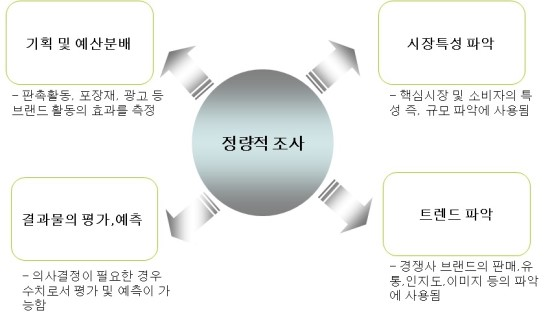
“하하~ 메모할 것 까진 없는데…., 일단 마케팅 리서치는 크게 정량조사(Quantitative Study)와 정성조사(Qualitative Study)로 나눌 수 있어. 정량(Quantitative)조사란 말 그대로 양적인 계산을 통해 정하는 조사 방법이야. 우리가 흔히들 접하는 인구센서스 조사나, TV 시청률 조사, 선거할 때 하는 전화 조사 및 출구조사 등이 모두 정량조사에 속해. 그리고 이제 우리가 하려고 하는 브랜드 인지도나 이미지 조사 같은 것도 대표적인 정량조사이지. 우리회사 마케팅부에서도 브랜드에 대한 A&U, 즉 Attitude & Usage(브랜드에 대한 태도와 사용현황)를 파악하기 위해 정량조사를 많이 하고 있어. 그러니 정량조사에서 가장 중요한 것이 무엇이겠어?”
“네? 글쎄요…. 조사의 신뢰성 아닐까요?”
조윤희가 잠시 생각하다 갑자기 큰 소리로 대답하는 모습이 마치 천진난만한 초등학생이 갑자기 학구열에 불타 올라 ‘저요’하며 일어나서 손들고 말하는 것만 같았다.
“그렇지. 뉴스에서도 가끔 어떤 조사결과가 발표되면 신뢰구간이 95%라는 등의 말이 나오는 것 들어봤을 거야. 아무래도 전 인구를 다 조사하는 것이 아니라 표본을 선정해서 조사하는 것이기 때문에 표본 수가 많을수록 신뢰성도 높아지겠지. 그러나 아까 윤희씨도 우리 예산이 2천만 원뿐이 안 된다고 했듯이 우리에겐 자원이 한정되어 있기 때문에 모든 사람을 대상으로 조사할 수 없단 말이야.
따라서 일부의 표본이 전체를 대표할 수 있도록 표본을 선정하는 것이 조사를 시작하기 전에 그 무엇보다도 중요한 일이야. 이런 점에서 ‘시작이 반’이라는 말처럼 정량조사의 반은 조사설계라 해도 과언이 아니야. 초기 정확한 조사설계가 이루어져야 정확한 표본의 선정, 정확한 설문지 작성, 정확한 조사 수행이 가능하기 때문이거든.”
신대리도 그녀의 열의에 덩달아 신나서 더욱 열띠게 설명하였다.
“아~, 그래서 지금까지 조사설계서를 만드신 거에요?”
“아니, 나 같은 비 전문가가 어떻게 만들겠어? 그건 전문회사에서 만들어야지. 내가 만든 것은 클라이언트(Client)로서, 조사에 대한 가이드 라인이지. 이게 제대로 되어야 조사설계도 제대로 되는 것이니 이 일도 무지 중요한 일이야. 결국 리서치의 궁극적인 목적이 우리가 원하는 신뢰성 있는 정보를 정확히 얻어서 중요한 의사결정을 하는 것이잖아? 영어로 ‘Garbage-in Garbage-out’이란 말이 있어. 즉 쓰레기를 넣으면 쓰레기가 나온다는 말이지. 그러니 쓰레기를 넣지 않기 위한 리서치의 기초 설계단계가 무지 중요한 거야.”
“대리님, 만드신 거 제가 좀 봐도 되어요?”
“당연하지. 우린 한 팀인데.”
신대리가 말이 끝나기 무섭게 바로 PC의 그룹웨어 창을 열고 작업한 내용을 조윤희에게 이메일로 보내주자 그녀는 기뻐하며 말했다.
“그럼 마케터는 리서치 회사에 이런 걸 다 만들어 줘야 하나 보죠?”
“글쎄…, 사람마다 다르겠지.”
신대리는 잠시 주저하듯 말을 하지 못하다가 이내 다시 그녀에게 차근히 설명하듯 말하였다.
“윤희씨, 이건 말이야, 참으로 중요한 일인데, 솔직히 우리회사 마케터들은 좀 소홀이 하는 일이야. 나는 마케팅에서 조사업무를 하다 보니 그 중요성을 잘 알게 되었지만, 조사설계 단계에 클라이언트가 깊이 관여하지 않고 리서치 회사에게만 의존하면, 배가 산으로 갈지도 몰라. 그러니 나중에 윤희씨가 이 일을 하게 되면, 반드시 지금 나처럼 신중하고 꼼꼼하게 내가 얻고자 하는 모든 것들을 나열해야 해. 잘 알겠지?”
“네. 대리님 근데 아까, 리서치에는 정성조사도 있다고 했는데, 그건 뭔가요?”
“아~그건…, FGI(Focus Group Interview)라는 게 있는데, 나중에 우리가 하게 되면 그때 다시 설명해 줄게. 지금 설명해줘도 직접 경험 해보지 않으면 이해하기도 힘들거든.”
“네. 잘 알겠습니다. 자세히 설명해 주셔서 고마워요.”
( 계속 )
—————
Thanks to the united efforts of the Business Development Team, they were able to narrow down dozens of brands to just three within a month. Coincidentally, all three brands were not only globally recognized fashion magazine brands but also already established in Korea through their magazines, women’s apparel, and fashion accessories. The remaining challenge was to choose one of the three. Because the brands had similar images, making a definitive choice was difficult, prompting Assistant Manager Shin to seek out Team Leader Song.
“Team Leader, I’ve managed to narrow it down to these three brands, but I’m not sure how to proceed from here. I don’t think it’s appropriate for me to make such an important decision based solely on my personal opinion. I believe it would be better to conduct a consumer research study through an external agency, even if it costs us some money.”
“Consumer research? That sounds reasonable, but how much time and money would that require?”
“Well, I’m not entirely sure, so I’ll consult with the Marketing BMs to get recommendations for reliable agencies they’ve worked with. Based on what I’ve heard, the cost is about 35,000 won per participant. If we conduct surveys with three groups of 100 people, the total cost would be roughly 10 million won.”
Team Leader Song appeared deep in thought for a moment before calling over Jo Yoon-hee.
“Yoon-hee, what’s our research budget?”
“Just a moment, Team Leader,” Jo responded as she checked the budget records. A moment later, she replied cheerfully, “We have some flexibility—our budget is 20 million won.”
“Great! Alright, Shin, schedule meetings with two research agencies and proceed carefully. This is an important matter, so make your decision wisely. Also, keep in mind that we may need to conduct additional research in the future, so let’s use our budget conservatively.”
“Understood,” Shin replied.
Shin quickly contacted two agencies recommended by the Marketing BMs and scheduled meetings for the next day. He and Park Sung-joon then prepared the survey proposal for the upcoming discussions. Having always conducted market research himself, this was Shin’s first time working with a professional agency, and he was excited about the potential insights this approach might offer.
As Shin stretched after an intense work session, Jo Yoon-hee, noticing that he was almost done, approached him with a question.
“By the way, Assistant Manager Shin, what exactly is this market research about?”
It was a question befitting someone still new to marketing.
“Ah, Yoon-hee, you haven’t experienced this before, right? Well, I haven’t worked with an agency like this either, but let me explain what I’ve learned from studying the subject.”
“Yes, please do,” she replied, pulling out her notebook to take notes.
“Haha, you don’t need to take notes… but here’s the gist. Marketing research is broadly divided into quantitative research and qualitative research. Quantitative research, as the name suggests, involves numerical data and calculations. Examples include population censuses, TV ratings, election polls, and exit surveys. What we’re about to do—brand awareness and image surveys—is also a classic example of quantitative research. Our marketing department often conducts quantitative research to assess A&U, which stands for Attitude & Usage, regarding our brands. So, what do you think is the most important aspect of quantitative research?”
“Hmm… maybe reliability?” Jo answered after a moment of thought, her enthusiastic tone reminiscent of an eager elementary student excited to answer in class.
“Exactly. You’ve probably heard news reports mentioning things like a 95% confidence interval in survey results. Since we can’t survey the entire population, selecting a representative sample is crucial. The larger the sample size, the higher the reliability, but as you mentioned earlier, our budget is limited to 20 million won. This means we can’t survey everyone. Therefore, designing a survey that ensures a representative sample is the most critical step before starting the research. In a way, the saying ‘well begun is half done’ applies here; the design phase is half the battle in quantitative research. A solid research design ensures accurate sample selection, proper questionnaire creation, and reliable survey execution.”
Shin, inspired by her enthusiasm, continued his explanation with even more energy.
“Ah, so the document you prepared is the research design?”
“No, I’m not a professional. The research design will be created by the agency. What I prepared is a guideline for the research, outlining our needs as the client. This step is just as important because the design process depends heavily on these guidelines. The ultimate goal of research is to provide us with reliable information to make key decisions. Have you heard the phrase ‘Garbage in, garbage out’? It means that if you input poor data, you’ll get poor results. That’s why the initial design phase is crucial for ensuring high-quality research.”
“Can I take a look at what you’ve prepared?” Jo asked.
“Of course! We’re a team, after all.” Shin quickly opened his groupware application and emailed her the file. Jo beamed with excitement.
“So, do marketers always have to prepare such detailed guidelines for research agencies?” she asked.
“Well… it depends on the individual,” Shin replied, hesitating briefly before continuing. “This is a critical step, but honestly, many marketers in our company overlook its importance. Because I’ve worked in market research, I understand its significance. If the client doesn’t actively participate in the design phase and relies entirely on the agency, the project might go off track. So, if you ever handle this in the future, make sure you thoroughly outline all your needs like I did. Got it?”
“Yes, I understand. By the way, earlier you mentioned qualitative research. What’s that about?”
“Oh, that involves methods like FGI—Focus Group Interviews. When we conduct one, I’ll explain it in detail. It’s hard to fully grasp without experiencing it firsthand.”
“Alright. Thank you for the detailed explanation!”
(Continued)