대규모로 외국시장에 진입하는 것은 경쟁력 있는 분야의 판도를 바꾸는 중요한 전략적 몰입(Strategic Commitment) 효과를 가져온다. 그러나 높은 수준의 전략적 몰입은 장기적으로는 효과가 있지만 쉽게 되돌릴 수 없다는 단점도 있어서, 자금적으로 여력이 있는 기업에 효과적이다.
따라서 효과보다는 효율성 측면에서, 중소기업은 소규모로 해외시장에 진입하여, 그 시장에 대해서 서서히 학습하고 전략적으로 기회를 확대해 나가는 몰입의 가속성(Escalation of Commitment)이 필요할 것이다.
해외시장 진출 방법에는 여러가지가 있다. 해외법인을 설립하고 제품을 현지화 하여 마케팅과 유통을 직접 개척할 수도 있으며, 현지법인과 합작해서 시장을 확대하는 등 다양한 요소가 종합적으로 고려되어야 한다.
그러나 현실적으로 중소기업에선 하기 어려운 일이라서, 대부분의 화장품 중소기업들은 현지 법인이나 유통사에 브랜드를 떠맡기고, 감나무에서 감 떨어지기만 바라는 경우가 많은데, 나는 여기부터가 잘못된 안전제일주의 소극적 마인드라고 생각한다.
어떤 사업이라도 작은 리스크도 감당하지 않고 얻어 들일 수 있는 수익은 없다. 특히 국내보다 리스크가 더 큰 해외시장에선 더욱 더 “No Pain, No Gain”인 것이다.
내가 중국법인장으로 근무했을 당시에, 나는 중국에서 10개의 화장품(약 100여개 품목) 브랜드를 개발하여 중국 현지 OEM 공장에서 생산하였고, 마케팅과 유통을 직접 하였으며, 오프라인 대리상들을 개척하기 위해 중국 전역을 수년간 누비고 다닌 적이 있다. 이렇게 기업이 외국에서 제품을 생산하거나 판매하기 위해 직접 투자하여 경영을 하는 경우를 나는 해외진출의 가장 좋은 방법이라고 생각한다.
그러나 현지법인 설립은 해외진출 전략 중 가장 바람직한 만큼 가장 어려운 일이다. 특히 자본투자가 이루어져야 하며, 주재원도 파견하고 현지 직원도 채용해야 하기 때문이다. 그래서 굳이 초기에 법인설립을 할 필요는 없다. 작은 출장 사무소부터 시작해도 좋고, 현지에 거주하는 아는 인맥이 있으면 파트타임으로 활용해도 좋다. 결국 문제는 현장에 있으니 답도 현장에서 찾아야 하기 때문이다.
이런 과정은 시장을 중국으로 바꾸고 중국 직원들과 함께 일하며 중국 고객을 상대했을 뿐이지, 한국 내수에서 했던 것과 똑 같은 일이다. 결국 글로벌 마케팅 또한 국내 마케팅의 개념과 다름이 없다. 차이가 있다면 시장이 나라 밖에 있고, 그로 인해 해당 시장의 환경, 접근방법 등에 차이가 있을 뿐이다.
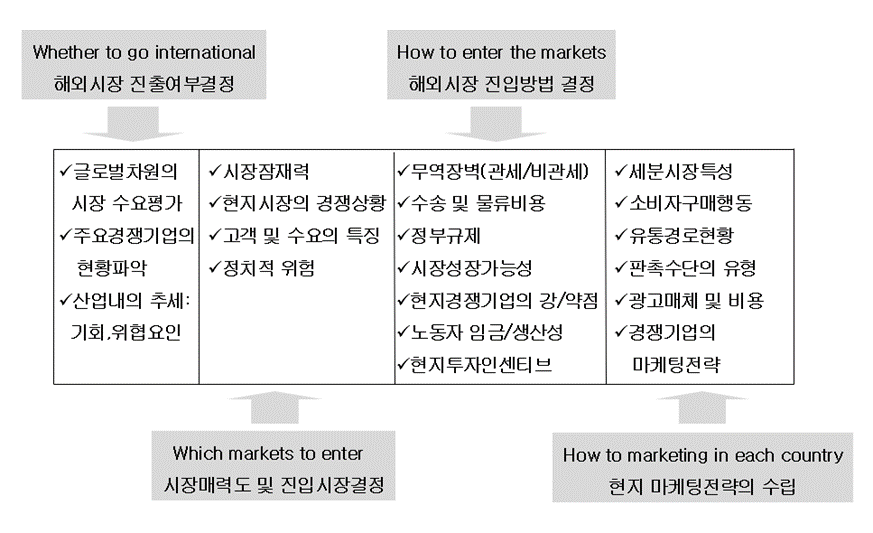
즉 해외진출 기업은 마케팅 목표를 수립하고 해외시장을 선정하여, 그 시장에 맞는 마케팅전략을 개발, 실행하고 성과를 피드백 하는 일련의 과정을 통해, 해외시장에 성공적으로 도달할 수 있게 된다. 그런 의미에서 나는 최선의 글로벌 브랜드는 또한 최선의 로컬 브랜드라고 주장하고 싶다.
———————-
Entering a foreign market on a large scale is a strategic commitment that can shift the competitive landscape in areas where a company has an edge. However, such high-level strategic commitment, while effective in the long term, is not easily reversible and thus is more suitable for financially robust firms.
For small and medium-sized enterprises (SMEs), efficiency rather than sheer effectiveness is key, suggesting that they should gradually enter foreign markets. This approach allows SMEs to learn about the market incrementally and strategically expand their opportunities.
There are various ways to enter foreign markets. Establishing local subsidiaries and localizing products to directly manage marketing and distribution channels is one approach. Another method is to expand the market through joint ventures with local entities, among other strategies.
However, these methods can be challenging for SMEs. Many SMEs in the cosmetics industry often resort to relying on local entities or distributors to handle their brand, hoping for passive success. This passive, safety-first mindset is fundamentally flawed, as no business can yield profits without taking on some risk. Especially in foreign markets, which inherently carry more risks than domestic ones, the principle of “No Pain, No Gain” is even more pertinent.
During my tenure as the head of a Chinese subsidiary, I developed ten cosmetic brands (approximately 100 items), produced them in local OEM factories, and managed marketing and distribution directly. I traveled across China for several years to establish offline dealerships. I believe that this direct investment and management in foreign markets is the best method for overseas expansion.
However, setting up a local subsidiary, while ideal, is also the most challenging. It requires significant capital investment, dispatching expatriates, and hiring local employees. Therefore, it is not necessary to establish a subsidiary from the outset. Starting with a small office or leveraging part-time contacts living locally can be effective. Ultimately, the solution lies in the field, as the problem is also in the field.
This process is essentially the same as domestic marketing, with the market shifted to China, working with Chinese employees, and dealing with Chinese customers. In the end, global marketing is not fundamentally different from domestic marketing. The main difference is that the market is abroad, requiring different environmental and approach considerations.
Thus, a company entering a foreign market must establish marketing objectives, select the target market, develop and execute a marketing strategy tailored to that market, and continuously feedback the performance. In this context, I would argue that the best global brands are also the best local brands.