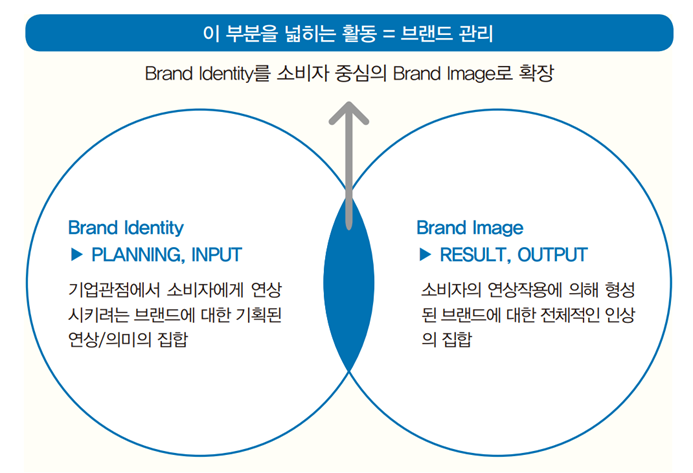
브랜드 강화 전략의 목표는 브랜드를 널리 소비자들에게 알려서 판매를 증가시키는 한편, 궁극적으로는 브랜드의 자산가치를 높이기 위한 것이다. 이를 위하여 기업이 소비자들에게 브랜드를 인지시키려고 하는 일련의 마케팅 활동들이 BI, 즉 브랜드 아이덴티티(Brand Identity)라고 한다.
이런 기업의 BI(Brand Identity) 활동(Input)의 결과는 소비자 관점에서 또 다른 BI, 즉 브랜드 이미지(Brand Image)를 형성(Output) 한다. 하지만 기업이 마케팅 활동을 통해 고객의 의식 속에 브랜드를 심어 넣으려고 많은 돈을 쏟아 부어도, 소비자에겐 기업이 의도한 데로 정확하고 뚜렷하게 잘 전달되지는 않아서, 소비자들은 기업이 원하는 브랜드 이미지를 형성하지 않는다.
개인의 브랜드 이미지는 다양한 매체뿐만 아니라, 주변 사람들의 평가, 권유, 그리고 무엇보다도 중요한 개인적인 성향과 경험을 통해 형성되기 때문이다. 이처럼 브랜드 이미지는 소비자의 브랜드에 관한 생각과 느낌이 추상적인 이미지로 형성되기 때문에, 기업의 의도와는 다른 결과를 초래할 수 있다.
따라서 기업의 관점으로만 소비자들에게 BI(Brand Identity)를 푸시(Push)를 한다면, 오히려 소비자들의 긍정적인 BI(Brand Image) 형성에 큰 낭패를 당할 우려도 있음에 주의해야 한다. 그래서 브랜드 아이덴티티는 제품으로서 눈에 보이는 실재의 모습이 아닌, 이를 받아들이는 소비자의 주관적인 인식이란 관점에서 시작해야 한다.
즉, 기업은 제품개발에서 광고홍보까지도 일관되게 소비자 관점으로 생각의 틀을 바꿔야만, 기업의 브랜드 아이덴티티와 소비자의 브랜드 이미지의 간극을 좁힐 수 있을 것이다.
브랜드는 사람의 일생과 유사하다. 따라서 브랜드도 한 사람이 보유하고 있는 정체성(아이덴티티)으로 표현하면 이해하기 쉬울 것이다. 한 사람의 아이덴티티는 그 사람이 갖고 있는 성향, 인생에서 추구하는 목표와 의미를 명확하게 전달해 주는 개념이라고 할 수 있다. 자아의 정체성을 갖고 있는 사람은 남과 비교하여 개성이 뚜렷할 것이고, 목표의식을 갖고 성실하게 삶을 살아가는 사람일 것이다. 사람들은 자신의 정체성에 대하여 때때로 다음과 같은 질문들을 스스로에게 던진다.
- 내가 추구하는 핵심가치는 무엇인가?
- 나는 어떤 모습으로 표현(상징) 되는가?
- 나는 주위 사람들에게 어떻게 여겨지길 원하는가?
- 나는 어떤 개인적인 특징을 가지고 있는가?
- 내 인생에서 가장 중요한 관계(인간관계, 일과의 관계 등)는 무엇인가?
위의 질문을 진지하게 생각하고 여기에 효과적으로 답을 할 수 있을 정도로 자신의 정체성이 명확하게 구축된다면, 사회에서도 인정받는 사람이 될 수 있을 것이라고 생각한다. 브랜드 아이덴티티도 마찬가지로, 브랜드가 추구하는 성향과 목표를 명확히 제시해주고, 브랜드가 존재하는 의미를 설명해 준다는 측면에서 한 개인이 보유하고 개발하려고 하는 정체성과 같다고 할 수 있다.
따라서 브랜드 아이덴티티를 효과적으로 개발하기 위해서는 단순히 제품으로서의 브랜드라는 한정된 개념이 아니라, 가치, 목표, 조직, 관계, 심볼 등 다양한 차원에서 제품 이상의 것을 체계적으로 정리해야 한다. 즉, 브랜드 아이덴티티란 제품의 특장점이 아니라, 제품 속에 담겨 있는 차별적인 브랜드 이미지가 되어야 하는 것이다.
———————————–
The goal of brand enhancement strategies is to make the brand widely recognized among consumers, thereby increasing sales and ultimately raising the brand’s asset value. To achieve this, a series of marketing activities aimed at making the brand known to consumers is referred to as Brand Identity (BI).
As a result of these corporate BI activities (Input), another BI, the Brand Image, is formed from the consumer’s perspective (Output). However, even if a company spends a lot of money trying to implant its brand in the minds of consumers through marketing activities, it often does not convey the intended brand image clearly and accurately.
This is because a person’s brand image is formed through various media, evaluations, and recommendations from surrounding people, and most importantly, personal tendencies and experiences. Thus, brand image can be shaped by a consumer’s abstract thoughts and feelings about the brand, potentially leading to outcomes different from the company’s intentions.
Therefore, if a company pushes its BI only from its perspective, it risks negatively impacting the formation of a positive BI (Brand Image) among consumers. Thus, brand identity should begin from the perspective of the consumer’s subjective perception rather than the visible and tangible aspects of the product. In other words, a company must consistently think from the consumer’s perspective throughout the entire process, from product development to advertising and promotion, to narrow the gap between the company’s brand identity and the consumer’s brand image.
A brand is similar to a person’s life. Therefore, understanding a brand’s identity in terms of a person’s identity makes it easier to comprehend. A person’s identity can be described as the concept that clearly conveys their tendencies, goals, and meaning in life. A person with a clear identity is likely to have a distinct personality, live life sincerely with a sense of purpose, and occasionally ask themselves questions such as:
- What are my core values?
- How am I represented (symbolized)?
- How do I want to be perceived by others?
- What personal characteristics do I have?
- What are the most important relationships in my life (with people, work, etc.)?
If one seriously considers and effectively answers these questions, they can become a socially recognized individual. Similarly, brand identity must clearly present the brand’s tendencies and goals, and explain its existence, akin to an individual’s identity.
Thus, to effectively develop brand identity, it is essential to systematically organize not just the brand as a product but also its values, goals, organization, relationships, symbols, and more. In essence, brand identity should transcend the product’s features and become a distinctive brand image embedded within the product.