

< 환국의 황금 시대 >
인류의 시원 국가인 환국은 삼성조 시대의 첫 머리로 조화신(造化神)의 신성이 구현된 때입니다. 환국의 신교의 삼신(조화. 교화. 치화) 사상이 인간 역사로 실현된 삼성조 시대는 환국, 배달, 고조선입니다. 환국은 조화신의 시대, 배달은 교화신의시대, 고조선은 치화신의 시대입니다. 다시 말해서 인간이 대자연과 한마음 되어 천지의 조화신성 속에 살며 우주광명의 심법을 체득한 시대였습니다.
때문에 환국 사람들은 ‘사람을 사귐에 친하고 멀리하는 구별이 없었고, 높고 낮음의 차별이 없었으며([태백일사]<환국본기>), 전쟁과 폭력을 몰랐으며 천지의 광명을 직접 체험하며 무병장수하는 신선의 삶을 누렸습니다. 한마디로 환국은 자연과 인간이 극치의 조화를 이룬 ‘환의 인간’시대였습니다.
환국은 3301년의 역사를 7세에 걸친 환인천제가 이끌었던 무병장수 문화 시대였습니다. 이것을 7대 왕조사로 보는 것은 태고적 조화신성 문명에 대한 무지의 소치입니다.
‘오래도록 사시며[長生久視] 항상 즐거움을 누리셨다[恒得快樂]’(삼성기 상), 도를 깨쳐 장생하시니[得道長生], 온 몸에는 병이 없었다[擧身無病]‘(삼성기 하) 등의 기록에서도, 환인의 평균 재위 기간 470년이 결코 불가능한 것이 아님을 알 수 있습니다. 동양 의학서인 고전 [황제내경] 제 1장에 나오는 황제와 기백의 대화에서도 먼 옛날에 누렸던 장수 문화를 확인할 수 있습니다. ‘옛 사람들은 어찌하여 백 세가 넘도록 건강하게 살았는가?’ 라는 황제의 질문에, 기백이 ‘그들은 천지의 법칙을 지키며 살았기 때문’이라 답하였습니다.
수메르 문명의 원형을 보여주는 [구약전서]<창세기>에 나오는 아담의 자손들도 노아에 이르기까지 모두 수백 살을 살았고, 유대족의 믿음의 아버지로 추앙받는 아브라함도 175세를 살았습니다. 우리나라의 신선계보를 적은 [청학집]에서 동방 선의 최고 조상으로 환인을 지목한 것에서도 환국은 인간이 선의 경지에서 살았던 조화 시대였음을 유추해 볼 수 있습니다.
서양의 고대 문명 연구가들은 인류 역사의 초기를 ‘황금 시대(The golden age)’라 부릅니다. 그들의 이야기를 종합하면, 그 시대 사람들은 금속 무기가 없이, 오직 석기만 쓰면서 전쟁을 꾀하지도 않았고, 사람을 대규모로 살상하지도 않았고, 하늘과 땅에 애정을 듬뿍 쏟으며 살았습니다.
원시 샤머니즘을 연구한 독일인 칼바이트(Kalweit)에 의하면, 먼 옛날은 인간이 행복과 평화 속에 살면서 초자연적인 힘을 쓰던 황금 시대로, 그때 사람들은 별 어려움 없이 신과 소통할 수 있었고, 죽음을 모르고 질병과 고통이 없는 자유로운 경지에서 살았습니다.
세계의 거석 문화를 연구하는 마샬(Peter Marshall) 또한 ‘거석 유적지가 요새로 쓰인 흔적이 없고 주변에서 무기가 발견되지 않은 점으로 보아, 고대 사람들은 평화롭고 창조적인 문명의 황금 시대를 누렸다’고 말합니다. 고대인들은 영성 문화만 갈구한 것이 아니라 어떤 면으로는 오늘의 문명에 못지않은 과학 문명도 발달시켰습니다.
환국의 중기 시대 이후라 할 수 있는, BCE 5000년경부터 나타나기 시작한 유럽의 거석 문명, BCE 3500년 경 지중해의 크레타 섬에서 시작된 미노스 문명 등 고대 유럽 문명을 연구한 서양 학자들은, 고대인들이 지구가 1년 동안 자전하는 횟수가 365회인지 366회인지를 놓고 논쟁할 정도로 세밀한 천문 관측 기술을 가지고 있었음을 알아냈습니다.
고대인들은 또한 달과 태양의 크기도 측정하였고, 그것을 바탕으로 도량형도 만들었습니다. 그들이 사용한 단위는 지금과 다르지만, 그들이 잰 수치는 현대 천문학의 관측 결과와 거의 동일하게 나옵니다. 세계에서 가장 유명한 거석 유적지인 영국 스톤헨지의 거석들은 달과 태양이 지나가는 열 두 곳의 주요 위치에 맞추어 정렬되어 있습니다. 이 사실은 고대인의 놀라운 천문 기술을 눈으로 확인시켜 줍니다.
태고 시대 인류는 신의 계시를 받아 내려, 하늘과 직접 소통하며 천지광명 속에서 무병장수하는 삶을 추구하였을 뿐만 아니라, 자연 탐구를 바탕으로 놀라운 수준의 과학 문명에 도달하였던 것입니다.
< 환국의 열두 나라 >
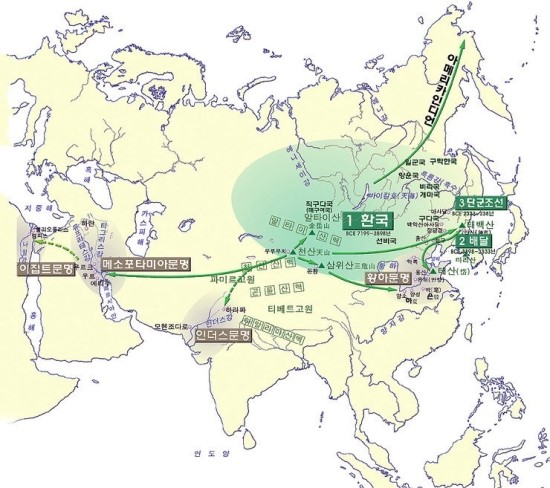
환국은 모두 아홉 족속(九桓)으로 나뉘었고, 이 구환족은 열두 나라를 이루고 살았습니다. 12 환국의 이름은 이렇습니다.
12환국 – 비리국, 양운국, 구막한국, 구다천국, 일군국, 우루국, 객현한국, 구모액국 매구여국, 사납아국, 선비국, 수밀이국
[단군세기]를 보면 양운국, 일군국, 수밀이국, 구다천국 등은 고조선의 21세, 27세 단군 때까지 나라 이름으로 계속 사용되었습니다. 고조선 시대의 제후국으로 기록된 이 네 나라의 이름은 바로 12환국에서 유래한 것입니다.
중국 문헌에서도 12환국의 이름을 볼 수 있습니다. 예컨대 진서(晉書) 사이전(四夷傳)을 보면 비리국, 양운국, 구막한국, 일군국이 있었는데, 이들은 2만~5만 호정도를 가진 소국으로 시베리아 등지에 있었다 합니다. 당서(唐書) 북적전(北狄傳)에는 우루국이라는 이름이 나오고 삼국사기에는 구다천국과 매구여국이 구다국과 매구곡이란 명칭으로 남아 있습니다. 이처럼 아홉 개 나라의 이름이 후세의 사사에 나타납니다.
오늘날 전 세계 모든 나라의 시원이라 할 수 있는 환국이 열 두 나라로 이루어진 배경에는 심오한 우주론적 원리가 있습니다.
동양의 천지음양론에 의하면 하늘의 질서는 10간(十干)로 펼쳐지고 땅의 질서는 12지(十二支)로 펼쳐지므로, 땅에서 일어나는 모든 변화는 12수를 한 주기로 하여 일어납니다. 그래서 천상의 삼신상제님 나라가 땅에 이식된 첫 나라인 환국도 열 두 나라로써 그 역사를 만들어 나간 것입니다. 그런데 흥미롭게도 이 12수는 동서양의 여러 고대 신화에 나오는 신의 숫자와 일치합니다.
그리스 신화에서, 제우스를 비롯한 올림포스 신전의 신들은 언제나 열둘이었습니다. 새로운 신이 한 명 추가되면 기존의 한 신이 빠지는 방법으로 항상 12수가 유지되었습니다. 인도의 고대 경전 [베다]에 나오는 중요한 신도 12명입니다. 뿐만 아니라 인도 신들의 아내, 자식에 대한 이야기는 그리스 신화의 복사판이나 다름 없습니다.
그리스인과 인도인이 갈려 나간 근원으로 추정되는 소아시아 지역의 히타이트족도 12신을 모셨습니다. 고대 히타이트의 수도 외곽에서 나온 반원형으로 된 석조 조각물에 신이 12명씩 짝을 지어 행진하는 모습이 새겨져 있습니다. 이집트에서도 위대한 신들은 12명으로 구성되어 있어 최고의 신, 라(Ra, 창조자)가 12명으로 이루어진 신의 회합을 주관합니다.
그리스, 인도, 소아시아, 이집트와 같은 동서양 고대 문명 발상지의 신화에 등장하는 신이 열셋도 열하나도 아니고 열둘이었다는 사실은 인류 문명이 하나의 시원 처, 12환국의 12성수(聖數) 문화에서 뻗어 나왔을 가능성을 강하게 시사합니다.

————
The Golden Age of Hwan-guk
Hwan-guk, the earliest state of humanity, marks the beginning of the Samseongjo era, a time in which the divine nature of Jo-hwa-shin (the Creator God) was realized. In Hwan-guk’s Samshin philosophy, which comprises Jo-hwa (Creation), Gyo-hwa (Teaching), and Chi-hwa (Governance), each era of human history reflects one of these divine aspects: Hwan-guk embodies the Creation era, Baedal represents the Teaching era, and Gojoseon symbolizes the Governance era. This was a time when humanity lived in unity with nature and experienced the enlightenment of universal wisdom, harmonized with the divine.
Due to this alignment, the people of Hwan-guk lived without distinctions of closeness or remoteness in relationships, nor did they have ranks or social stratification, as noted in Taebaek Ilsa‘s “Hwan-guk Bon-gi.” They lived without war or violence, experiencing the radiant light of heaven and earth and enjoying long, illness-free lives akin to those of divine beings. In essence, Hwan-guk was an age of “Hwan-in’s humanity,” an era of ultimate harmony between nature and humankind.
During Hwan-guk’s 3,301-year history, it was governed by seven Hwan-in rulers, creating an era of longevity and health. Interpreting these seven rulers as distinct dynasties demonstrates a misunderstanding of this ancient, divine civilization. The records in Samseong-gi show that “they lived long lives and enjoyed continual happiness” (Samseong-gi I) and “achieved enlightenment and longevity, with no sickness throughout their entire bodies” (Samseong-gi II). These descriptions suggest that the average reign of each Hwan-in, around 470 years, is not implausible. The classical Eastern medical text, Huangdi Neijing (The Yellow Emperor’s Classic of Medicine), also supports the existence of this ancient culture of longevity. When the Yellow Emperor asks, “Why did the people of ancient times live beyond one hundred years in health?” Qi Bai responds, “Because they lived in accordance with the laws of heaven and earth.”
Similarly, in the Book of Genesis from the Old Testament, a reflection of the proto-Sumerian civilization, the descendants of Adam lived for hundreds of years, with Noah among them, and Abraham, regarded as the father of the Jewish faith, lived to be 175 years old. The Korean Cheonghakjip, which chronicles the genealogy of Korean sages, identifies Hwan-in as the supreme ancestor of Eastern sages, further indicating that Hwan-guk was a golden era where humanity lived in divine harmony.
Western historians of ancient civilizations refer to this early period in human history as “The Golden Age.” From their perspectives, people in this age used only stone tools, not metal weapons, avoided warfare, refrained from mass killings, and lived with deep affection for the heavens and earth.
The German scholar Kalweit, who researched primitive shamanism, describes an ancient Golden Age when humans lived peacefully, possessed supernatural abilities, communicated effortlessly with gods, and were free from illness and suffering. Similarly, Peter Marshall, who studied megalithic cultures, notes that megalithic sites show no signs of military use, nor were weapons found nearby, suggesting that ancient people enjoyed a peaceful and creative civilization.
Ancient people, in fact, did not solely focus on spiritual pursuits; they also developed scientific advancements comparable to today’s. Western scholars studying ancient European civilizations, such as the European megalithic culture that emerged around 5000 BCE and the Minoan civilization that began around 3500 BCE on Crete, have discovered that ancient people possessed detailed astronomical knowledge. They even debated whether the Earth’s annual rotation counted 365 or 366 days, indicating highly precise astronomical observation skills.
Ancient civilizations also measured the sizes of the sun and the moon and developed measurement systems based on these observations. While their units of measurement differed from ours, their results were strikingly similar to modern astronomical calculations. The famous megalithic site of Stonehenge in England, for instance, is aligned with twelve key points corresponding to the paths of the sun and moon, showcasing ancient peoples’ advanced astronomical knowledge.
Early humanity, through divine inspiration, sought to live in harmony with the radiant light of heaven and earth, enjoying long, healthy lives. At the same time, they reached impressive levels of scientific achievement through their exploration of nature.
The Twelve Kingdoms of Hwan-guk
Hwan-guk consisted of nine clans, or Gu-hwan, which collectively formed twelve countries. These twelve Hwan-guk countries were as follows: Biri-guk, Yang-un-guk, Guma-han-guk, Gu-da-cheon-guk, Il-gun-guk, Uru-guk, Gae-hyeon-han-guk, Gumo-aek-guk, Maegu-yeo-guk, Sanaba-guk, Seonbi-guk, and Sumi-ri-guk.
According to Dangunsegi, some of these nations, like Yang-un-guk, Il-gun-guk, Sumi-ri-guk, and Gu-da-cheon-guk, continued as state names even into the era of the 21st and 27th Dangun rulers of Gojoseon, showing their origins from the twelve nations of Hwan-guk.
The names of some of these twelve countries also appear in Chinese historical records. For instance, in Jinshu’s Record of the Four Barbarians, Biri-guk, Yang-un-guk, Guma-han-guk, and Il-gun-guk are mentioned as small nations of about 20,000 to 50,000 people in Siberia and other regions. Tangshu’s Record of the Northern Barbarians mentions Uru-guk, while the Samguk Sagi mentions Gu-da-cheon-guk and Maegu-yeo-guk under slightly different names. These references attest to the historical legacy of these nine nations.
The twelve countries of Hwan-guk, which can be seen as the origin of all present-day nations, are believed to have been founded based on profound cosmological principles. According to the Eastern cosmology of Heaven and Earth, the heavenly order unfolds through the ten celestial stems (십간), while the earthly order unfolds through the twelve earthly branches (십이지). Thus, all changes that occur on Earth follow a twelvefold cycle. Consequently, the first human civilization to carry out the heavenly Samshin culture on Earth, Hwan-guk, developed a history with twelve nations.
Interestingly, this number twelve appears in the mythologies of ancient civilizations in both East and West. In Greek mythology, Zeus and the gods of Olympus always numbered twelve, with any addition or replacement of a god maintaining this twelve-member structure. In the ancient Indian Vedas, twelve key deities are mentioned, and their relationships resemble those found in Greek mythology. The Hittites of Asia Minor, considered an ancestral people of Greeks and Indians, also worshipped twelve gods, as depicted in stone reliefs found near their ancient capital.
In Egypt as well, the pantheon was composed of twelve deities, presided over by Ra, the creator. The fact that ancient civilizations, whether Greek, Indian, Hittite, or Egyptian, consistently revered twelve gods hints at the possibility that early human civilization originated from a single source, namely the twelvefold culture of Hwan-guk.