

한국을 강탈한 일제의 고민은 우리 민족이 일본보다 더 오랜 역사를 가진 문화 민족이라는 사실이었습니다. 총칼로 잠시 지배할 수는 있겠지만 영원히 식민지로 만들기에는 조선의 문화적 저력이 너무 컸던 것입니다. 이에 일본은 조선 민족을 완전히 일본에 동화시키고자 가장 먼저 조선 상고사 말살 작전을 펼쳤습니다.
일제강점기 초대 총독 데라우치 마사타케(1852~1919)는 “조선인들에게 일본혼을 심어 주어야 한다. 그렇지 않고 그들의 민족적 반항심이 타오르게 된다면 큰일이므로 영구적이고 근본적인 사업이 시급하다. 이것이 곧 조선인들의 심리 연구이며 역사 연구이다”라고 하여 조선사 편찬의 필요성을 강조했습니다.
일제는 조선사를 말살하기 위해 ‘조선사편수회’를 만들었습니다. 조선사 편수 사업은 경술국치 이전인 1906년부터 시작된 ‘조선 구관제도 조사사업’에서 시원합니다. 일제는 조선 강점 이전부터 이미 한국사 말살을 기획하고 있었던 것입니다.
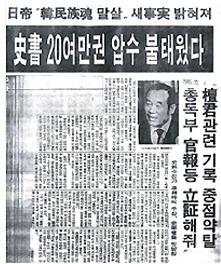
이 사업은 1910년 국권 강탈 후 조선을 통치하는 법령 제정과 형벌을 관장하는 가장 악질적인 기관인 취조국으로 이관되었습니다. 취조국은 조선의 관습과 제도를 조사한다는 미명 하에 헌병과 헌병 보조원을 앞세워, 1910년 11월부터 약 14개월 동안 조선 강토 구석구석을 뒤져 역사서를 포함한 20여 만 권의 각종 도서를 수거하여 대부분 불살라 버렸습니다.
이 때 한민족 상고사에 관한 주요 서적을 일본의 황실 도서관으로 옮겨 비장한 사실이 그곳에서 1933년부터 12년 동안 근무한 박창화(1889~1962)의 증언으로 공개된 바 있습니다. [KBS역사 스페셜 “추적, 화랑세기 필사본의 미스터리” 1999. 7. 10)
사서를 수거, 소각한 데 이어 일본은 철저한 금서 정책을 폈습니다. 조선의 역사책, 전기, 족보, 만세력 등을 금지하여 민족 사상을 말살코자 했고, 조선의 인문, 지리, 풍습에 관한 책을 금지하여 전통문화를 말살코자 했고, 독립운동사를 기록한 외국 역사책을 금지하여 독립정신을 저해코자 했습니다. 또한 무궁화나 태극기에 관한 책을 금지하여 민족혼을 일깨우지 못하도록 하였고, 민주주의와 사회주의 사상에 관한 책을 금하였고, 농민운동, 청년운동, 여성운동, 야학운동 등을 다룬 책을 금하였습니다. (김삼웅-일제는 조선을 얼마나 망쳤을까 232~233쪽)
그러면서도 조선사를 왜곡하는 데 무리가 없거나 식민화에 도움이 될 만한 사서는 그대로 넘겨 뒀습니다. 역사서 수거는 그 후 [조선사]편찬이 마무리될 때까지 지속적으로 이루어졌습니다. 일제는 1915년에 이 사업을 이완용, 권중현 등 부일 역적을 앉혀 놓은 중추원으로 이관하고, 1916년에 중추원 산하에 ‘조선반도사편찬위원회’를 발족시켜 한민족의 혼을 말살하기 위한 역사서 편찬을 시작하였습니다.
1919년 3.1운동 후 일제는 조선 통치 방향을 무단정치에서 문화정치로 바꾸었습니다. 조선총독부는 중추원 산하에 있던 역사편찬 업무를 조선총독부 직속 ‘조선사 편찬위원회’(1922)로 이관하고 식민통치를 합리화할 역사서 편찬을 본격화 하였습니다.
그러나 조선인 학자들이 외면하여 활동이 미진하자, 일왕의 칙령으로 조선사편수회(1925)로 개편하고 조선총독부 직할 독립 관청으로 승격시켰습니다. 조선사 말살 정책이 조선총독부 문화정치의 핵심 사업이었기 때문입니다. (계속)

————–
Japan’s concern after forcibly annexing Korea was the cultural depth of the Korean people, who had a longer and richer historical tradition than Japan. Though it could temporarily rule Korea through military force, turning it into a permanent colony was difficult due to Joseon’s cultural resilience. To fully assimilate Koreans into Japanese identity, Japan first launched a campaign to eradicate Korea’s ancient history.
Terauchi Masatake (1852–1919), the first Governor-General of colonial Korea, emphasized the need to implant the “Japanese spirit” into Koreans. He stated, “We must implant the Japanese spirit in Koreans. If their nationalistic resistance ignites, it will become a major issue. Therefore, a permanent and fundamental project is urgent. This is precisely the psychological and historical study of Koreans.” Thus, he underscored the necessity of compiling Korean history.
To obliterate Korean history, the Japanese colonial government established the Joseon History Compilation Committee (Chōsenshi Henshūkai). The origin of this historical revision project can be traced back to the “Old Joseon Institutions Survey Project” which began in 1906, prior to Korea’s annexation in 1910. This indicates that Japan had planned the eradication of Korean history even before the formal colonization.
After the annexation, the project was transferred to the Investigation Bureau—the most brutal institution responsible for creating colonial laws and overseeing punishment. Under the pretense of investigating Korean customs and institutions, this bureau, with military police and their auxiliaries, conducted a 14-month operation starting in November 1910, scouring every corner of Korea to confiscate approximately 200,000 books, including historical texts. Most of these were incinerated.
Some of the major texts related to ancient Korean history were transferred to the Imperial Household Library of Japan, a fact revealed by Park Chang-hwa (1889–1962), who worked there from 1933 for 12 years. This testimony was made public in the KBS documentary History Special: “Tracking the Mystery of the Handwritten Hwarang Segi” (aired July 10, 1999).
After confiscating and burning historical texts, Japan implemented a strict censorship policy. It banned Korean historical books, biographies, genealogies, and almanacs to eliminate national consciousness. It prohibited literature on Korean humanities, geography, and customs to erase traditional culture. Books documenting independence movements published abroad were banned to suppress the spirit of resistance. Texts about symbols like the Mugunghwa (national flower) and the Taegeukgi (national flag) were banned to prevent the awakening of national identity. Furthermore, books related to democracy, socialism, and movements such as those led by farmers, youth, women, and night schools were also banned (Kim Sam-woong, How Much Did Japan Destroy Korea, pp. 232–233).
However, history books that posed no threat or were useful in distorting Korean history to fit colonial narratives were left untouched. The confiscation of historical materials continued until the compilation of the Joseon History series was completed. In 1915, this project was transferred to the Privy Council (Jungchuwon), led by pro-Japanese collaborators such as Yi Wan-yong and Gwon Jung-hyeon. In 1916, the council launched the Committee for the Compilation of the History of the Korean Peninsula to begin systematically erasing Korean national identity through historical revisionism.
After the March 1st Movement in 1919, Japan shifted its colonial strategy from military rule to so-called “cultural rule.” The compilation of Korean history, previously under the Privy Council, was transferred in 1922 to the Joseon History Compilation Committee under the direct control of the Governor-General’s Office. This marked the full-scale launch of historical compilation aimed at rationalizing Japanese colonial rule.
When Korean scholars refused to participate, the committee was restructured by Imperial decree into the Joseon History Compilation Committee in 1925 and elevated to an independent agency directly under the Governor-General. This restructuring signified that the erasure of Korean history had become the core project of Japan’s cultural policy in colonial Korea.
(To be continued…)