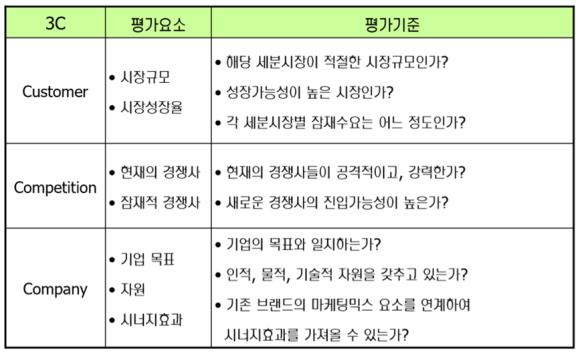
마케팅 STP전략의 시장세분화(Segmentation)를 위해선 다시 환경분석에서 다루었던 3C를 이야기하지 않을 수 없다. 당연히 신제품 기획을 하거나 기존 제품을 리포지셔닝(Repositioning)을 한다면, 철저한 환경분석이 이루어졌을 것이고, 다음과 같은 분석이 선행되었을 것이다.
시장세분화는 마케터의 개인적인 주관 또는 감으로 즉흥적으로 이루어져서는 안된다. 설령 마케터의 인사이트(Insight)에 의해 세분화가 필요하다고 해도, 철저한 조사와 분석이 뒤따르지 않으면, 실패로 끝날 확률이 높다.
따라서 시장세분화는 객관적인 자료와 분석에 근거해서, 목표에 부합되는 적절한 규모 이상의 측정이 가능한 시장이어야 하며, 기존과는 다른 차이성이 있고 시장진입이 용이하고 실행이 가능한 시장으로 세분화 되어야 할 것이다.
이를 위해 시장세분화는 다음과 같은 단계를 거친다.
(1) 시장세분화 목적의 명확화.
(2) 시장세분화 기준 선택 : 인구통계적, 지리적, 사회경제적, 라이프스타일 특성적, 소비자들의 제품사용, 구매 패턴, 요구되는 편익(Benefit) 등
(3) 자료의 수집 및 세분시장의 특성 확인
(4) 세분시장의 프로파일 작성 및 결과의 해석.
이러한 조사분석은 환경분석 과정에서 선행되어야 하지만, 그러지 못할 경우에는 STP과정에서 다시 보다 정교하게 설계되어 진행되어야 할 것이다.
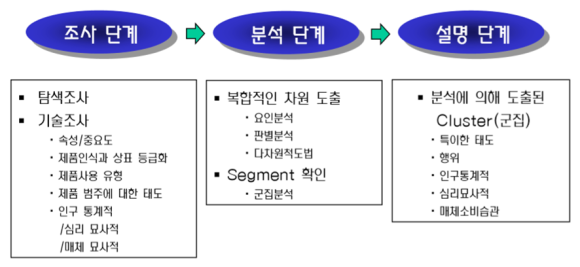
나도 과거 애경산업에서 마리끌레르 브랜드를 출시했을 때, 초기 환경분석을 FGI만 해서 전반적인 시장세분화와 컨셉을 수립하였으나, STP를 진행하면서 확신을 갖기위해 추가로 정량조사인 A&U Test를 통해 소비자의 제품에 대한 태도(Attitude)와 사용성(Usage)을 조사함으로써, 타겟을 여대생 집단으로 선정하고 이에 맞는 포지셔닝과 제품기획을 해서 크게 성공한적이 있다.
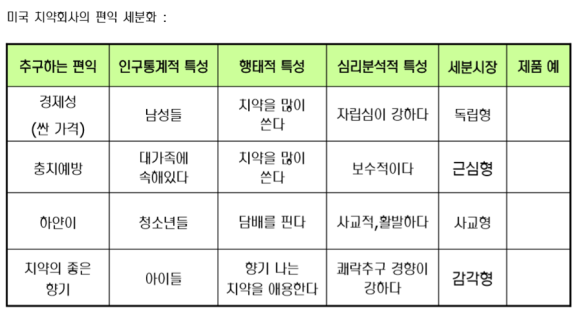
이처럼 시장세분화는 바로 환경분석과 이어져야 한다. 그래서 STP전략의 제일 앞에 ‘S’, Segmentation 이 먼저 나오는 이유이다. 다음의 미국의 한 치약회사의 시장세분화 사례를 보면 좀 더 이해하기 쉬울 것이다.
To address Market Segmentation within marketing STP strategy, we cannot help but revisit the 3Cs previously covered in environmental analysis. Naturally, when planning a new product or repositioning an existing one, a thorough environmental analysis would have been conducted beforehand, and the following analysis must have preceded it.
Market segmentation must never be carried out spontaneously based on a marketer’s personal subjectivity or gut feeling. Even if a marketer’s insight suggests that segmentation is necessary, if it is not accompanied by rigorous research and analysis, there is a high probability of ending in failure.
Therefore, market segmentation must be grounded in objective data and analysis. The segmented market should be measurable above an appropriate size that aligns with goals, distinct from existing options, easy to enter, and actionable for execution.
To achieve this, market segmentation undergoes the following steps: (1) Clarification of the market segmentation objective (2) Selection of segmentation criteria: demographics, geography, socioeconomics, lifestyle traits, product usage/purchase patterns of consumers, desired benefits, etc. (3) Data collection and identification of segment characteristics (4) Profiling of segmented markets and interpretation of results
Although such research and analysis should ideally be conducted during the environmental analysis phase, if that was not possible, it must be designed and executed more precisely during the STP process.
In the past, when I launched the Marie Claire brand at Aekyung Industrial, I initially established the overall market segmentation and concept based solely on FGIs during the preliminary environmental analysis. However, to gain certainty while proceeding with STP, I conducted an additional quantitative A&U (Attitude & Usage) Test to examine consumers’ product attitudes and usages. Through this, I successfully selected female college students as the target group, designed appropriate positioning and product planning, and achieved massive success.
As such, market segmentation must connect directly with environmental analysis. That is why “S” for Segmentation comes first at the very front of the STP strategy. Looking at the following market segmentation example of an American toothpaste company will make this concept much easier to understand.