

“그런데, 한 가지 의견이 더 있습니다.”
신팀장은 디자인이 결정나자 기다렸다는 듯이 경영진이 떠나기 전에 얼른 일어서며 말을 했다.
“지난 번 사업개발부에서 소비자 조사했을 때는 디자인이 없이 진행하다 보니, 제품과 브랜드의 연결이 안된 상태에서 기 형성된 M&C의 브랜드 이미지만으로 조사가 되었습니다. 그러다 보니 좀 더 명확한 타겟과 컨셉을 발견할 수 없었습니다. 따라서 M&C 브랜드와 함께 이 디자인을 보여주며 FGI(Focus Group Interview)를 한번 하고 싶습니다. 이 것이 검증되지 않으면 일을 진행하면서도 이것이 과연 바른 길인지 왠지 꺼림칙해서 자신 있는 일이 진행될 것 같지 않습니다.”
신팀장의 제안에 민이사가 거들었다.
“좋은 생각입니다. 사장님! 이건 반드시 짚고 넘어가야 할 일입니다. 신팀장, 조사 때문에 런칭이 지연되진 않겠지?”
“네, 이사님. 다른 일에 방해되지 않게 병행해서 함께 수행해 나가겠습니다.”
민이사의 도움에 신팀장은 대표이사의 허락을 받고 지난 번 정량조사를 실시했던 D사의 엄대리와 다시 함께 조사를 하기로 하였다. 아무래도 지난 조사를 통해 브랜드를 누구보다도 이해할 수 있는 엄대리가 믿음이 갔기 때문이며, 당시 조사비용을 깎으며 다음 조사도 꼭 맡기겠다는 약속도 이행하기 위한 것이었다.
신팀장은 이번에 엄대리를 통해 두 명의 마케팅 팀원뿐만 아니라 TFT 멤버 모두에게 FGI 조사에 대한 설명을 부탁했다. 예전에 사업개발부에서 조윤희가 질문을 했을 때도 자신이 설명하는 것보다 전문가가 직접 교육을 해주는 것이 더 좋을 것이라는 생각이 들었으며, 비록 마케팅부원들은 아니더라도 TFT 멤버들도 이런 조사방법론을 기본적으로 알아 두면 좋을 것 같다는 생각이 들었기 때문이다.
TFT 회의가 시작하기 약 30분 전에 엄대리는 FGI를 이해하기 쉽게 프레젠테이션 자료를 준비해와서 짧고 굵게 설명해 주었다.
“정성조사는 정량조사와는 달리 확률적 기초에 근거를 둔 샘플이 아닌 적은 인원을 대상으로 하여, 소비자들의 의견을 직접 보고 들으면서 그들의 Needs를 심층적으로 조사하는 것입니다. 따라서 정성조사는 대규모의 정량조사를 실시하기 전에 예비적 정보 수집을 통해 가설을 수립한 후 정량 조사로써 검증하고자 할 때나, 이번 M&C FGI처럼 정량 조사의 결과에서 불투명한 점을 더 깊이 찾아 내고자 할 때, 그리고 신브랜드의 컨셉에 대한 소비자들의 깊은 의견을 듣고자 할 때 사용하면 좋습니다.
그래서 형식에 얽매이지 않고 자유로운 질의 응답을 통해, 정량조사의 설문지에서 표현하지 못했던 소비자들의 깊은 속마음에 대한 답변을 얻을 수 있고, 독창적인 아이디어도 이끌어 낼 수가 있어, 소비자를 깊이 이해하는데 매우 큰 도움이 됩니다.
그러나 정성조사는 수치로 명확하게 제시되지 않을 뿐만 아니라, 작은 표본으로 인해 신뢰도와 타당성이 부족하여 조사결과에 대한 설득력이 약하고, 조사자의 자질에 따라 영향을 많이 받기 때문에 조사결과의 해석이 주관적일 수도 있어서, 조사결과를 전체 시장에 일반화할 수 없는 한계점이 있습니다. 그런 점에서 정량조사와 병행을 하면 더욱 효과적이겠지요.”
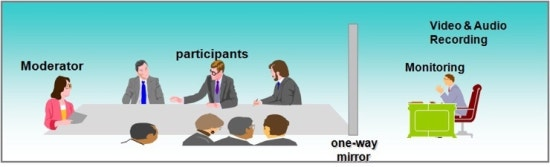
엄대리는 화면을 바꿔 FGI에 대해 설명하기 시작하였다. 화면에는 FGI 조사실이 그림으로 잘 설명되어 보였다.
“FGI는 그림에서처럼 특별한 방에서 7~8명의 참석자를 대상으로 비구조화된 설문 가이드라인을 가지고 전문 모더레이터(Moderator)라고 하는 숙련된 사회자의 진행에 따라 약 2시간 동안, 참석자들 간의 상호작용과 자유로운 대화 분위기에서 자연스럽고 무의식적인 표현 방법을 통해 폭 넓고 심층적인 정보를 수집한 방법입니다. 방에는 한쪽으로만 보이는 거울이 설치 되어 있어서, 여러분들 같은 클라이언트들이 오시면 참석자들 모르게 다른 방에서 직접 회의하는 모습을 참관할 수도 있습니다.”
엄대리는 그 외에도 FGI 조사 방법 및 효과 장단점 등을 자세히 설명해 주는 한편, 이번 조사가 주는 의미가 얼마나 가치있는지도 부연 설명해 주어, 참석자들도 쉽게 FGI 조사에 대해 이해 할 수가 있었으며, 실제로 조사 기간 중에 직접 FGI 룸을 찾아가서 참석자들의 회의하는 모습을 지켜 보기도 하였다.
M&C 디자인 목업을 보여주며 실시한 FGI 조사결과는 예상대로 타겟이 20대 젊은 여성으로 나왔다. 이렇듯 새로운 초기 진입 시장의 경우, 소비자의 의견이 항상 정답일 수가 없다. 이런 경우는 소비자보다도 마케터의 시장에 대한 인사이트(Insight)가 더 중요한 경우가 많기 때문에, 조사를 통해 고객의 니즈(Needs)만을 반영하기 보다는, 새로운 밭에 씨를 뿌리듯이 기업에서 소비자를 이끌어 나가는 씨즈(Seeds)가 더 중요하기도 하다. 하지만 마케터가 수립한 새로운 전략 안은 입증되지 않은 가설에 불과하므로, 이에 대한 검증을 위하여 소비자 조사는 반드시 필요한 것이다. (계속)

——————-
“However, there is one more suggestion I’d like to make.”
As soon as the design decision was finalized, Team Leader Shin stood up quickly before the executives left and began speaking.
“During the last consumer survey conducted by the Business Development Department, the process was carried out without the design being included. As a result, the survey reflected only the pre-existing brand image of M&C, without linking the product and brand. This made it difficult to discover a clearer target and concept. Therefore, I’d like to propose conducting an FGI (Focus Group Interview) to showcase this design along with the M&C brand. Without verifying this, I feel uneasy about moving forward confidently, as it might lead to second-guessing later in the process.”
Executive Director Min supported the suggestion.
“That’s a great idea. President, this is an essential step we need to address. Team Leader Shin, will the survey delay the launch?”
“No, sir. We will proceed simultaneously without interfering with other tasks.”
With the support of Executive Director Min, Team Leader Shin obtained the president’s approval and decided to collaborate again with Assistant Manager Um from D Company, who had conducted the previous quantitative survey. This was partly because Um had gained a solid understanding of the brand through the previous survey and partly to fulfill a promise to assign them another project in return for a discounted rate on the last survey.
Team Leader Shin asked Assistant Manager Um not only to assist the two marketing team members but also to explain the FGI methodology to all the TFT members. When Jo Yoon-hee from the Business Development Department had previously asked a question, Shin felt it would be more effective for an expert to provide the explanation rather than doing it himself. Additionally, he believed it would be beneficial for the TFT members, even those not in the marketing department, to have a basic understanding of such research methods.
About 30 minutes before the TFT meeting began, Assistant Manager Um came prepared with a concise and impactful presentation on FGI.
“Qualitative research differs from quantitative research in that it does not rely on probability-based sampling but instead involves a smaller number of participants. Through direct observation and listening, it allows for an in-depth investigation of consumer needs. Therefore, qualitative research is useful for collecting preliminary information to formulate hypotheses before large-scale quantitative research or, as in the case of this M&C FGI, to delve deeper into unclear aspects of quantitative survey results. It is also valuable for gathering detailed opinions on the concept of a new brand.”
Um continued, “This approach allows for flexible questioning and answers, enabling the discovery of deep insights into consumers’ minds that cannot be expressed through standardized quantitative survey questionnaires. Additionally, it can generate original ideas, making it highly effective for understanding consumers more deeply.”
“However, qualitative research has its limitations. It does not provide clear numerical results, and its small sample size can result in a lack of reliability and validity. This makes the findings less convincing and subject to the skills of the researcher, leading to potentially subjective interpretations. As a result, the findings cannot be generalized to the entire market. These limitations are why qualitative research works best when combined with quantitative methods.”
Assistant Manager Um then switched slides to explain the FGI methodology in more detail. The presentation included an illustrated explanation of an FGI session room.
“FGI, as shown in the illustration, is conducted in a specially designed room with 7–8 participants. Using an unstructured survey guide, a skilled moderator facilitates the session for approximately two hours. The natural and spontaneous interactions and free-flowing conversations among participants provide broad and in-depth information. One-way mirrors are often installed in such rooms, allowing clients like you to observe the session without participants being aware of your presence.”
In addition to detailing the FGI methodology and its pros and cons, Um emphasized the significance of the upcoming survey, ensuring that all attendees could easily understand the process. The participants were even encouraged to visit the FGI room during the survey period to observe the sessions firsthand.
The FGI survey, which involved showcasing the M&C design mock-up, confirmed the target audience as young women in their 20s, as expected. In new and early-stage markets like this, consumer opinions are not always the ultimate answer. In such cases, the marketer’s insight into the market often plays a more critical role. Rather than merely reflecting consumer needs, the company may need to take the lead in guiding consumers by planting “seeds” in untapped fields. However, since a newly developed marketing strategy is no more than an unproven hypothesis, consumer research remains essential for its validation. (To be continued)