

- 중국이 주장하는 조선, 기자조선
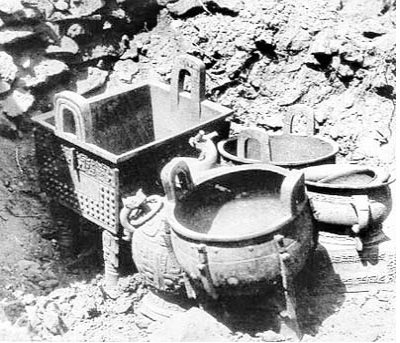
중국인들은 漢代 이래 기자조선을 역사적 사실로 믿어 왔습니다. 이러한 중국의 주장을 뒷받침이라도 하듯 1973년, 요령성 객좌현에서 기후箕侯라는 명문이 새겨진 청동 솥이 발굴 되었습니다. 이 유물은 기자가 살던 상말.주초에 해당하는 BCE12세기에 제작된 것으로 판명되었습니다.
이보다 앞서 1951년에는 산동성 황현에서 8점의 기기箕器가, 1969년에는 산동성 연대시에서 기후정箕侯鼎이 출토되었습니다. 이것들은 기자가 죽고 수백 년이 지난 주나라 후기, 춘추 시대에 만들어진 것입니다. 발견된 유물의 수준으로 볼 때, 기자와 그 후손들은 상당한 재력과 정치적 영향력을 가졌던 것이 분명합니다.
그렇다면 기자는 중국이 주장하듯 과연 조선이란 나라의 왕이었을까요? <사기색은> 에서는 기자를 상나라의 왕족이라 하면서 “기자는 箕는 國名 이고 子는 작위의 명칭이며 기자의 이름은 ”서여“이다 라고 하였습니다. 이로 볼 때, 箕子는 箕國의 통치 계급에 속하는 인물이었습니다. 윤내현의 해석에 의하면 기국은 상나라의 제후국이었고, 기자는 그 기국의 지배 계급이었습니다. 최고의 지배자였다면 기자는 기국의 왕이었을 것입니다.
발견된 유물과 중국 사서의 기록을 종합하면, 기자는 제후 수준의 지배 계급에 속하는 상나라 말기의 왕족입니다. 하지만 <사기>의 기록을 보충 설명한 주석서인 <사기색은>은 사마천이 말한 ‘봉기자어조선’에 대해 아무런 설명을 덧붙이지 않았습니다. 이 점은 기자조선을 역사적 사실로 받아들이기 어렵게 합니다. 기자가 설사 왕이었다 하더라도, 기국을 다스린 왕이었을지언정 고조선을 다스린 왕은 결코 아니었던 것입니다. 하지만 <사기>가 말한 기자조선은 그 후 중국 역사서에서 역사적 사실로 굳어졌습니다.
예를 들면 3세기 진나라 때 진수陳壽(233~297)가 쓴 <삼국지>는 [위략魏略]을 인용하여 고조선 말기에 위만에게 왕위를 빼앗긴 箕準을 기자의 후예로 기술 하였습니다. 여기에는 고조선을 망할 때까지 기자조선으로 존재했다고 보는 중국인의 의식이 엿보입니다. 고려와 조선의 사대주의자들은 중국이 날조한 기자조선을 한민족사의 뿌리로 여기고 기자를 은인으로 받들었습니다. 기자는 고조선의 서쪽 변두리를 맴돌았을 뿐 한반도 지역으로 넘어 온 적이 없건만, 고려 때 송나라 사신이 “그대 나라에 기자묘가 어디 있는가?”라고 묻자 황급히 서경(평양)에 가짜 기자묘와 기자사당을 만들었습니다. 또한 서경의 반듯한 도로 흔적을 기자가 만들었다는 정전제의 증거로 간주하셨습니다.
하지만 1960년대 북한 역사학계에서 기자 정전 터로 주장되던 곳과 평양 을밀대 북쪽에 있던 기자묘를 조사하면서 그 허구가 밝혀졌습니다. 기자 정전 터는 고구려 시대에 도시를 구획한 흔적으로 판명되었고, 그곳에서는 사기 파편과 벽돌조각만 나왔습니다.
요즘 국내 사학계에서는 기자조선을 중화주의 사상에 빠진 중국이 지어낸 것으로 간주하는 견해가 지배적입니다. 그러나 한번 잘못 쓴 역사 기록의 폐해는 쉽게 걷히지 않고 있습니다.

- 일본이 주장하는 조선, 위만조선.
(일본은 왜 기자조선이 아닌 제3의 또 다른 조선을 만든 것일까?)
중국의 기자 조선은 상나라가 망하고 주나라가 들어서던 BCE 12세기를 시대 배경으로 합니다. 중국의 제후국이라 하더라도 BCE 12세기부터 조선이 존재했다는 것을 일본은 받아들일 수 없었습니다.
왜?
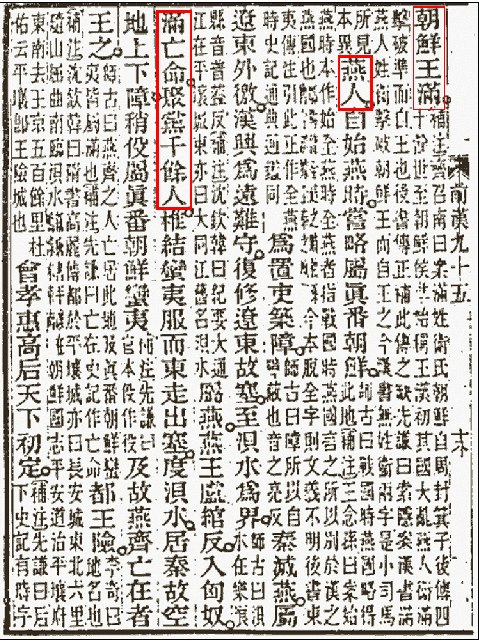
그때는 아직 일본이란 국가가 존재하지 않았던 때로서 조선을 일본보다 더 오랜 역사를 가진 나라로 인정 할 수 없었기 때문이었습니다. 1910년 한일병탄 후, 일본은 BCE 2세기 때 인물인 연나라 사람 위만을 조선의 창시자로 앉혔습니다. 위만은 원래 노관의 부하였습니다. 연嚥왕 노관은 한고조 유방과 동향이자 같은 날 같은 시에 태어난 인물로 한고조가 나라를 개창하는 것을 도와 공을 세운 개국공신입니다.
BCE 195년 노관이 여태후의 숙청을 피하여 흉노 땅으로 도망가자, 위만은 고조선 땅으로 피신하였습니다. 위만은 조선인으로 변장하여 당시 고조선의 서쪽 강토인 번조선으로 넘어 왔습니다. 번조선 왕 기준은 위만을 불쌍히 여겨 국경 수비대장으로 임명하였습니다. 그러나 이듬해 위만은 은혜를 배신하고 모반을 일으켰습니다. 급습을 당해 의관도 제대로 갖추지 못한 채 도망한 준왕을 대신하여 위만은 번조선의 왕이 되었습니다(BCE 194). 위만정권시대가 시작된 것입니다.
그 후 손자 우거가 한무제에게 망할(BCE 108)때까지 약 90년간 존속한 이 위만 정권을 일본은 위만조선으로 격상시키고 이것을 조선 역사의 시작으로 정하였습니다. 게다가 일본은 위만조선의 위치를 요동반도가 아니라 한반도의 평양 이북으로 비정하였습니다. 이리하여 조선은 일본보다 짧은 역사를 가진 나라가 되었습니다.
일본은 위만조선이 망한 후의 한국사도 뜯어고쳤습니다. 우거를 멸하여 위만조선을 무너뜨린 한무제가 그곳에 한사군을 설치하여 조선인을 식민 통치한 것으로 기술하였습니다. 위만조선에 한사군 설이 결합되면서 고대 조선은 결국 중국이 세운나라로, 나아가 중국의 식민지로 왜곡되어 버린 것입니다.
그렇다면 일제에서 해방되어 대한민국이 된 지금 위만조선의 망령은 깨끗이 사라진 것일까요?
마땅히 그러해야 하겠지만 현실은 그렇지 못합니다. 위만조선의 망령은 한국 교과서에 여전히 살아 있습니다. 초등학교에서 고등학교까지 거의 모든 역사에 조선의 왕이 되었다고 서술합니다. 심지어 위만이 집권하면서 고조선의 세력이 크게 확대되었다(중학교 역사 (상) 2010, 41쪽)고 하여 위만을 조선인의 구세주로까지 묘사합니다. 그러면서도 위만이 연나라 출신이란 점에 대해서는 일체 언급이 없습니다. 기원전 2세기경 위만이 집권하였다고 하거나 유이민 집단 중에 위만이 무리를 이끌고 고조선으로 왔다고만 합니다. 조선의 한쪽 변방을 강탈한 도적이며 침략자에 불과한 위만에 관한 이러한 기록은 반드시 역사 정의에 따라 심판을 받아야 할 것입니다.

- 신채호 – 위만정권을 우리의 변강 침략사로 다루어야 한다.
- 안정복(1712~1791) – 위만은 나라를 찬탈한 도적이다(동사강목)
- 이상룡(임시정부 국무령) – 위만은 한 명의 강도에 불과하다.
————————
China’s Perspective on Joseon: The Gija Joseon Claim
Since the Han Dynasty, the Chinese have believed in the historical reality of Gija Joseon. Supporting this claim, in 1973 a bronze cauldron inscribed with the name Ji-hou (Gija) was excavated in Jiuzuoxian, Liaoning Province. This artifact was identified as having been made in the 12th century BCE, corresponding with the late Shang and early Zhou periods, when Gija was believed to have lived.
Prior to this, in 1951, eight Gija artifacts were discovered in Huangxian, Shandong Province, and in 1969, another Ji-hou ding was found in Yantai, Shandong. These were determined to have been made hundreds of years after Gija’s death, during the late Zhou Dynasty and the Spring and Autumn Period. Judging by the sophistication of these artifacts, it is evident that Gija and his descendants possessed considerable wealth and political influence.
But was Gija truly a king of Joseon as China claims? The Shiji Suoyin states that Gija was a royal relative of the Shang Dynasty, explaining, “Ji is the name of a state, zi is a noble title, and Gija’s personal name was Seoye.” This indicates that Gija was part of the ruling class in the Ji state. According to the interpretation of historian Yoon Naehyun, Ji was a vassal state under the Shang, and Gija belonged to its ruling elite. If Gija held supreme authority, he would have been the king of Ji.
From the discovered artifacts and historical records in Chinese literature, it appears Gija was a noble of vassal status and part of the Shang royal family. However, the Shiji Suoyin, a commentary supplementing Shiji, offers no explanation for Sima Qian’s phrase “Gija was enfeoffed to Joseon,” making it difficult to accept Gija Joseon as historical fact. Even if Gija were a king, he would have ruled the Ji state, not Gojoseon. Despite this, Gija Joseon eventually became accepted as historical fact in Chinese records.
For instance, in the Records of the Three Kingdoms, Chen Shou (233–297) cites Weilüe, describing Gijun, who was dethroned by Wiman at the end of Gojoseon, as a descendant of Gija. This reflects a Chinese belief that Gija Joseon existed until Gojoseon’s fall. The tribute-minded elites of Korea’s Goryeo and Joseon dynasties accepted the Gija Joseon narrative fabricated by China, venerating Gija as the founder of the Korean nation. Although Gija never crossed into the Korean Peninsula, when a Song Dynasty envoy asked where Gija’s tomb was, the Goryeo court hastily built a fictitious tomb and shrine for Gija in Seogyeong (Pyongyang). The straight roads in Seogyeong were even misattributed to Gija’s supposed establishment of the well-field system.
In the 1960s, however, North Korean scholars investigated the site purported to be Gija’s well-field system and the alleged tomb of Gija north of Eulmildae in Pyongyang, debunking these myths. The site was identified as an urban structure from the Goguryeo period, with only fragments of ceramics and bricks unearthed.
Today, the prevailing view in South Korean academia is that Gija Joseon was a construct of Chinese Sinocentrism. Nonetheless, the damage caused by miswritten history is not easily rectified.
Japan’s Perspective on Joseon: The Wiman Joseon Claim
China’s Gija Joseon theory situates its timeline in the 12th century BCE, when the Shang Dynasty fell, and the Zhou Dynasty rose. However, Japan found it unacceptable to acknowledge a Joseon as early as the 12th century BCE, regardless of its vassal state status under China.
Why?
At that time, Japan did not yet exist as a nation and could not accept a Joseon with a history older than its own. Following the annexation of Korea in 1910, Japan placed Wiman, a man from Yan in the 2nd century BCE, as the founder of Joseon. Originally a subordinate to Lu Wan, King of Yan, Wiman was a man of humble origin. Lu Wan was a trusted official who supported Emperor Gaozu of Han in founding the empire, but he fled to the Xiongnu to escape the purge ordered by Empress Dowager Lü in 195 BCE. It was during this time that Wiman also fled to Gojoseon. Disguised as a Joseon native, Wiman sought refuge in Beonjoseon, the western territory of Gojoseon. King Jun of Beonjoseon took pity on Wiman and appointed him as a border guard. However, Wiman betrayed him the following year, launching a coup and ousting Jun, who escaped without his regalia, thus marking the beginning of the Wiman regime in Beonjoseon in 194 BCE.
For around 90 years, Wiman’s rule persisted until Wiman’s grandson, Ugeo, was defeated by Emperor Wu of Han in 108 BCE. Japan elevated this Wiman regime to the status of Wiman Joseon, declaring it the starting point of Joseon’s history. Japan further claimed that Wiman Joseon was situated not on the Liaodong Peninsula but in northern Pyongyang, thus defining Joseon as a nation with a shorter history than Japan.
Japan also revised the Korean history following the fall of Wiman Joseon. They recorded that Emperor Wu, who toppled Ugeo and ended Wiman Joseon, established the Four Han Commanderies to govern and colonize the Joseon people. By coupling the Four Han Commanderies with Wiman Joseon, Japan distorted ancient Joseon as a Chinese creation and ultimately as China’s colony.
Then, with Korea’s liberation from Japan and the establishment of the Republic of Korea, has the specter of Wiman Joseon disappeared?
Ideally, it should have, but reality suggests otherwise. The ghost of Wiman Joseon remains present in Korean textbooks. From elementary through high school, history books still depict Wiman as a king of Joseon. Some even go as far as describing Wiman as a savior who expanded Gojoseon’s influence (Middle School History, Vol. 1, 2010, p. 41), while omitting the fact that he was from Yan. Wiman’s reign is merely mentioned as taking place in the 2nd century BCE, with him leading a group of migrants to Gojoseon. These accounts portraying Wiman—a bandit and invader who seized a part of Joseon’s frontier—must be reexamined in the interest of historical justice.
- Shin Chae-ho – Wiman’s regime should be treated as an invasion of our frontier.
- An Jung-bok (1712–1791) – Wiman was a usurper of the throne (Dongsa Gangmok).
- Lee Sang-ryong (Prime Minister of the Provisional Government) – Wiman was nothing but a thief.