

19세기 중반 메이지 유신으로 근대화를 시작한 일본은 세계 제패의 꿈을 키우면서 한국을 대륙 진출의 발판으로 삼기 위해 식민주의 사관을 확립하였습니다. 식민주의 사관은 일본 제국주의의 조선 침략과 식민 통치를 합리화하기 위해 조작한 역사관입니다. 조선인을 예로부터 다른 나라의 식민지 백성으로 살아온 열등감과 자기 비하에 빠진 민족으로 묘사하여 조선을 영원히 지배하겠다는 것이 일제 식민지사관의 요지입니다.
이러한 식민사관 정립과 실현을 위해 일제는 조선침략을 군사적으로 준비함과 동시에 자국의 쟁쟁한 사학자들을 독려하여 한국사를 연구하게 하였습니다. 한국사 연구를 반석에 올려놓은 일본의 식민 사학자는 하야시 다스케, 시라토리 구라키치, 후쿠다 도쿠조 등입니다. 이 세 사람은 독일에 직접 유학을 하거나 일본 내 대학을 다니면서 실증주의 사학을 공부하였습니다. 실증주의 사학은 조상의 무덤과 집터를 파헤쳐 꺼낸 유골과 유물을 과학적으로 검증함으로써 문헌에 기록된 역사적 사실을 고증하려 합니다. 그리고 고증되지 않은 기록은 모두 불신합니다.
이러한 실증사학의 정신에 따라 식민주의 사학자들은 태곳적 환단시대를 고증되지 않은 신화 시대로 만들어 버리고 그 대신 위만조선과 한사군 시대를 한민족의 태고 시대라 정의 하였습니다. 그들은 만철조사부(일본이 세운 남만주철도주식회사의 지리, 역사 연구부서이자 정보기관. 침략의 발판을 마련함이 목적)를 세워 만주와 한반도의 역사와 지리에 관한 조사를 하였는데, 그 목적은 한국인의 뿌리 역사를 말살하고 그 자리를 중국과 일본의 식민지로 채우는 데에 있었습니다.
마침내 1910년에 한국을 강제 병탄한 일제는 자국의 신민주의 사학자를 대거 조선으로 데려와 조선사편수회를 조직하고 조선 역사를 본격적으로 변조하여 조선 역사는 중국과 일본의 식민지에서 시작되었다고 주장하였습니다. 한반도의 북쪽은 한사군이라는 중국의 식민지였고, 남쪽은 임나일본부라는 일본의 식민지였다는 것입니다. 또한 상고 이래의 한일교섭사 중에 일본에 불리한 사실은 모두 은폐하였고 임진왜란을 마치 일본이 승전한 것처럼 기술하고, 광개토대왕비의 비문과 칠지도 명문을 조작하는 등 우리 역사와 문화재에 손대지 않은 부분이 없었습니다.
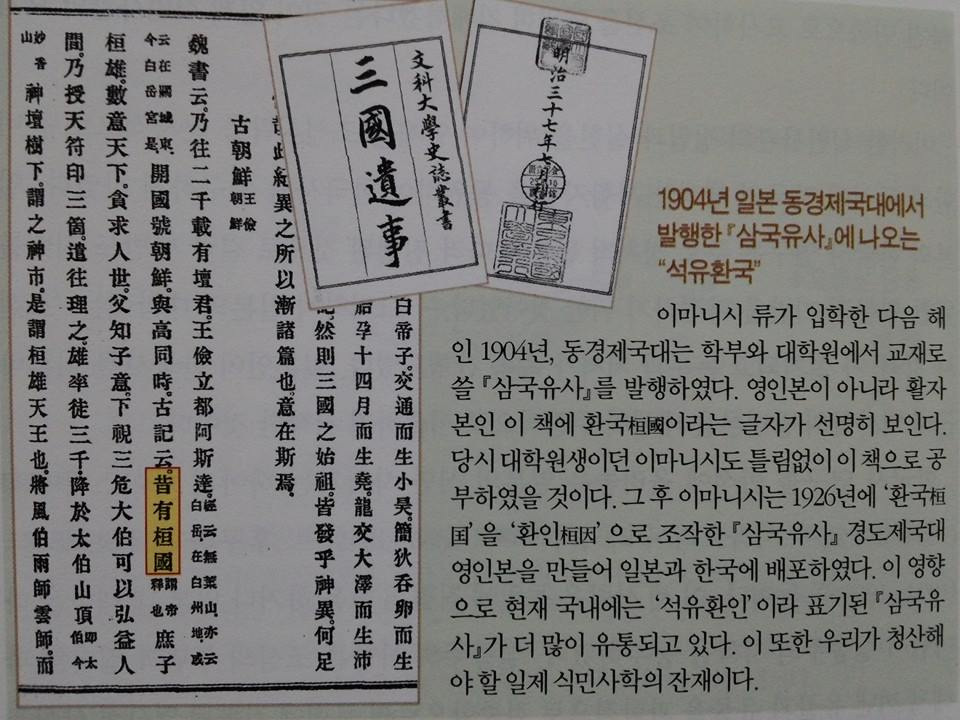
일본이 왜곡한 사례 중에서 한국인이라면 꼭 알아야 할 것이 있습니다. 그것은 한민족사의 밑뿌리를 송두리째 뽑아버린 것으로, 이마니시 류가 조작한 석유환인입니다. 1903년 동경제국대 대학원에서 한국사를 전공한 후 조선에 파견된 이마니시는 조선 역사를 일본에 미치지 못하는 역사로 깍아 내리기 위해 고심 하던 중 마침내 조선의 한 사서에서 실마리를 찾아 냅니다. 그 사서가 바로 앞서 말한 삼국유사입니다.
그는 조선 중중 1612년에 간행된 삼국유사 임신본에 적힌 석유환국의 國(국)자를 因(인)자로 변조시켰습니다. 일연이 붙인 제석을 말한다는 주석에 힘입어 석유환국을 석유환인으로 과감히 변조시킨 것입니다. 이리하여 환국을 불교 신화에 나오는 나라로 둔갑시키고, 환국을 계승한 배달과 고조선도 허구의 나라로 만들어버렸습니다. 이것은 실로 한국 고대사의 핵을 도려낸 사건입니다. 이로써 한국사의 영혼이 뽑히게 되었습니다. 일제의 만행으로 7천년 상고사가 통째로 잘려 나간 것도 통탄스럽지만 해방 이후 한국 사학계가 식민사학을 추종하여 환인, 환웅, 단군을 신화의 인물로 전락시킨 것은 더욱 가슴 아픈 일입니다.

한민족은 1945년에 일제의 압박에서 벗어나 광복을 맞았지만, 이 땅의 사학은 여전히 식민사학의 잔재를 떨쳐 내지 못하였습니다. 지금까지도 이 땅의 역사 광복은 전혀 이루어지지 않고 있고, 해방 후 한국 사학계가 조선사편수회에 몸담고 식민사학의 주구 노릇들 하던 몇몇 학자와 그 후예에게 잠식되었기 때문입니다.
그들은 역사상 가장 반인륜적이고 파괴적인 역사관으로 8백만 이상의 동포를 참살한 일본 제국주의가 주장한 식민사관을 실증사학이라는 가면 아래 교묘히 숨겨 그대로 수용하였습니다. 이들은 더 나아가 자신들의 기득권을 지키기 위해 식민사관을 옹호하고 변론하였습니다. 이것은 자국의 역사를 자국민이 파괴하는 해괴한 행위로, 세계인들 앞에서 고개를 들 수 없는 수치스러운 일입니다.
그 단적인 예가 바로 “한사군재 한반도”설입니다. 일제는 대동강 유역에 점제현신사비라는 유물을 조작하고 그 비석을 한사군 유물로 내세우면서 한사군의 위치를 한반도로 정하였습니다. 그런데 한국 사학계는 그 조작설을 그대로 따랐습니다.
최근 그 비석의 화강암 재질을 분석한 결과 위조된 유물임이 드러났지만, 한국인들은 한반도 내 평양 주변에 한사군이 있었다고 배우고, 낙랑.임둔.진번.현도라는 이름을 반세기가 넘도록 열심히 외우고 다녔습니다. 그리고 일제가 내세운 한사군설을 그대로 따라 우리 역사학자들의 손으로 한반도에 한사군을 설정한 것이 빌미가 되어 우리는 지금 다시 중국에게 역사를 빼앗기고 있습니다.
중국은 한사군이 한반도에 있었다는 설을 동북공정에 적극 활용하여 2,100여 년 전 한나라 때의 중국 영토를 한강 이북까지 확장하였습니다. 중국의 이 허황한 주장이 서양의 세계사 교과서에 그대로 실려 있습니다. 중국의 동북공정을 무너뜨리려면 일제 식민사학의 잔재부터 청산해야 합니다. 일제의 식민사관과 중국의 동북공정이 한 덩어리가 되어 한국사의 뿌리를 뽑기 때문입니다. 중국의 중화주의 사관과 일본의 식민사관은 남의 역사를 강도질하는 패악의 근원입니다. 초중고 교과서에서 우리는 일제가 꾸민 역사 사기극의 잔재를 쉽게 찾아볼 수 있습니다.
예컨대 환국과 배달의 역사는 전혀 보이지 않고 단지 족장이 다스리던 부족사회가 있었다고만 서술하고 고등학교 교과서에는 고조선의 출현에 대해 족장 사회에서 가장 먼저 국가로 발전한 것은 고조선이다라고 하면서, 삼국유사와 동국통감의 기록에 따르면 단군왕검이 고조선을 건국하였다라고 서술합니다.
얼핏 보아도 너무나 싱거운 “단군왕검이 고조선을 건국하였다”라는 이 서술은 우리역사를 찾으려는 뜻있는 사람들의 각고의 노력으로 2009년에야 어렵사리 개정된 내용입니다. 그 전까지는 “건국 되었다고 한다” 또는 “건국하였다고 한다”라고 하여 남의 나라 역사를 말하듯 하고 설사 우리 역사라 해도 완전히 신뢰할 수 없다는 듯 서술하였습니다.
그런데 비단 학교 교과서뿐 아니라 국가공무원 수험서, 육.해.공군의 역사 교재, 아동용 역사책에 이르기까지 이 땅의 모든 역사책에는 일제가 조작한 역사가 들어 있습니다. 그 결과 식민사학의 여독이 모든 한국인의 뼈 속 깊이 배어 있게 되었습니다.
——————-
In the mid-19th century, as Japan began its modernization through the Meiji Restoration, it harbored ambitions of world domination and established a colonialist historical perspective in order to use Korea as a stepping stone for its continental expansion. Colonialist historiography is a manipulated historical view devised to justify Japanese imperialism’s invasion and colonial rule over Korea. The essence of Japan’s colonialist historiography was to portray Koreans as a people who had long lived with inferiority and self-deprecation, as subjects of other countries, and thus declare their intention to dominate Korea permanently.
To establish and implement this colonial historiography, Japan prepared militarily for its invasion of Korea and simultaneously encouraged its prominent historians to study Korean history. The Japanese colonial historians who laid the foundation for research on Korean history included Hayashi Taisuke, Shiratori Kurakichi, and Fukuda Tokuzo. These three studied positivist historiography in Germany or at Japanese universities. Positivist historiography attempts to verify historical facts recorded in literature through the scientific analysis of ancestral graves, excavated bones, and artifacts, and distrusts any records that cannot be verified.
In accordance with this positivist historiographical approach, colonialist historians turned the ancient Hwandan period into an unverified mythical era and instead defined Wiman Joseon and the Four Han Commanderies as the dawn of Korean history. They established the South Manchuria Railway Investigation Department (a research and intelligence division of the South Manchurian Railway Company, founded by Japan, with the goal of preparing for invasion) to investigate the history and geography of Manchuria and the Korean Peninsula. Their objective was to erase the roots of Korean history and fill the void with claims of it being a colony of China and Japan.
In 1910, after forcibly annexing Korea, Japan brought its colonial historians to Korea en masse, organizing the Joseon History Compilation Committee, which systematically distorted Korean history. They claimed that Korean history began as a colony of China and Japan. According to them, the northern part of the Korean Peninsula was a Chinese colony under the Four Han Commanderies, and the southern part was a Japanese colony under the Mimana Nihonfu. They concealed facts unfavorable to Japan in the history of Korea-Japan relations since ancient times, presented the Japanese invasions of Korea (1592–1598) as a Japanese victory, and tampered with Korea’s historical relics, such as the stele of King Gwanggaeto and the inscription on the Seven-Branched Sword, leaving no aspect of Korean history or cultural heritage untouched.
One of the most important distortions that every Korean must know about is the complete uprooting of Korean history, particularly the fabrication of Seokyu Hwanin by Imanishi Ryū. In 1903, after majoring in Korean history at Tokyo Imperial University, Imanishi was dispatched to Korea, where he found a clue in a Korean historical text that allowed him to degrade Korean history to one inferior to Japan’s. That text was none other than the Samguk Yusa.
Imanishi altered the character for “nation” (國) in Seokyu Hwan-guk (石有桓國) to “person” (因), thereby changing Hwan-guk into Hwanin (桓因). With the aid of a note by Ilyeon, who associated this with a Buddhist mythological figure, Imanishi brazenly transformed Hwan-guk into Hwanin. In this way, Hwan-guk was recast as a mythical Buddhist country, and its successors, Bae-dal and Gojoseon, were also portrayed as fictional nations. This event effectively excised the core of Korean ancient history. It was an attack on the very soul of Korean history. While the Japanese obliterated 7,000 years of ancient history during their occupation, what is even more painful is that after liberation, Korean historians continued to follow colonial historiography, relegating Hwanin, Hwanung, and Dangun to mere mythical figures.
Though the Korean people gained independence from Japanese oppression in 1945, the remnants of colonial historiography still linger in Korean academia. Korean historians never fully achieved historical liberation, as many who were involved in the Joseon History Compilation Committee during the colonial period and their successors continued to dominate the field after liberation.
These historians, under the guise of positivist historiography, subtly accepted the colonial historiography asserted by Japanese imperialists, which justified Japan’s invasion and resulted in the deaths of over eight million Koreans. To protect their vested interests, they went so far as to defend and justify this colonialist view. This act of Koreans destroying their own history is an absurd and shameful behavior that leaves them unable to hold their heads high before the world.
A prime example of this is the theory that the Four Han Commanderies were located on the Korean Peninsula. Japan fabricated an artifact, the Stele of Jeomjehyeon Shrine, near the Daedong River, and presented it as evidence of the Four Han Commanderies, thereby establishing their location on the Korean Peninsula. Korean historians uncritically accepted this fabricated theory.
Although recent analysis of the granite material of this stele has revealed it to be a forged artifact, Koreans have been taught for more than half a century that the Four Han Commanderies were located around Pyongyang. They memorized names like Lelang, Imdun, Jinbeon, and Hyunto, while our historians, following the theory advanced by Japan, officially positioned the Four Han Commanderies in Korea. As a result, we are now in danger of losing our history to China.
China has actively used the theory that the Four Han Commanderies were located on the Korean Peninsula in its Northeast Project to extend its ancient Han Dynasty territory up to the Han River, some 2,100 years ago. This baseless claim has already made its way into Western world history textbooks. To counter China’s Northeast Project, we must first root out the remnants of Japan’s colonial historiography. Japan’s colonialist perspective and China’s Northeast Project are two sides of the same coin, both working to erase the foundations of Korean history. The sinocentric view of history propagated by China and the colonialist historiography of Japan are sources of historical vandalism. One can easily find the remnants of Japan’s historical fraud in our elementary, middle, and high school textbooks.
For example, the history of Hwan-guk and Bae-dal is nowhere to be seen. It merely states that Korea was a tribal society governed by chiefs. High school textbooks describe Gojoseon as the first state to develop from such a tribal society. They also say, “According to Samguk Yusa and Dongguk Tonggam, Dangun Wanggeom founded Gojoseon.”
At first glance, the phrase “Dangun Wanggeom founded Gojoseon” might seem too bland, but this was only included after much effort by those committed to reclaiming our history, and the text was finally revised in 2009. Before that, the text read, “It is said that Gojoseon was founded,” or, “Gojoseon is believed to have been founded,” as if talking about the history of another country, casting doubt even on our own history.
However, it’s not just school textbooks that are problematic. Civil service exam preparation books, military history textbooks for the army, navy, and air force, and even children’s history books in Korea all contain the history fabricated by Japan. As a result, the toxic remnants of colonial historiography have permeated deeply into the bones of all Koreans.